
Easter is a busy period for many charities offering support and relief for those in need. But the price of fuel is impacting how charities carry out their services. Some are now questioning the sustainability of those services.
Listen to Australian and world news, and follow trending topics with SBS News Podcasts.
TRANSCRIPT
The cost of filling up at the bowser continues to bite.
"It's just becoming so, so expensive for us."
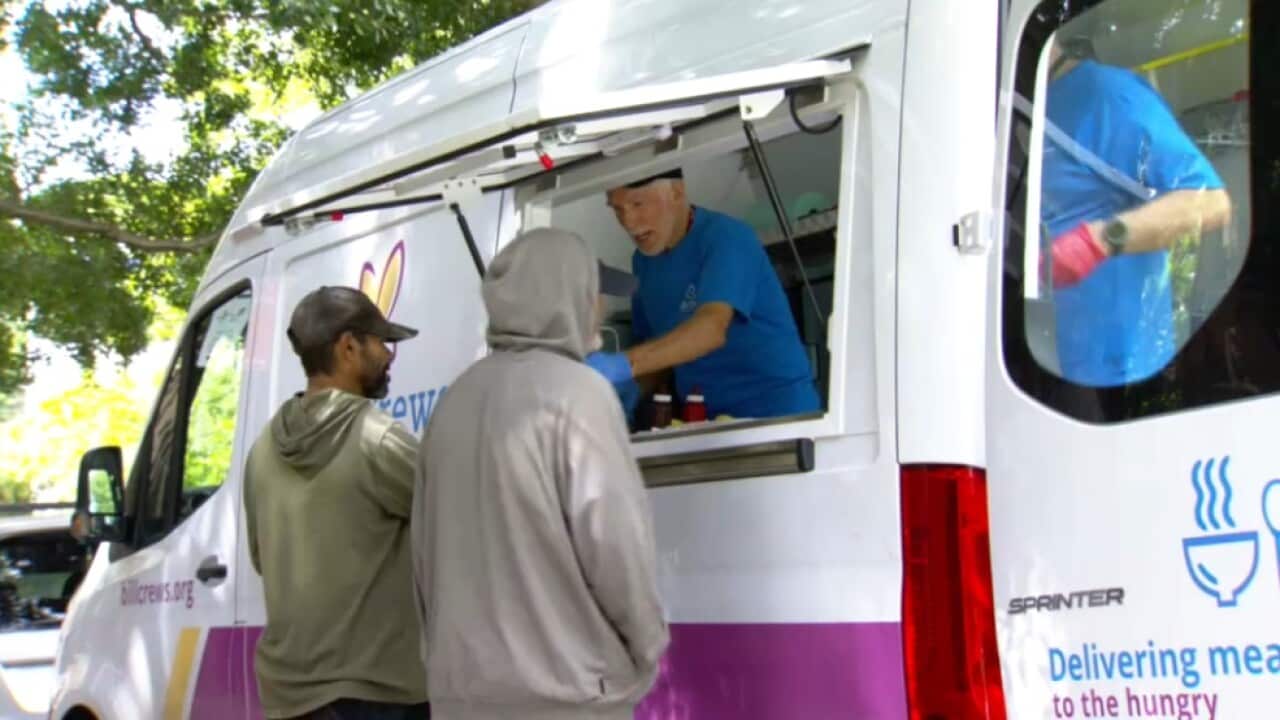
That's Eric Markantonakis, the site manager for The Reverend Bill Crews Foundation in Sydney.
The charity provides care and free meals to address homelessness and poverty.
But these meals need to be transported from their kitchen headquarters to locations across the city - meaning the price of fuel is beginning to affect operations.
"Even at the current prices, they're double what we had forecasted in our budgets. And everything that we overspend on running our vehicles comes at another cost and that's the cost to our ability to service our frontline."
Uniting Church minister Bill Crews says something needs to change.
"We realise we're so vulnerable to impacts like this and so many of the people we get, if we don't turn up, they don't eat."
George has been volunteering with the foundation, delivering and serving free hot meals for nearly two decades.
He says he's seen an increase in demand for their services over the past year.
"If people are having a hard time, which now of course, they obviously are with the cost of living going the way it is. But even in the proceeding years, it's always a struggle to manage to feed themselves properly, so, we like to think that we are there for them."
The entire foundation, he says, is feeling the impact.
"It's obviously making a dent in our finances. We have six vans now on the road each day. So, to keep six vans full of diesel is costing a lot more than what it used to."
Reverend Bill Crews says they may have to go to the petrol station half as often as they used to, but with double the number of meals.
"We're like our guests - we make do with what we've got. But it's given us a big wake-up call. So, as soon as possible we will be electrifying everything."
Despite government measures to ease the cost for motorists, fuel is still a big concern.
Amar Singh is the president of charity Turbans4Australia, providing emergency goods and services to those experiencing financial hardship, food insecurity and homelessness.
"We're seeing our hamper requests going up probably by 10, 15 per cent in the last two weeks. So, people are reaching out more to say, 'Hey I really need food now.' And that's really heartbreaking. Especially, coming into Easter, instead of people celebrating and buying chocolate for their kids, people are really watching their wallet, and going, 'hey, can I really afford this?"
It's just after lunchtime at the truckyard in Western Sydney where his van is parked.
Usually at this time of day, the yard would be largely empty.
But the cost of fuel is forcing many truckies to have to come back early.
"We're struggling with running our vans and trucks to pick up donations and pick up our food rescue donations. But also, we're seeing on the other side clients that are coming to us are struggling even further, because we've got a lot of people saying, 'Hey, I'm still working but I can't afford to buy the groceries just because of the fuel bills."
Caitlin Bowral is the general manager of her family owned trucking business JATEC.
She says the price of fuel is having a huge effect on peoples' wallets.
"Operators aren't able to afford the diesel at the moment. So if they don't have that option to pass it on to their customers, they simply just aren't working."
Reverend Bill Crews says they've got to adapt to survive.
"We've been talking with government because these are things that have to be done. Everyone that gives us a dollar would love all of that dollar to go on food, rather than on diesel. So let's make sure we've got the right vehicles for this time. For the past, maybe diesel was okay, but not anymore."
Like many, the fuel crisis is now forcing people to consider alternatives.