
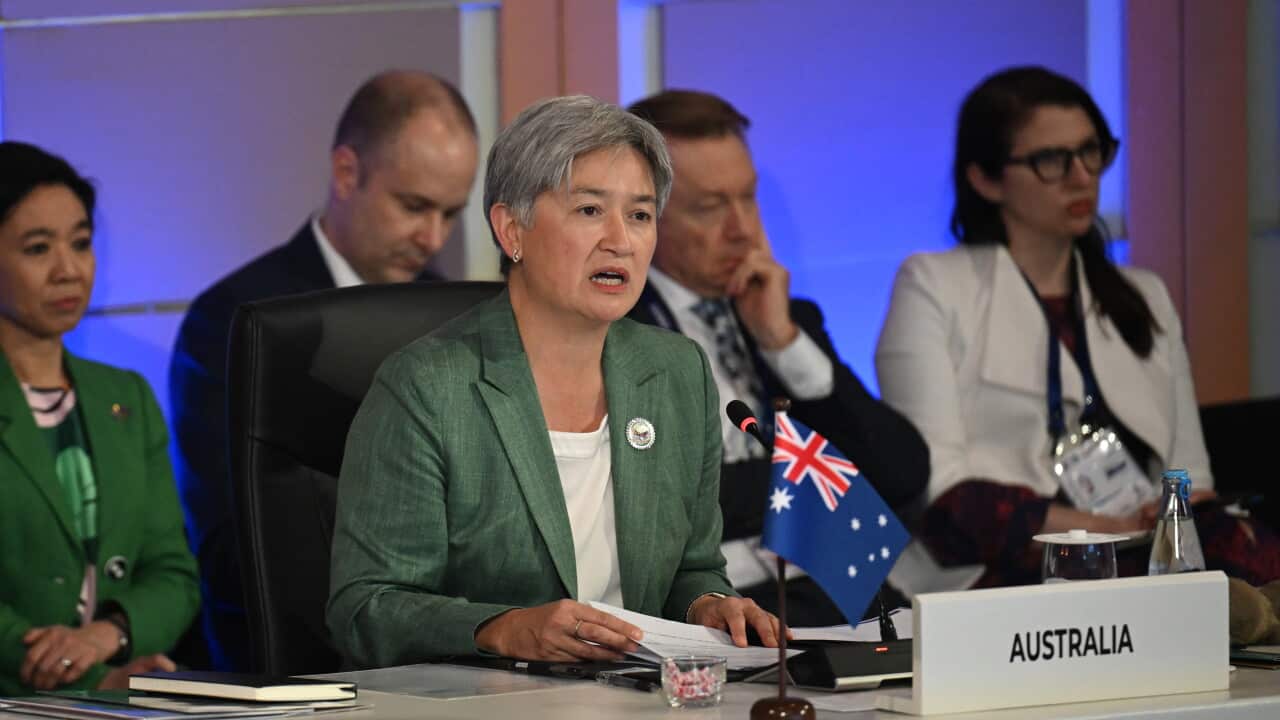

The ASEAN Regional Summit is wrapping up in Manila, where Australia has raised concerns about Chinese military action in the region. Tensions over the South China Sea and recent missile testing in the Pacific have drawn condemnation from Australia, which says regional stability relies on a balance of power
Listen to Australian and world news and follow trending topics with SBS News Podcasts.
TRANSCRIPT
In the clear blue waters near the heavily disputed Spratly Islands, an altercation broke out between the Chinese and Filipino coast guard.
The confrontation, which took place ahead of the ASEAN regional summit in Manila, marks just the latest in a series of regular clashes in the South China Sea.
China claims sovereignty over almost all of the waterway, while multiple nations in the region lay claim to their own Exclusive Economic Zones, as ruled under international law.
During the meeting in Manila, China's aggression was condemned by Philippine allies.
Among them, was Australian Foreign Minister Penny Wong.
"The erosion of collective rights under international law does not benefit stability. It does not reinforce sovereignty and it does not strengthen our shared resilience. So Australia with others will continue to register our concerns about Chinese vessels engaging in destabilising and dangerous conduct in the South China Sea, including towards Philippines, Vietnamese, Malaysian and Indonesian vessels."
Australia has sought to step up their strategic ties in the Pacific recently, through a series of security deals with Pacific Island nations.
Complementing the Pacific strategy, Australia also hopes to strengthen ties in Southeast Asia, aiming to deter Chinese influence on the region.
On the sidelines of the summit, Penny Wong visited the headquarters of the Philippine Coast Guard, offering to provide them with 'cutting-edge' US drone technology.
"One of my first events here was an announcement of additional funding with your (Philippine) Coast Guard, where we are contributing more on drones and other mechanisms to try and improve maritime domain awareness.”
In response, China's Foreign Ministry spokesperson Lin Jian has accused Australia of blowing the matter out of proportion.
“The countries concerned are not parties to the South China Sea issue and have no right to interfere in maritime matters between the countries directly involved. Anyone can see that whenever there is the slightest stir at sea, it is always the same small handful of countries that rush out, with great fanfare, to oppose China without bothering to distinguish right from wrong.”
Tensions over Chinese military action in the region were also heightened earlier this month when Beijing conducted missile testing in the Pacific.
The test launch of a nuclear-capable missile into the waters near Tuvalu was described as 'destabilising' by Australian and Pacific leaders, yet dubbed simply as 'routine' by leaders in Beijing.
As Australia stresses the need for global pressure on China to obey international law, Penny Wong says she won't rule out stepping up joint patrols in the South China Sea.
“We are concerned about some of the aggression we are seeing. We are concerned about some of the destabilising conduct we are seeing. And the countries of the region have a choice to make about how we all respond to that. And Australia believes we should respond to that by working for peace and stability, by continuing to call for and encouraging compliance with observation of international law and of safe and professional conduct at sea and in the air.”
While China attempts to downplay recent military activity in the region as 'routine', others see the actions as a test.
For Australia and its allies in the region, unchecked military aggression in the South China Sea could set a dangerous precedent.
Philippine Foreign Minister and ASEAN Chair Maria Theresa Lazaro says cooperation on international norms is critical to keeping the region stable.
"We honour the fundamental principles we have successfully guided ASEAN for five decades. Mutual respect for sovereignty, non-interference in the peaceful settlement of disputes. These time-tested norms remain the bedrock of our regional stability ensuring our code of conduct that stands strong against global winds. We must continue this journey together because cooperation is no longer a choice, it is a strategic necessity."
As Australia attempts to counter Chinese influence in the region, Russia is also seeking to expand ties in the bloc.
Ahead of the Summit, President Vladimir Putin hosted ASEAN leaders for a two-day meeting in the city of Kazan, a major industrial area known historically as a bridge connecting Russia and Asia.
Speaking at the ASEAN summit, Russian Foreign Minister Sergey Lavrov says there are many opportunities for Russia and ASEAN to work together.
"For our part, we consistently support the central role of ASEAN in all regional affairs. We make a strong contribution to strengthening the system of interstate relations built around the association, which are based on the principles of international law, openness, equality and, I would like to emphasise, consideration of the interests of all participants."
While some ASEAN members such as the Philippines are considered closely aligned with the US, others maintain strong trade and security ties with China and Russia.
Penny Wong says while Australia will continue to support the United States, stability in the region won't be achieved by domination.
"We do not want any single power to set the terms of our future. What we seek is a balance of power where no country dominates and no country is dominated, a region with ASEAN at its centre, a region characterised by the principles in the ASEAN outlook on the Indo-Pacific."