

Across Australia, rising costs and staff shortages have forced many traditional Chinese restaurants to close. Some younger chefs are forging a new path with fusion styles that celebrate local ingredients.
This story was produced in collaboration with SBS Chinese
Listen to Australian and world news and follow trending topics with SBS News Podcasts.
TRANSCRIPT
(The sound of eggplant sizzling in oil)
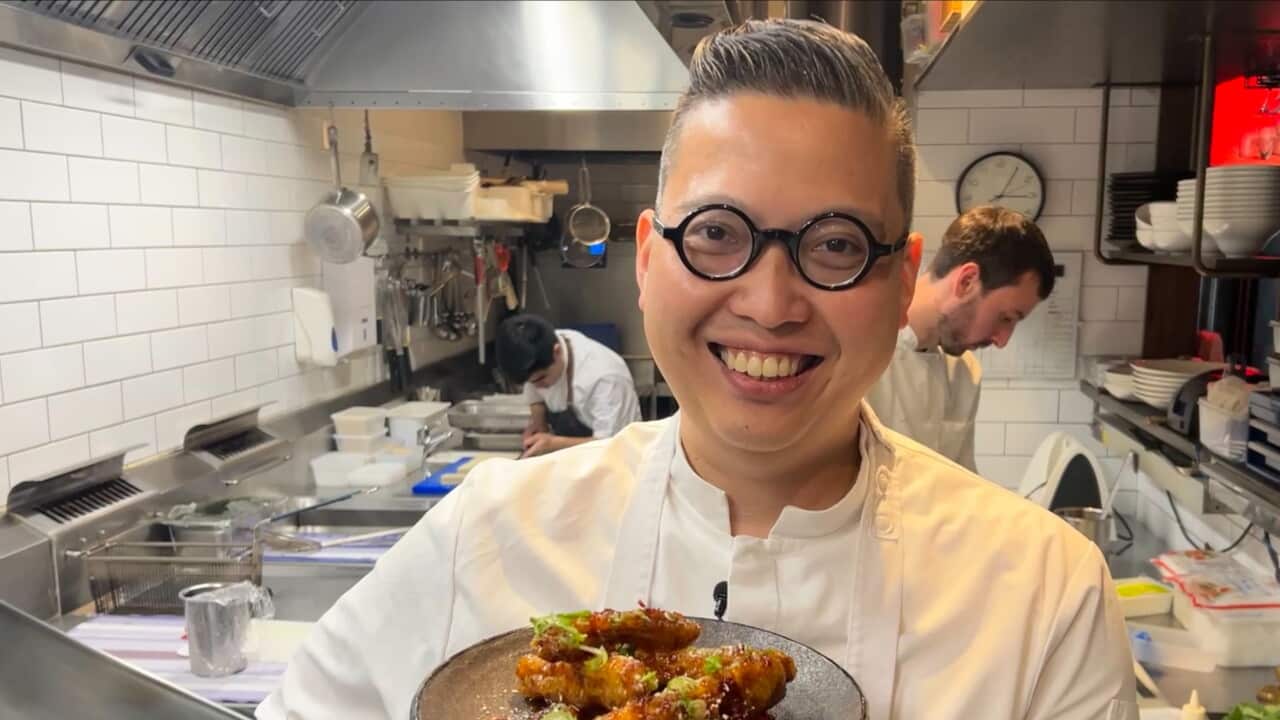
The eggplant strips are sizzling in oil at Lee Ho Fook, a modern Chinese restaurant in Melbourne.
Chef-founder Victor Liong is proud to showcase his signature dish.
"My version: I deep fry the eggplant, so it's crunchy. So it adds another layer of texture and easy to approach in terms of either with your fingers or with chopsticks."
Victor Liong's among younger Chinese chefs forging change, while featuring local produce and new cooking styles
"Our first reference point is to look at a dish and its authenticity; and then kind of deconstruct or work backwards from that. A good example is Peking duck. How do we get maximum crispiness and puff and flavour from the skin process, but still maintaining some of the integrity of like a juicy, flavourful meat."
Mr Liong migrated from Brunei aged six with his family and later trained as a European-style chef.
But he has since embraced his eastern heritage - through food.
"A lot of it is my flavour memory and exploration on the heritage personal journey in terms of looking at the food that I grew up eating, the many dinner tables of my childhood, but also I travel to China a lot."
Blending European traditions with Asian flavours, has evolved from the early dishes cooked by Chinese migrants who fed hungry workers on the goldfields.
University of Sydney historian Sophie Loy-Wilson specialises in the history of Chinese Australian communities.
"Cantonese food is very focused on vegetables. We know that very early on when Chinese miners came out from Hong Kong, they were looking for fresh veggies. So, they were some of the first to start growing a garden at the back of their tent, at the back of their mine. And they would sell this to kind of malnourished Europeans who've been living on mutton and damper."
As waves of migration continued, she says Australian Chinese cuisine evolved catering to local tastes and produce.
"Chinese chefs developed really clever ways of taking cheaper meat and keeping it moist and succulent and fresh. And I think sizzling beef is an example of that, right? Like this is like the Australian barbecue, but it's on a little plate."
Third generation restaurant owner Gavin Chan runs Happy’s Chinese in Canberra, a family business that started in 1962.
In the early days, he says the menu adapted to local supplies.
"In the '60s and '70s, I remember my grandfather telling us that you could not get a lot of ingredients. So, you couldn't get Chinese broccoli to Canberra back in those days there was no Asian grocery stores. You couldn't get fresh rice noodles. You had to use the dried ones. So you had to make do of what you had, what the ingredients you had and put a spin on the version that you could cook for your particular clients."
Many traditional Chinese restaurants have shut down in recent years.
New data from credit reporting agency CreditorWatch shows that, across the country, cost and demand pressures are bearing down on cafes and restaurants, with 1 in 8 closing their doors to the end of May this year.
Happy's Chinese is among the oldest Chinese restaurants still trading.
Gavin Chan says demand remains strong for family favourites like honey chicken and Mongolian beef.
"My grandfather, Happy if he walked in here today, he'd be really proud of what we've preserved. He did it as a way of survival, employment. And in doing so, he bought the culture, bought the different types of cuisine to the Australian palate."
Mr Chan says generations of customers grew up sharing meals around a table.
"What Chinese food brings in my belief is memories how people celebrated birthdays, anniversaries, date nights. It was very much ingrained in the Australian culture. To this day, I still get people that come down and say: 'I had my first Chinese meal here in this location.' And then they bring their kids, they bring their grandkids and that's probably the most valuable part of my business, just having that connection with the customers."
Even so, Mr Chan says running a restaurant in this economy isn't easy.
"Happy's probably would have been closed by now if I didn't come back and take over it. Look, it's really hard work, really, really hard work and like any hospitality business, it’s a high-pressure environment, a lot of physical labour. You feel how much your parents and the generations before you actually put in to establish the business and how hard it would have been for them even compared to what we have to go through now."
Academic Sophie Loy-Wilson says as more people travel and sample international cuisines, food trends are changing.
"People are looking for something really different, food that is kind of more upmarket, more experimental, more unique, combining European techniques with Asian techniques, I do think that it's the future."
It’s a view shared by chef Victor Liong, who’s proud to champion a new wave of Australian Chinese food.
"The way we ate 20 years ago is different to the way we eat now and it's still moving. We're not bound by traditions and that drives a sense of creativity, a sense of like a hopeful future, a sense of like constantly adding to the colour of our society, which I think is exciting."