
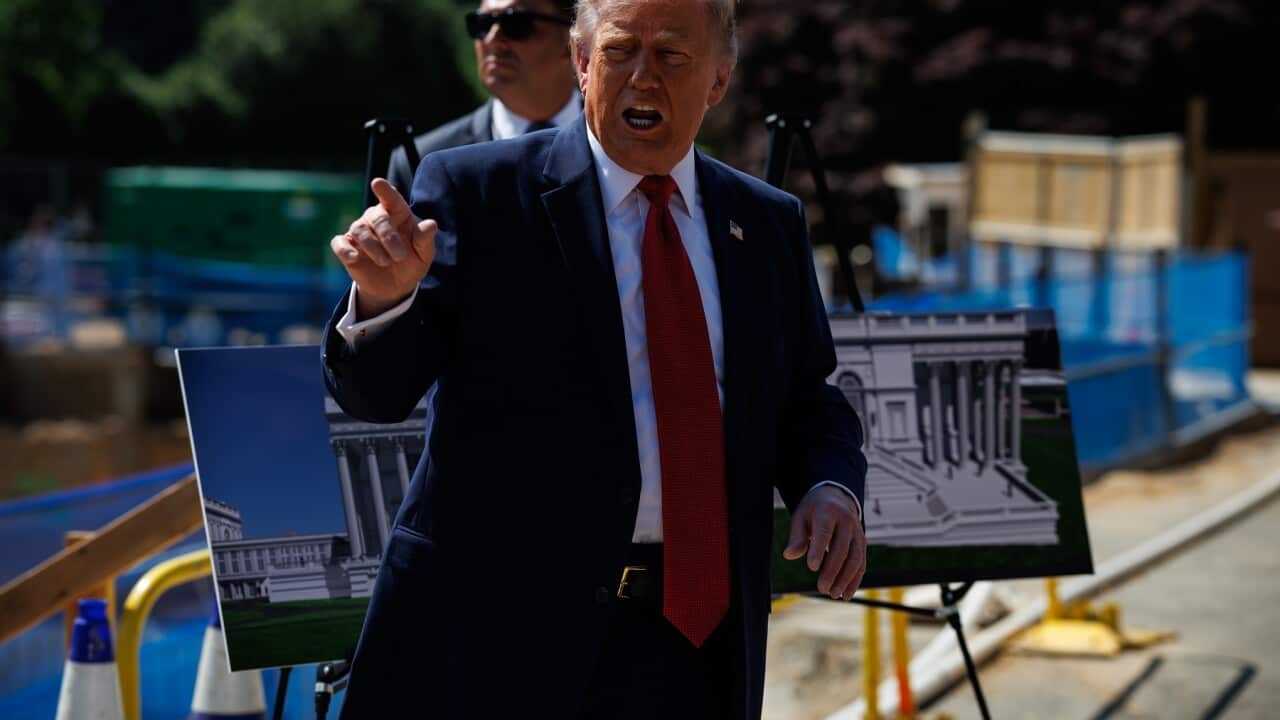

US President Donald Trump's allies who believe they have been wrongly investigated and prosecuted could soon have access to a nearly $1.8 billion compensation fund. The US Justice Department has made the announcement in a move to settle a lawsuit against the US Tax Office, heavily criticised by Democratic Party members as unconstitutional and corrupt.
Listen to Australian and world news and follow trending topics with SBS News Podcasts.
TRANSCRIPT
This year, US President Donald Trump has been embroiled in a lawsuit with the US Internal Revenue Service.
In a complaint filed in Miami federal court, Trump, his adult sons, and his namesake company alleged certain precautions had not been taken to prevent former IRS contractor Charles Littlejohn from leaking their tax returns to newspapers they described as leftist outlets.
US Treasury spokesman Scott Bessent earlier this year said Trump had clear plans for any damages if he won the case.
"The President has said he would donate the proceeds to charity. You may have missed that."
That's not quite how things have turned out.
Acting Attorney-General Todd Blanche has now announced that Trump is dropping the case in exchange for a settlement agreement in the $10 billion lawsuit, at the centre of which is an Anti-Weaponisation fund to provide a formal process for people or entities who say they were unfairly targeted by the government for political, ideological or personal reasons.
The $1.8 billion compensation fund is in keeping with Trump's long-running claims that the Justice Department during the Biden administration was weaponised against him, even though then-President Joe Biden himself was also scrutinised during that time.
Trump has confirmed as much in remarks to reporters at the White House.
"This is reimbursing people that were horribly treated, horribly treated. It's anti-weaponisation. They've been weaponised, they've been, in some cases, imprisoned wrongly. They paid legal fees that they didn't have. They've gone bankrupt. Their lives have been destroyed. And they turn out to be right. I mean, it was a terrible period of time in the history of our country."
But news of the fund has stunned Democrats on Capitol Hill, who say it's unconstitutional and corrupt.
Congressmen like Jamie Raskin argue the fund would represent not only a highly unorthodox resolution but also a further demonstration of the Trump administration's eagerness to reward allies who were investigated and in some cases charged and convicted.
He says it's building on other compensation payouts that are morally and legally questionable.
"They gave $1.25 million to his disgraced former national security adviser, Michael Flynn. They gave 1.25 million to Carter Page, as I guess, a dress rehearsal for this big $1.7 billion announcement. Those guys both went to court and lost in court. The Department of Justice already beat them in court, and now they want to turn around and give them money for claims that have already collapsed legally. That is a political slush fund."
Jamie Raskin says it's also not the only example of how Trump is misusing federal money.
"Another one is the Board of Peace. He took $1.5 billion out of the State Department budget - which was in there basically for disaster relief around the world - they took that out, put it into the Board of Peace. Then he got a billion from Qatar. He got a billion from the United Arab Emirates. He got a billion from Saudi Arabia and some other countries. And he is the chairman for life of the Board of Peace. And there's no rules. It wasn't set up by Congress. It's not regulated."
Others have reacted with equal horror.
The president of Citizens for Responsibility and Ethics in Washington, Donald Sherman, has said in a statement that the group regards the move as one of the single most corrupt acts in American history.
Meanwhile former Attorney-General during the Biden administration, Merrick Garland, has repeatedly denied allegations of politicisation, saying his decisions followed facts, the evidence and the law.
In 2022, he said his Justice Department investigated prominent Democrats too, most significantly by appointing a special counsel who scrutinised President Joe Biden for his handling of classified information, while another special counsel brought tax and gun charges against Biden's son Hunter.
"No person is above the law in this country. I can't say it any more clearly than that. There is nothing in the principles of prosecution or any other factors which prevent us from investigating anyone - anyone - who is criminally responsible."
The Trump-era Justice Department has not identified anyone by name who could theoretically benefit from the fund, but there were multiple investigations of Trump allies during the Biden administration where targets could look to obtain payouts.
Prosecutors, for instance, charged about 1,500 people in connection with the January 6 riots at the U.S. Capitol in 2021.
Other prominent Trump supporters who were investigated and charged include Steve Bannon, who served a prison sentence for defying a congressional subpoena, and Peter Navarro, who was similarly convicted of contempt.
Asked if individuals who committed violence that day should receive compensation from the fund, Mr Trump has said it will depend on the decisions of the committee.
He has also distanced himself from the creation of the fund.
"I know very little about it. I wasn't involved in the whole creation of it and the negotiation."
A group of nearly 100 members of Congress have already filed a brief teeing up a legal challenge to the case.
And last month, Senator Elizabeth Warren and a group of other Democratic politicians introduced the Ban Presidential Plunder of Taxpayer Funds Act, which would ban the sitting president and vice president from collecting settlement payments from the U-S, amongst other things.









