
Health workers are racing to contain the Bundibugyo strain of the virus in the Democratic Republic of Congo, for which there is currently no approved vaccine or treatment. The World Health Organisation says the Ebola outbreak spreading through the eastern D-R-C into neighbouring Uganda could be far larger than officially reported. In cities like Goma and Bunia, families are still trying to continue daily life amid growing fears the outbreak is spreading beyond control.
Listen to Australian and world news, and follow trending topics with SBS News Podcasts.
TRANSCRIPT:
In eastern Congo’s Goma, vehicles are being stopped at checkpoints where passengers are ordered to wash their hands, wear masks and undergo temperature checks.
The commercial hub of more than two million people has recorded a confirmed Ebola case, prompting authorities to tighten health measures at schools, offices and public buildings.
The WHO's director-general Tedros Adhanom Ghebreyesus says the outbreak is considered a serious threat.
"WHO assesses the risk of the epidemic as high at the national and regional levels, and low at the global level."
In eastern Congo, the outbreak is exposing tensions between grieving families and health authorities trying to stop the spread of the virus.
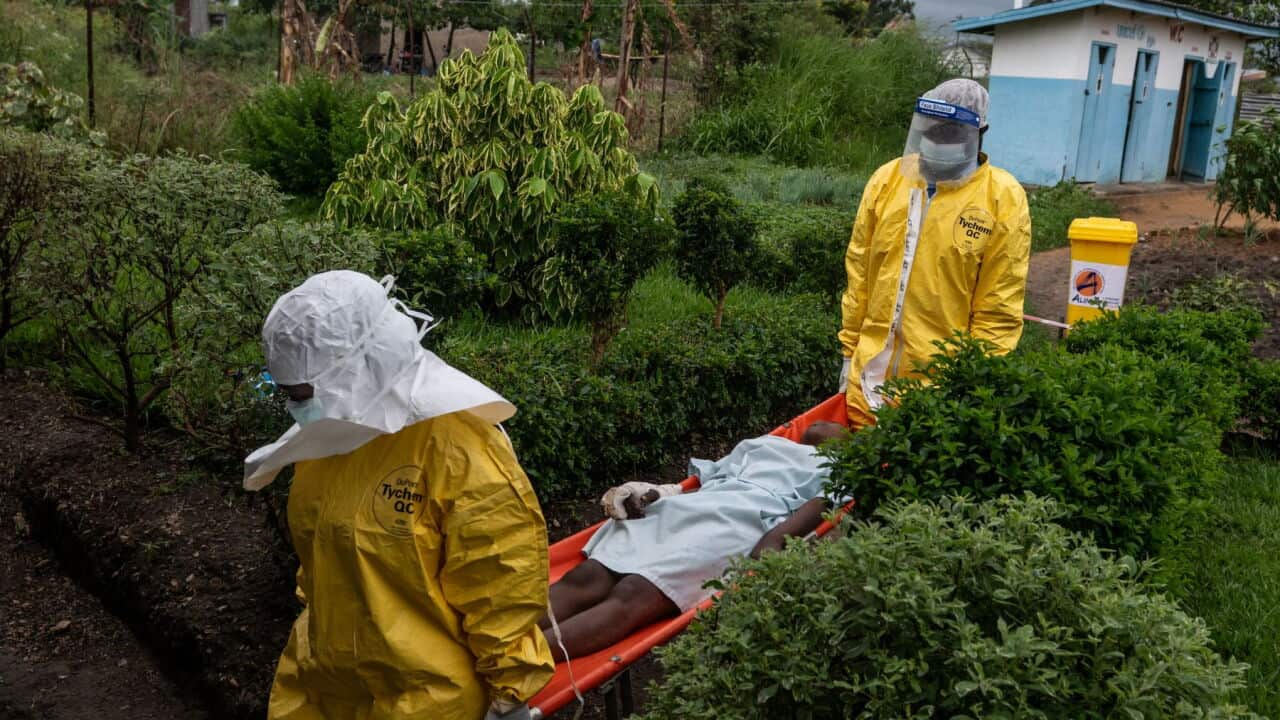
In the town of Rwampara, police fired warning shots and tear gas after relatives of a popular local footballer rejected a safe burial organised by health workers, insisting he had died of typhoid rather than Ebola.
Health officials say unsafe burials remain one of the leading drivers of transmission because bodies can remain highly infectious after death.
Still, some residents say they are trying to protect their families.
"I just took precautions to protect myself and my family. I bought them masks and I spoke to them about the measures to respect to protect themselves from this disease."
The outbreak has now spread hundreds of kilometres beyond its original epicentre in Ituri province, into South Kivu.
Authorities in neighbouring Uganda are tightening controls, with public passenger transport from the D-R-C suspended for four weeks.
Uganda’s health ministry permanent secretary, Diana Atwine, says cross-border movement means the threat remains elevated.
“Given Uganda's proximity to the epicenters and strong cross-border linkages that include trading movement for other economic activities and direct flights, the risk of further importation remains high.”
The World Health Organisation says nearly 600 suspected cases and more than 130 suspected deaths have now been linked to the outbreak in Congo and Uganda.
Unlike the more common Zaire strain of Ebola, there is currently no approved vaccine or treatment for the Bundibugyo variant driving the outbreak.
Scientists are racing to test experimental vaccines while aid agencies airlift supplies and construct isolation wards in affected areas.
But the Coalition for Epidemic Preparedness Innovations says the true scale of the outbreak could be much larger than current figures suggest.
"This outbreak is like an iceberg. We've seen the top of the iceberg. The top is, as we get closer to it, pretty large. Now what we know about icebergs is it's bigger under the water than it is above the water. So I think the WHO is now into the many hundreds of cases and hundreds of deaths. But the truth of the matter is that real numbers will be much bigger than that."
Meanwhile, many residents say life must continue.
"We must understand that the disease exists and is real. It is dangerous because it has neither vaccine nor medicine. The best prevention is to wash your hands with water and soap or to use hydroalcoholic solutions. My greatest message to the population is that everyone accepts that the epidemic is real."