
Cases of Ebola continue to rise in the eastern part of the Democratic Republic of Congo, with the number of suspected cases approaching 1,000, and suspected deaths at more than 200. Aid groups are warning they need more funding to tackle the disease, and health workers and volunteers are working to educate people and quash misinformation.
Listen to Australian and world news, and follow trending topics with SBS News Podcasts.
TRANSCRIPT
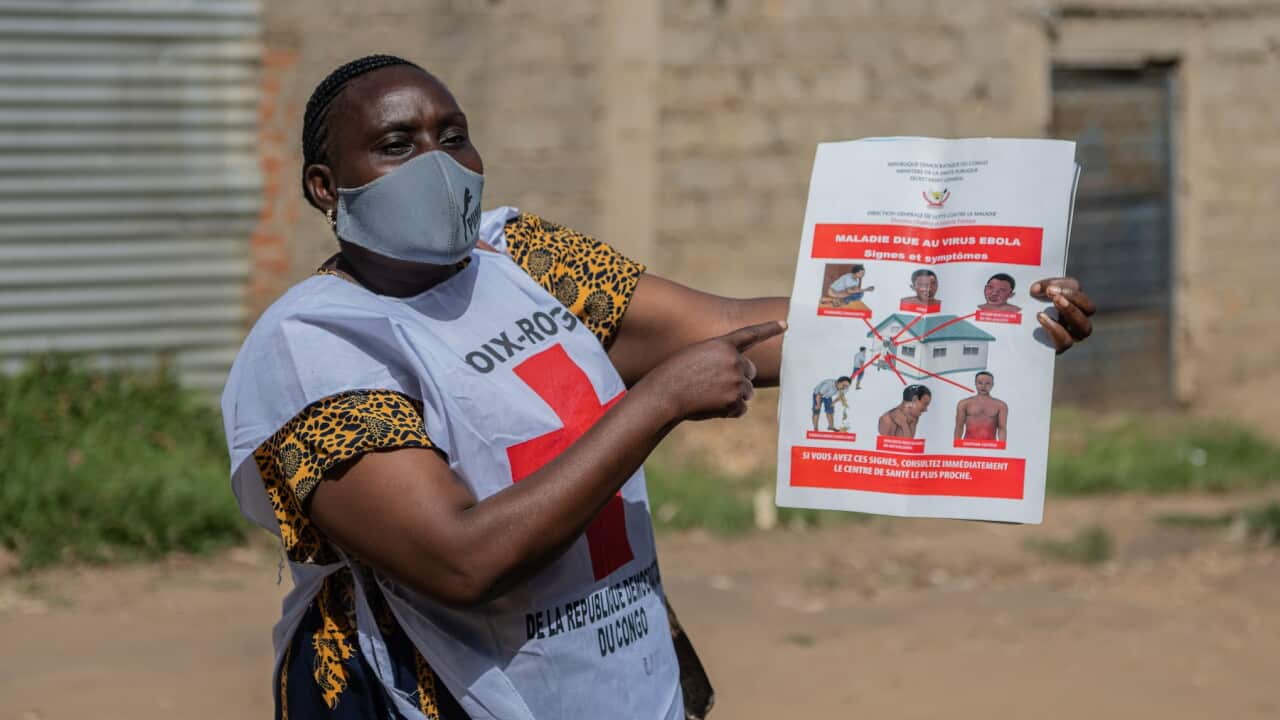
Red Cross Volunteer Vanny Birungi is going house-to-house in the neighbourhoods of Bunia in the eastern part of Democratic Republic of Congo, warning residents about the outbreak of the Bundibugyo strain of Ebola, and trying to bust misinformation.
Swahili then English VO: “We've come to tell the people the disease is here. Unfortunately, we're facing resistance, and some people want to stone us, but we're not going to give up. We're continuing to tell them that the disease is here. Some accept it, and others don't. We fear that because the resistance is strong, people will continue to die, but we're not giving up.”
Mistrust is making the response to the disease difficult with two treatment centers burnt down by local residents, including one in Mongbwalu .
Medical director of the Mongbwalu General Hospital, Richard Lokudu, says 18 patients who were in isolation escaped.
French then English VO: "The police and the military have been made aware. The general reference hospital of Mongbwalu [is not fenced. So the staff are exposed, but the patients too. As a consequence, to put it briefly, the burning of this tent caused panic among the senior staff, the medical teams of the general reference hospital of Mongbwalu and it also caused the escape of several suspected cases. So 18 patients who were being monitored in isolation have vanished into the community. So it is still a great risk, we will have to put in place the means to find them."
Back in Bunia, at the Kigonze displaced persons camp, supervisor Richard Mbagaro is urging people to wash their hands with soap or ash as fears grow over the spread of the disease.
Swahili then English VO: "I am raising awareness about Ebola. It is a very dangerous disease. It kills people quickly. You must wash regularly with soap and ash. You must also purify your water and wash your hands with ash. That is what can protect us."
He says there are 5,000 people in the camp and he's concerned by the amount not wearing face masks or taking other protective measures.
In some cases, there are issues getting the necessary supplies.
Many residents, including this man who gave his name as Kubamalaki, rely on ash to clean their hands because they can't afford or access soap.
Swahili then English VO:"We don't even have anything to wash our hands with, or soap to protect us from disease. We are appealing to the authorities for help. We are in the midst of an epidemic, but we don't even have soap. If we don't get help, we're all going to die here."
The World Food Program also warning a hunger crisis is making it hard for people to isolate as they should.
Here's the programme's Ituri bureau chief, Olivier Nkakudulu.
French then English VO: “There are health measures that suggest that people be contained in areas, but if these people are not receiving food assistance, they are not going to stay in the areas of containment, they are going to leave these areas and they are going to look for food. They will have to go in the markets and by passing through the markets, they can infect other people."
He says cuts to foreign aid making the situation worse.
French then English VO: “In the absence of resources we will have to prioritise. We won't be able to reach everyone. We already have people who are food insecure, and sometimes difficult choices will have to be made between those who are food insecure and those who need assistance with Ebola."
He says hundreds of millions of dollars is needed to bridge the gap.
"Most of the agencies that are on the front lines have had budget cuts. So the first thing to do is to ensure that long-term financing is sustainable, and is ensured for all agencies. From the perspective of WFP, there is a shortfall of 218 million US dollars in resources for this year.”
Tonnes of aid has been flown into Bunia and other hard-hit towns in Congo, but aid groups say they still need more supplies, including face shields and suits to protect health workers from infection, as well as testing kits, and body bags and other materials needed to safely bury the bodies of victims, which can otherwise be highly contagious.