
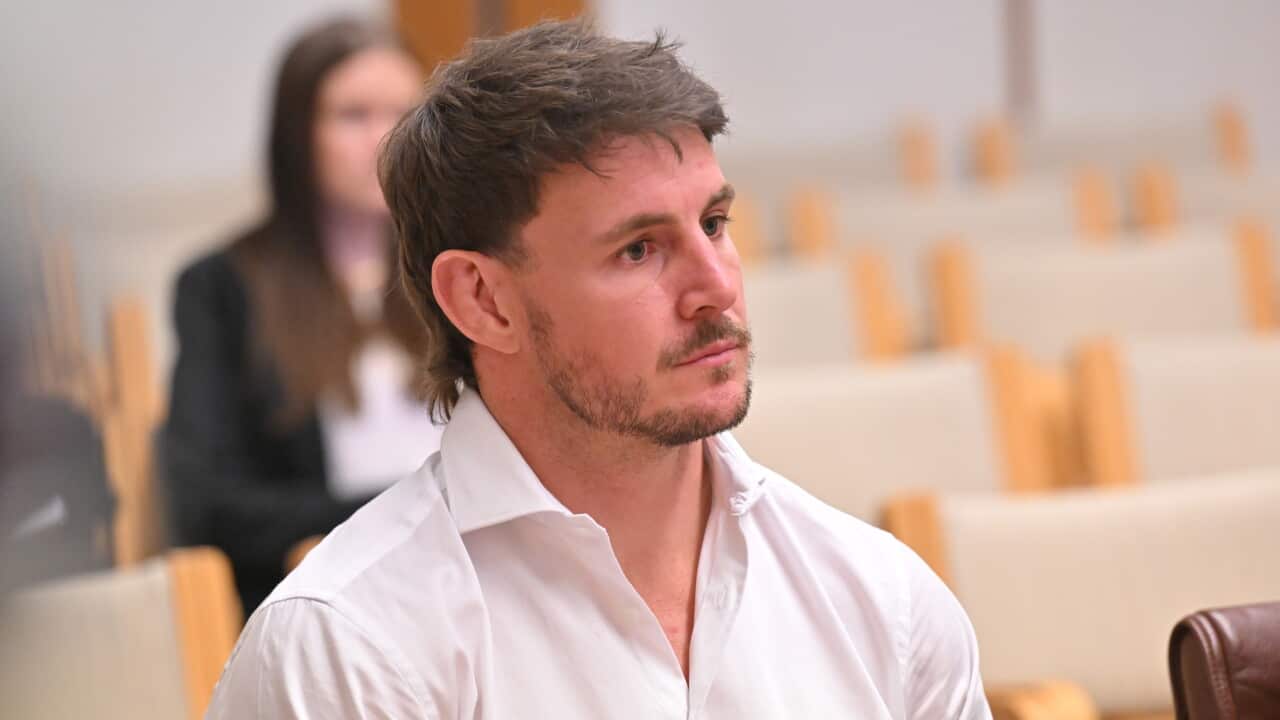

Free drugs, escorts, and flights to sporting events. A Senate committee in Canberra has heard about the extraordinary tactics some major betting companies use to incentivise gambling addicts to continue spending millions.
Listen to Australian and world news and follow trending topics with SBS News Podcasts.
TRANSCRIPT:
A Senate inquiry into proposed laws aimed at tightening rules on gambling advertisements has revealed some of the industry's darker secrets.
Luke Bateman is a former NRL player who played for the Canberra Raiders between 2015 and 2019.
After retiring from rugby league, he became known as a social media creator, particularly in the BookTok community, promoting reading and fantasy literature.
"Good morning Booktok ... quit your job and just read books ... Books change your lives."
He has also signed a publishing deal for his own fantasy book series.
That's the public chapter in Luke Bateman's life.
But it's not his TikToks or tackles that brought him in to the Senate - he's telling a gambling inquiry about an insidious addiction he estimates lost him one million dollars.
"Your VIP manager would offer you, go, hey, mate, what drugs do you want? Do you want you know do you want a couple bags for this weekend? We'll organise that for you, we'll have that ready for you when you get here. There was another time I remember when I went to an exclusive event through a betting company that was hosted in a rental on the canals of the Gold Coast, and the entire c-suite of the company were there, all the management team, administration and they were all in the back room doing drugs together and I was out in this room doing drugs with all of them."
Bateman was questioned by independent senator David Pocock.
POCOCK: "The actual leaders of these companies knew, in some instances what was what was happening and how the whole thing worked?"
BATEMAN: "Well, not only did they know, they were participating in it."
Inducements like this were pointed to as one of the most pernicious tactics used to lure victims back to their addictions.
Longtime anti-gambling advocate Tim Costello shared the story of just one victim.
"He was the TAB's biggest customer in that time, they were giving him 50,000 dollar bonus bets. He was also SportsBet's biggest customer, they were flying him to grand finals, they were offering him escorts, drugs, whatever he wanted. He was doing turnover of more than 20 million dollars a month."
Sportsbet has asked for any evidence of these claims, and says it has zero tolerance for the conduct.
Greens senator Sarah Hanson-Young was appalled.
"And the gambling addict, the person who is harmed, gets locked and and TabCorp and SportBet bank the profits - it's revolting."
Experts are demanding the laws on gambling advertising be strengthened, as recommended in the Peta Murphy review three years ago.
Samantha Thomas is a Professor of Public Health at Deakin University.
"Ban the ads, ban the inducements, and implement a national regulator for the health and wellbeing of Australian children and young people."
Racing and wagering companies are pushing back against the implementation of more red tape.
Here's CEO of Racing Victoria, Aaron Morrison:
"We don't necessarily support another national regulator, we think that would just be another entity sitting over the top, could just lead to further confusion and introduce another cost to the industry and I think necessarily."
Experts have also raised concerns with how ubiquitous advertising is in targeting children - not just on TV or radio but also in fun camera filters on social media.
A proposal to restrict ads only between 6am and 8:30pm was also not seen as helpful.
Hannah Pitt is a Public Health Researcher at Deakin University.
"I think it's a very obvious answer that children are of course not going to bed at 8.30, they're watching a sporting game. We want that to be as family friendly as possible and something that you can sit down and watch as a family but this 8:30pm rule appears completely arbitrary and is inconsistent with young peoples' media behaviours."
The government however, is fiercely defensive of the reform - saying it's the toughest ever proposed.
Communications minister Anika Wells says a program set up in 2024, called BetStop, is designed to help block ads.
"You can opt out forever using BetStop today."









