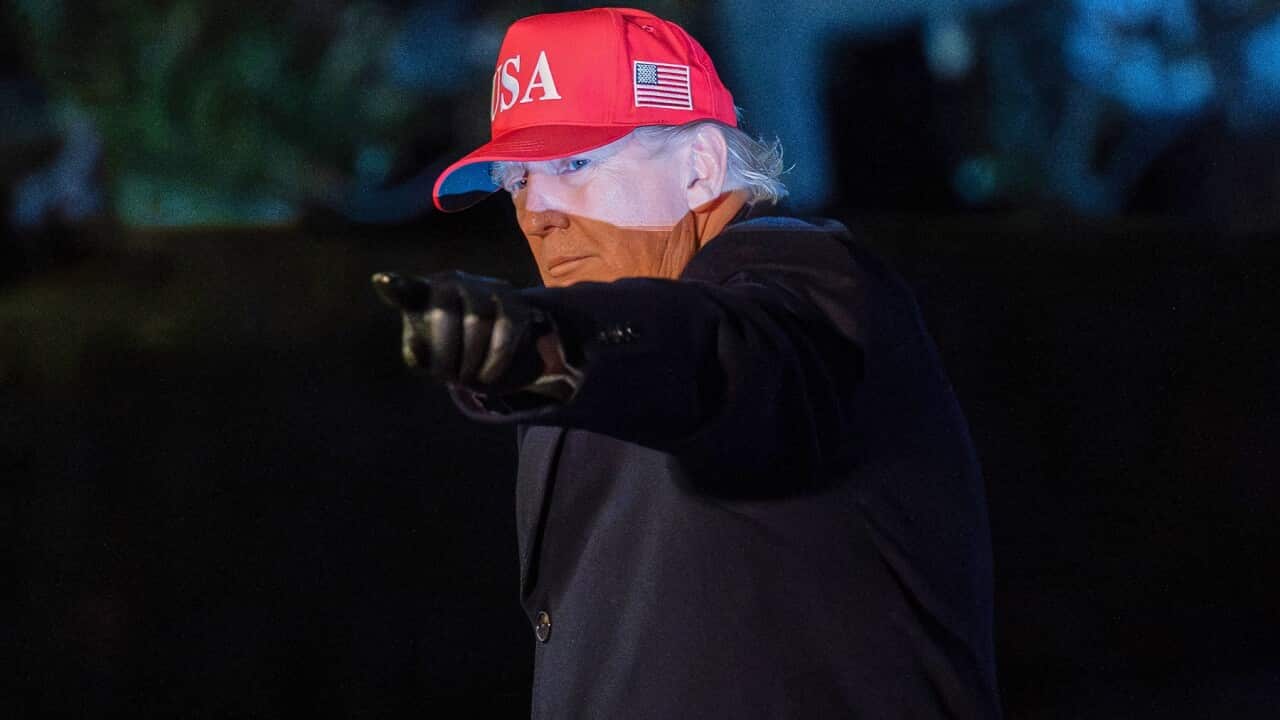

As Iran vows revenge on the United States for toppling its leader and launching attacks that have killed civilians, President Donald Trump is warning there will be more American casualties. But as the United Nations chief condemns the move, there are questions over what legal and diplomatic consequences the US could face for initiating the attacks.
Listen to Australian and world news and follow trending topics with SBS News Podcasts.
TRANSCRIPT
When the US initiated the first strikes on targets in Iran on Saturday, it set a war in motion.
And Donald Trump says strikes on Iran will continue until all objectives are met.
The US and Israel are continuing to pummel Iranian targets, dropping massive bombs on the country's ballistic missile sites and wiping out warships as part of an intensifying military campaign.
"This is the duty and the burden of a free people. These actions are right and they are necessary to ensure that Americans will never have to face a radical, bloodthirsty terrorist regime armed with nuclear weapons and lots of threats."
A number of experts cite evidence Iran was de-nuclearising since it signed a deal with the US under President Barack Obama in 2015.
Professor Ben Saul is an expert in International Law at the University of Sydney.
He says while the US President says the strikes were pre-emptive and addressed a nuclear threat - that isn't true, he has broken international law.
"This case does not fall anywhere close to self defence against an imminent attack. Iran has not yet enriched uranium to the point of building any kind of nuclear device. Experts are all on the same page on that. Iran does not have a nuclear weapon. Of course you don't have the weapon, there is no evidence you're about to use that weapon."
With reports of civilian casualties in Iran - more than 150 - including children, and with casualties in third-party countries across the Middle East, there are questions over who else is supporting this crusade.
The United Nations Security Council is not.
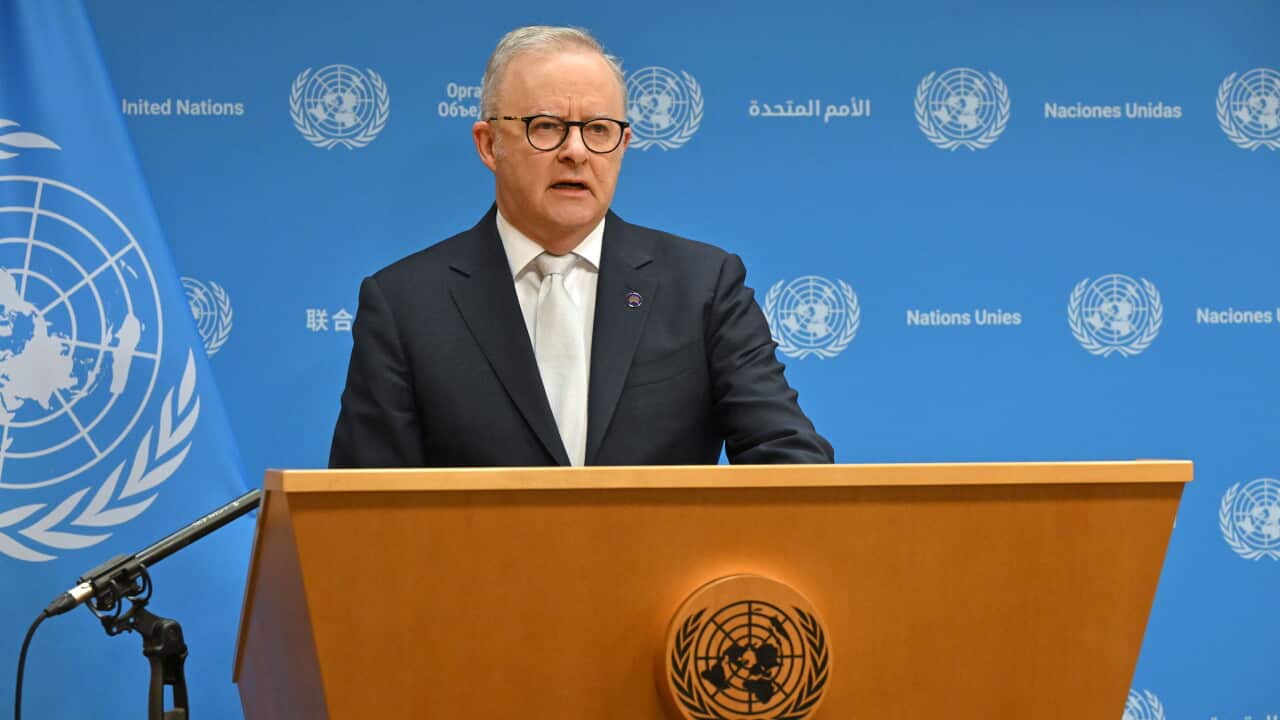
Secretary General Antonio Guterres convened an emergency meeting of the council on Sunday.
"International law and international humanitarian law must always be respected. That is why since this morning I have condemned the massive military strikes by the United States and Israel against Iran. And I have also condemned the subsequent attacks by Iran violating the sovereignty and territorial integrity of Bahrain, Iraq, Jordon, Kuwait, Qatar, Saudi Arabai and the United Arab Emirates."
The UN Security council has powers to penalise member states.
It can apply penalties including sancitons for breaking the law, as it has repeatedly done with other nations.
So, what can it do to signal its condemnation of the US?
According to Professor Emily Crawford, international law expert at the University of Sydney, not much.
"The UN Security Council is the only body which is authorised to pass things like sanctions. And of course, the UN security council has its permanent five members, of which the US is one. And the P-5 have the veto power. So if there is something the security council votes on and a member of the P5 veto's it, nothing happens."
Canada and Australia have shared support of the initial action - but other countries -including Egypt, Colombia, South Africa,Brazil and Spain have voiced grave concerns.
Spanish President Pedro Sanchez condemned the US for its lack of consultation.
"We are rushing headlong into an increasingly unstable, insecure and belligerent world, and therefore one that is increasingly unjust for ordinary people. Yesterday, these fears were sadly confirmed once again when two countries, the United States and Israel, unilaterally attacked Iran without consulting the international community.”
The US, under President Trump, has distanced itself from a number of the groups designed to keep world powers in check; like G20, NATO, and the UN, with recent formation of the so-called Board of Peace.
Professor Saul says it is difficult to level consequences at figures - like President Trump - who don't care.
"He has made it clear, he doesn't care about - he has said it expressly. He doesn't feel bound by international law. He is only bound by his own morality and whatever strategic objectives the US has. But recently of course, in January he invaded and committed aggression against Venezuela."
He and a broad spectrum of experts also say last year's strikes by the US on Iran - which targeted its nuclear infrastructure - were also illegal.
But international treaties and bodies like the UN, are not the only mechanisms to reign in or penalise world leaders and their governments.
The International Criminal Court has jurisdiction over breaches of international law.
If the US in initiating these attacks is found to have violated laws, President Donald Trump could be charged.
Key US ally and partner in the ongoing onslaught against Iran, Israeli leader Benjamin Netanyahu, is already being pursued by the International Criminal Court for alleged war crimes in Gaza - which he denies.
Professor Crawford says the ICC does have the power and potential to penalise Donald Trump over this aggression.
"So for example, when Duterte came to power in the Philippines and was basically engaging in crimes against humanity, against his own people in his drug war. When an arrest warrant was issued, everyone thought oh yeah, this will never happen, Duterte will never see justice - well he is currently on trial in the Hague. There are avenues, they're just not as quick as I think people would like them to be."
On a domestic level, the political consequences are already being felt.
There has been significant dissent among US citizens.
A Reuters survey found just one in four Americans supports their government's attacks on Iran.
Now, Democrat politicians are expressing deep concern over the president's apparent lack of a longterm plan for Iran as the nation faces a change in government.
CIA operatives have released a brief, warning the prospective new regime could be similarly totallitarian, as politicians report the President did not get congressional authority for military action.
Citing a series of conflicts that ignited with US action, including in Venezeula, Iraq and Afghanistan, Democratic representative Ro Khanna has joined Republican Thomas Massie in calling for a congressional vote on the war.
"The American people are tired of regime change wars that cost us billions of dollars and risk our lives. We don't want to be at war with a country of 90 million people in the Middle East."
Trump allies, including Republican Representative Mike Lawler rejects the Democrats claim the President did not consult with colleagues in Congress.
"We will get a briefing this week as required per the War Powers Act. The president did notify Congress. Congressional leaders were briefed. They were given advance notice. Uh, and so the president is fully in compliance with both Article 2 and the War Powers Act."
University of Melbourne Middle East expert, Doctor Dara Conduit, says regardless of the legal and political implications for the president and US government, the greatest consequences will ultimately be felt by the Iranian people.
"This is a really scary time for for people inside Iran, regardless of whether they support the regime, because they've witnessed war in Afghanistan, they've witnessed war in Iraq.There's huge uncertainty. And I think it's just really important for us to acknowledge that these people are now just pawns in this conflict that the US and Israel has frankly, illegally, started in their name and they're the ones that will bear the brunt of it if it doesn't work out."