
A slice of football history is taking place next month, when South Melbourne take on Melbourne Victory in the Australia Cup Final.The showpiece fixture will mark the first all-Victorian Australia Cup Final of the modern era, bringing together two giants of Australian football representing different generations. SBS looks at the significance of the event and the unique histories of both clubs.
Produced in collaboration with SBS Dinka
Listen to Australian and world news and follow trending topics with SBS News Podcasts.
TRANSCRIPT
It's a football final 22 years in the making, dubbed by some commentators and stakeholders in the game as potentially 'the biggest match in Australian domestic soccer history.'
South Melbourne takes on Melbourne Victory on Saturday the 10th of October at AAMI Park.
Before we get to know these two teams with unique histories respectively, let's look into the tournament they're in the final of, and the trophy they're striving to lift.
The FFA Cup was launched in 2014, and it's now known as the 'Australia Cup.'
This season's campaign involved 777 clubs from across Australia. That is a lot of clubs, big and small.
Melbourne Victory, the four-time A-League champions, up against South Melbourne Hellas, four-time NSL champions, and the original club of Ange Postecoglou. More on that later.
Ange also has a connection to Melbourne Victory.
Hellas are the third non-A-League team to make an Australia Cup Final.
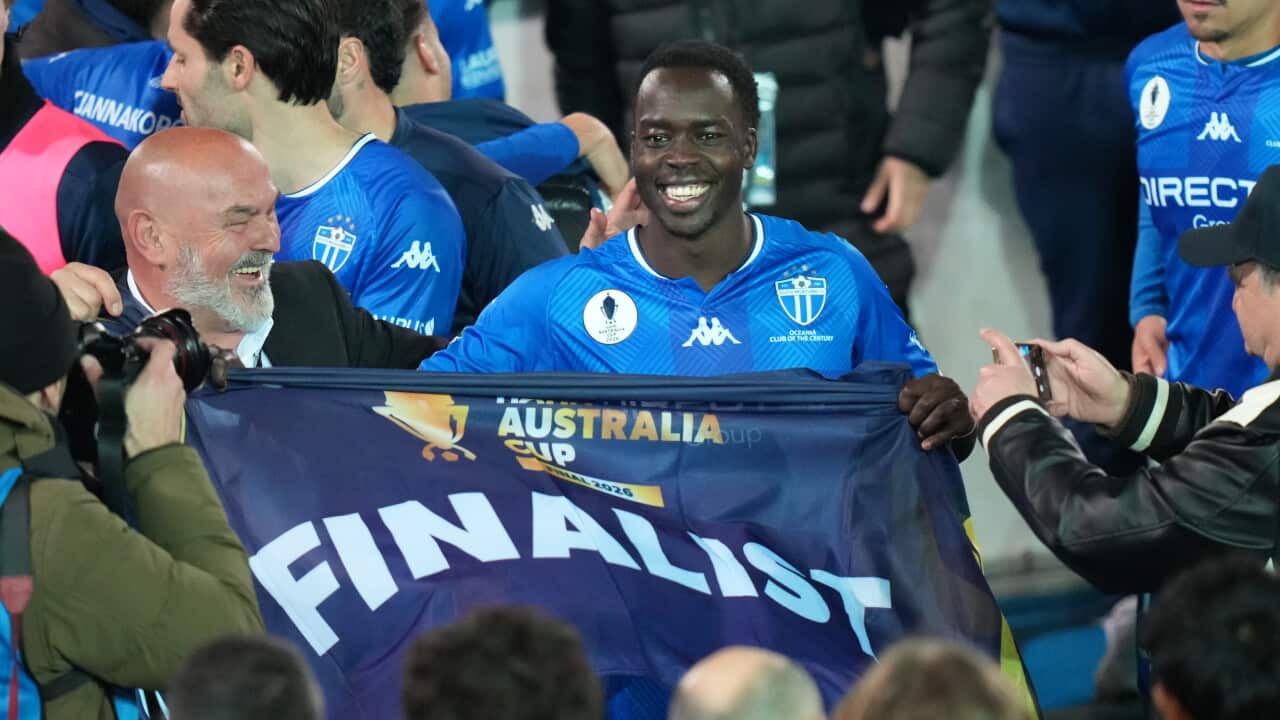
They got there largely thanks to Bul Juach who proved the hero in the semifinal, coming off the bench to score a hat-trick of goals.
“It's a good feeling. It's massive for the club. You can see the morale and everyone is happy. Very pleasing and a very good experience. SO far this year I have really enjoyed playing. The boys have been welcoming. The club has been welcoming. I picked up where I left off last year. I had a short stay in canada playing and tehn I came back. Since coming back I think it has been good to play games. I just have to keep going well and hopefully we can win some trophies.”
25-year old Juach is South Sudanese Australian, and migrated as a young boy to the nation's capital.
“That is where it all started. Came here when I was 12 years in to Canberra and I started playing organised sport. Before that it was street football. It's the world game. It's for everyone. That is the beauty of it. Football helped me a lot. It was a big change coming from Africa but football helped me a lot. I was able to learn the language and the culture. it helped me to adapt and helped me through my journey.”
It's just the second time in as many years and third time overall a semi-professional National Premier League side has made the final of this national competition.
The winner will not only claim silverware and a berth in next year's Asian Champions League 2, but also bragging rights from the two teams' first competitive meeting.
“There’s a bit of multiculturalism in the club (South Melbourne). That is what all of Australia is about. It’s good to see. Massive club. We are all proud to be representing this club. We can see how big it is and the ambition of the club and we all want to be part of that.”
South Melbourne club was founded by Greek immigrants in 1959.
Its origins were an amalgamation of three clubs; South Melbourne United, Hellenic and Yarra Park.
The word 'Hellenic' represented more than just fans of the local club.
The merger was the idea of Theo Marmaras, along with Georgios Samaras, who is the grandfather of the former Celtic and Greece striker, of the same name.
Despite the club's rich Greek diaspora connection, history and influence, today, Juach is part of a diverse make up of the playing group, which, on a larger scale, reflects the diversity of the sport more nationally.
“Big pride. It’s all good to push the younger generation to aim for bigger things and play at these levels and stages. It’s very good. You can see the likes of Awer Mabil and Thomas Deng. Even Nestory Irankunda and Mohamed Toure. They are an inspiration to the African community.”
Melbourne Victory has previously lifted the trophy in this competition, in 2015 and 2021, both at AAMI Park, and finished runners-up to Macarthur FC at the same venue in 2024.
The A-League giants go into this final without marquee Spanish player Juan Mata and early stages under coach Giovanni Savarese who was only appointed in June this year.
In a statement, Football Australia Chief Executive Officer, Martin Kugeler, says 'both clubs have proud histories and passionate supporter bases, and AAMI Park provides a fantastic stage for the occasion.'
While the governing body's Executive Director of Football, Heather Garriock, says the tournament has been 'a significant addition to the Australian football calendar since its inception in 2014, and it’s meant a lot to the NPL and community clubs across the country.'
South Melbourne captain Marco Jankovic is also feeling the excitement.
“It’s probably one of the form teams of the whole country. Very resilient. It seems written in the stars and it’s in a Cup final. It’s going to be a special day and we are looking forward to it.”
It's a local derby, with two titanic and colossus teams representing different eras of Aussie football.
South Melbourne represent the traditional NPL system and a club history stretching decades, while Melbourne Victory represent the professional A-League, a club with stability and resources, profile, prestige and experience associated with the country’s top domestic competition.
The little giant dubbed Hellas has long been the engine and blueprint of progress in football.
The club's former captain and manager, one Ange Postecoglou, is symbolic of the team's pride, development and lineage.
South Melbourne were once crowned Oceania’s club of the century by the International Football Federation of History and Statistics.
They were also widely regarded as the country’s, so called at the time, 'glamorous' entertainers, and were once managed by one of football’s greatest players in Ferenc Puskas.
Puskas is such a big name, the highest individual award honour best goal of the year globally by FIFA is in his name.
According to data from the 2016 national census, Melbourne’s Greek population stands at around 173,000, making it the largest Greek diaspora of any city outside Greece and Cyprus.
Not surprisngly, Melbourne Victory's fan base also captures the hearts, imagination and pride of Greek Australians, as well as many other cultural backgrounds.
Victory coach Giovanni Savarese says he's very content with the balance of his side heading into the final.
He also says he's pleased with the way experienced players and young players are connecting within the team.
The club has a modern legacy of success, elite performance and high standards.
Ange Postecoglou coached the side from April 2012 until October 2013, before graduating to the role of coach of the Socceroos.
The badge and jersey of Melbourne Victory has been worn by superstar players of high calibre including Juan Mata who I mentioned earlier, Luis Nani, Harry Kewell and Keisuke Honda.
In the case of Mata, the 38 year old elected to conclude his playing commitments with the club but he is still involved in a unique way.
How?
In a landmark move, the World Cup winner and reigning Johnny Warren medallist committed to taking an ownership interest in the Club earlier this year.
He says he will harness his expertise with Victory on his position in the Club’s ownership group.
The final of the Australia Cup on Saturday the 10th of October sets up a smooth football fan transition to the Australian Championship tournament on SBS and SBS On Demand, which starts on the 15th of October and finishes mid December.
It also takes place in the heart of what is a bumper, banner month of sport in Australia, including the NRL and AFL Grand Finals, the Bathurst 1000 Supercars race, the Rugby League World Cup, the Wallabies versus the All Blacks, and, Spring Racing Carnival in the lead up to the Melbourne Cup... among others.