
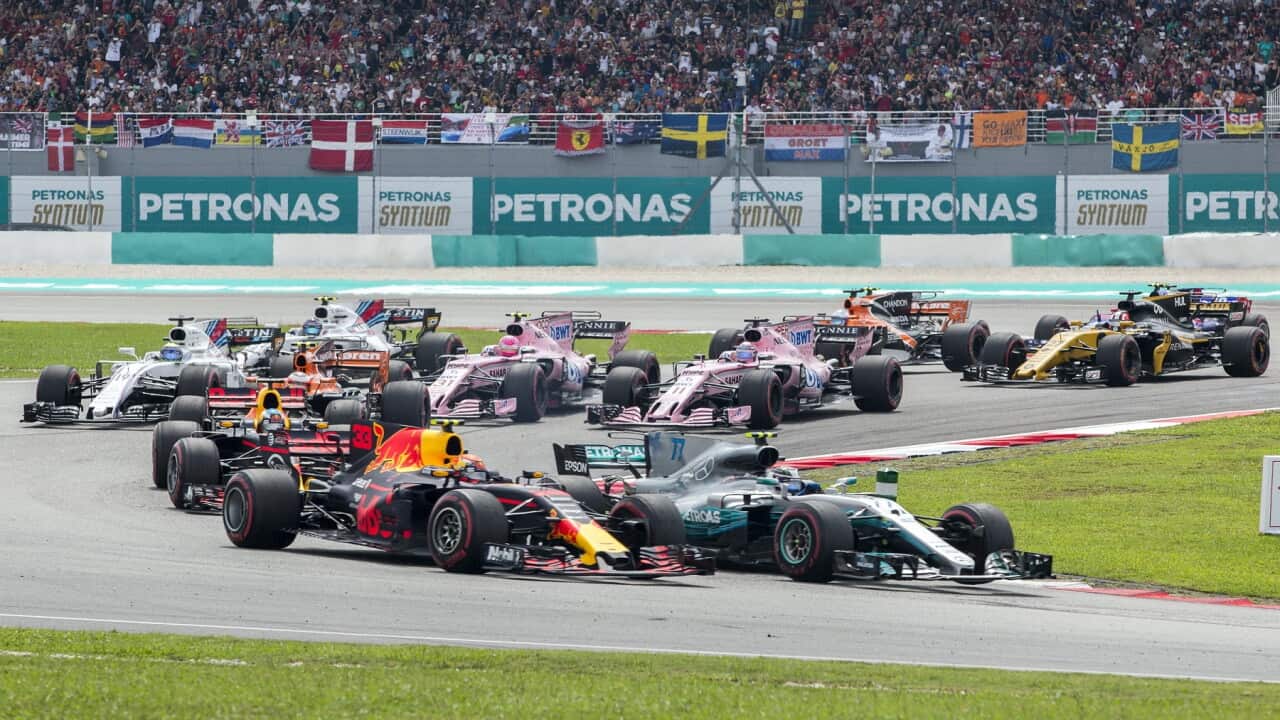

Formula One is returning to Malaysia for the first time in nine years, with the Gulf Air Bahrain Grand Prix to be held in the country, this October. The race - which was meant to be held earlier in the year - was postponed due to the US-Iran war. Both fans and drivers welcome the surprise return to the iconic Sepang International Circuit, but a sports diplomacy expert questions what this means for the future of the sport
Listen to Australian and world news and follow trending topics with SBS News Podcasts.
TRANSCRIPT
KA: "Ooh Sepang is back."
Interviewer: "Have you ever driven?"
KA: "So that's actually proper PETRONAS home race."
Interviewer: "Correct...is back."
KA: "That's cool. Also it's a really cool track, Sepang. I think it's going to be sick."
Interviewer: "Have you ever driven it virtually?"
KA: "Yes, of course."
Interviewer: "You've never driven it in real life?"
KA: No, no, so I think it's going to be a really cool one.”
That's Mercedes-AMG PETRONAS driver, Kimi Antonelli.
He's among the drivers excited to race at the iconic Sepang International Circuit, about 64 kilometres south of the country's capital, Kuala Lumpur, this October.
After a nine-year wait, Formula One returns to Malaysia, for the Bahrain Grand Prix after the race was postponed due to the war in the Middle East.
Formula One confirmed the agreement between their organisation, the Fédération Internationale de l'Automobile and the governments of Malaysia and Bahrain.
Malaysia's Prime Minister Anwar Ibrahim says the collaboration followed discussions with Bahrain's Crown Prince and Prime Minister, Prince Salman bin Hamad Al Khalifa, the King of Malaysia and Formula One President and CEO Stefano Domenicali.
He says the collaboration reflects the strong friendship and mutual trust between the two nations, and is more than the staging of a world-class sporting event.
It's welcome news for Mercedes-AMG PETRONAS driver, George Russell.
“To have a race in Malaysia, Sepang will be so so cool. Sepang was actually my favourite track as a kid when I used to play it on the F1 game, I've never driven there but I feel like I know it really well because I drove it so often, home of Petronas as well - yeah that'll be awesome.”
Whether it was rain or shine in the country, the Malaysian Grand Prix was a regular fixture on the Formula One calendar from 1999 until 2017.
Sepang circuit was also home for Lewis Hamilton, who was a driver for the Mercedes-AMG PETRONAS Formula One Team for 12 seasons, before he made his final visit to the PETRONAS Twin Towers in Kuala Lumpur in December 2024.
The seven-time Formula One World Champion bid an emotional goodbye to the team and fans, before switching over to Ferrari.
The 2017 Malaysian Grand Prix - which saw Max Verstappen winning that edition for Red Bull - earlier marked the end of a 19-year chapter of F1 history in the country.
So how does geopolitical conflict affect global sporting calendars and host nations?
Lecturer at the Western Sydney University, Dr Andy Grainger says, Bahrain is retaining the event's title despite it being staged in Malaysia.
“The race is still gonna be called the Bahrain Grand Prix in Malaysia. And of course, with its attendant sponsor before that, which I think says a lot about kind of the way a number of Middle Eastern countries, particularly places like Bahrain, but predominantly Saudi Arabia, UAE, have appropriated sport as a means of kind of nation branding. And I think for Bahrain, it's maybe not so much about necessarily where the race is held, but in terms of having their brand presence and their national kind of brand presence, so that's preserved.”
He says for Malaysia, it's a big win.
“Malaysia has a, a strong, well, not, not so much a formalised, but a strong sport diplomacy, background and has long used, I think back to the ninety ninety-eight Commonwealth Games and before that, uh, and well, in the early two thousands, obviously, F1. So I think it sort of views sport both in terms of promotion of its own brand identity as well as some-- says something about the regional brand identity.”
Bahrain had been due to host their race on April 12 but it was postponed due to the ongoing US-Iran war.
The relocated race will take place between the Azerbaijan and Singapore Grands Prix.
So will this impact the Qatar and Abu Dhabi races?
“It'll be very interesting to see, for instance, whether there'll be an impact on the, Qatar and Abu Dhabi races later on in, in the season to see the sort of whether that, whether they, and I know their call on that's not that far away, but to see whether, they remain on the calendar in terms of, whether the sort of risk outweighs the costs involved or the cost loss, and whether the move to Europe. But yeah, certainly, within a number of sports we've I mean, I think there's, there's long been sort of tensions over the Russia and Ukraine, it's that typical kind of question whether sport and politics should mix.”
The hope was that the event could still go ahead this year, but continued uncertainty in the region has made that impossible.
Dr Grainger says it would've taken a lot to cancel the event in the home base, considering the athletes and also the contract in place.
“I sort of speaks to, I mean, the fact that they need- they have a broadcast agreement where they need to run at least 22 races, so I mean I think that's one of the driving forces they can't be in breach of their contract.”
In a statement, F1 CEO Stefano Domenicali said the sport has demonstrated its ability to adapt, find solutions, and deliver, creating an exciting moment for everyone who follows Formula One.
Domenicali says its fantastic news for fans, who will continue to enjoy a full and exciting Formula One calendar, while also seeing the sport return to a great venue.
Dr Grainger adds that one of the main reasons a lot of these Gulf states have invested in sport was to build interdependence and security.
“Qatar, for example, or, or in, and Bahrain has relied on other countries investing in their sporting infrastructure, and that's sort of shown the real vulnerability, and it lays- and it's really laid bare, I think, the weaknesses of the Gulf, many of these Gulf states' plans, to diversify through sport. So it sort of shows that risk that they've almost sort of gone from putting all their eggs in the oil basket to all their eggs in the sport basket. And so this, current conflict in many ways has scuttled a lot of their plans, and it comes, when these countries, a lot of their sport tourism is based around events-based rather than any kind of form of manufacturing or sporting infrastructure.”
He points to Saudi Arabia's aspirations to grow to three percent of its GDP by 2030.
He says as far away as it seems, it affects organisation of the 2034 football World Cup, as well as a number of other events in the region.
“We're in a war, which is sort of, despite Donald Trump's reticence or Pete Hegseth, sorry, sort of, took offense at the description of it being a quagmire. Obviously, it seems to be, and so the longer, the longer-term impacts are, are gonna be interesting. As I say, there's already sort of questions around Qatar and Abu Dhabi and F1, but a number of other sporting events.”
The current US-Iran war means the Saudi Arabian Grand Prix - which was meant to be held on April 19 this year - is to be scrapped altogether from the calendar.
This year's championship, as it stands, is scheduled to finish with events in Qatar on November 29 and in Abu Dhabi a week later, but both races remain in doubt.
It is understood F1 chiefs have a contingency plan if they cannot go ahead, with Imola in Italy expected to take Qatar's place on the same weekend.