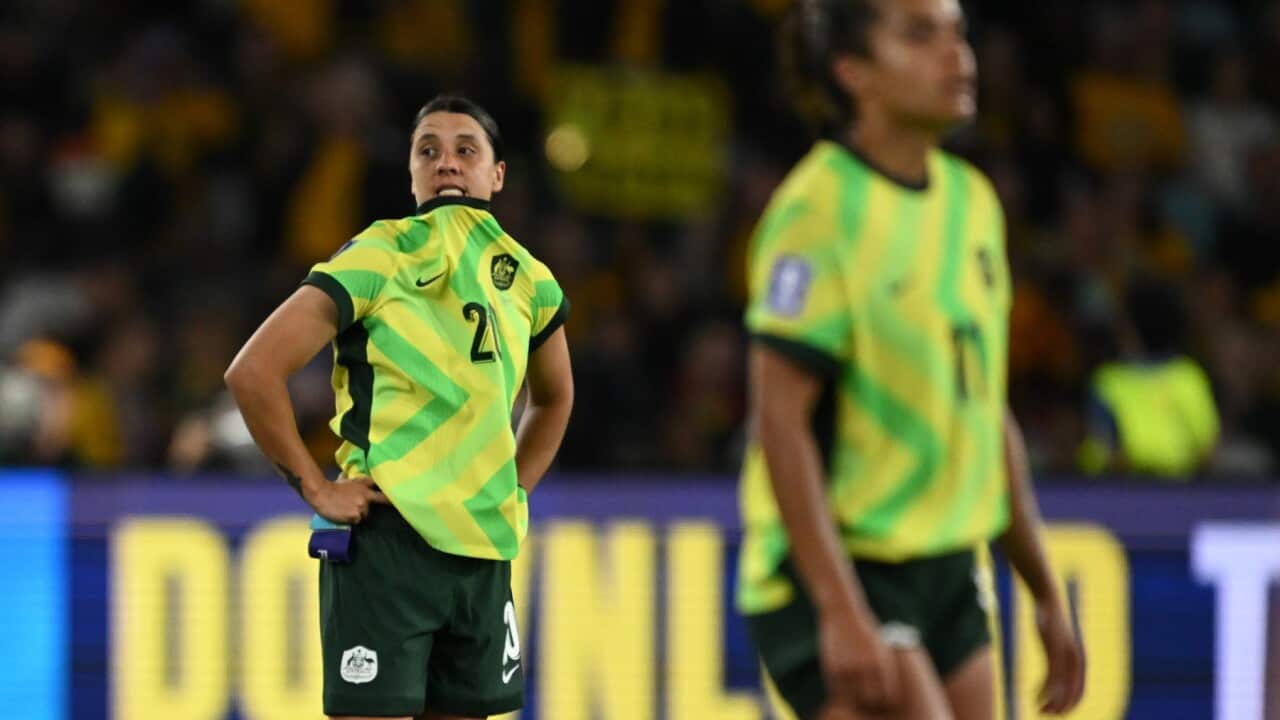

Australia have faced South Korea in one of the AFC Women's Asia Cup's most anticipated fixtures, surrendering the top spot in the group to South Korea, after a 3-all draw. The match delivered a crucial result at the eleventh hour for home side. As fans celebrate the rise in women's football, experts say more work needs to be done in the space.
Listen to Australian and world news, and follow trending topics with SBS News Podcasts.
TRANSCRIPT
"I think it's going to be a pretty even match, but if I was going to say South Korea; 3-2."
That's 11 year-old Ha Rang with his predictions for South Korea against Australia's Sunday match.
He wasn't wrong.
(UPSOT of South Korea scoring third goal)
Until this happened.
(UPSOT of Australia scoring third goal)
A pulsating moment after a 3-all draw before a crowd of more than 60,000 [[60,279]] at Stadium Australia - setting a fresh record for the largest attendance in the tournament history.
Born in South Korea, Ha Rang moved to Australia when he was four with his family.
"Honestly I feel like I have mixed emotions like I mean the country that I'm living in and the country that I'm born in playing against each other is kind of crazy."
With roots tying back to South Korea, Klara, who's an occupational therapist echoes a similar sentiment.
"Living in Australia and being Australian I'm very proud of but I think staying connected to my family and my extended family is very important to me. So deep down I think I am rooting for Korea, but you know the Matildas are such a strong team and all the players are fantastic. We got to watch a few of the Matildas players when we were living in London in the EPL team so yeah, definitely cheering for them too."
Jae moved from South Korea to Australia in 1988 with his wife.
"I always teach my kids, we are Australian-Korean, we go for both. But it's hard to get that Korean feel living here, so today we're red today."
His 11 year-old son Joshua says he goes for both teams.
"I'm here to experience what it feels like to be in a stadium, experiences..I think I'll just hope for the best."
Geena Han is a student at the University of Sydney with ties to South Korea.
She says they've always championed their home country from a young age.
"We are Australians, citizenship and everything and from a young age we watched all the sports online with our parents who were Korean, so naturally over time we always cheered for Korea, but it is hard because we also want to cheer for Australia, but if they are versing each other - I think - we just tend to wear red."
The Matildas will be in Perth this week for a quarter-final clash with the second-placed team in group B.
They will be playing against either China or North Korea after Monday night's match.
Alanna Kennedy who scored both of those goals on Sunday night [[March 8]] - and four in the tournament so far - says they need to recover, regroup and stick together.
"We had moments, they had moments, we caught our way back into the game and unfortunately let them get back in the second half. But I think we showed our never say die spirit towards the end of the game and I'm sure we'll take that into the next match as well."
But Australia's coach Joe Montemurro says they've got to learn to keep the ball better.
"We've got to keep the ball better. We can't afford to - it's been the thing that I have been endorsing from day one - when we do it, we do it well. And then we started to force things when we didn't need to. When the momentum wasn't there. The game got scrappy and it got to a point which I didn't like, to be honest. But there were some very good moments also in the first half. There were some chances that I think we should have converted."
Matildas fan Emily Cokely, tells SBS she was there to soak in the atmosphere and energy of fans from both sides.
"It made me feel a lot more hopeful and optimistic the way the country got around the Matildas during the World Cup and so it's making me feel the kind of good feeling again, it's sort of proven it wasn't just a phase and that people are showing up for the Asian Cup as well. It's been a really lovely feeling to see how much more women's sport has been showed respect in recent years."
As someone who used to play soccer herself, Matildas fan Brioney Staples says it's good to see the sport pick up for women.
"I think it's really good how soccer has picked up for women, because I've been playing since I was in my 20s, I'm now almost 30. So it's really good to see the sport pick up and the teams get bigger for women."
But writer, lecturer and researcher at the Queensland University of Technology's Centre for Justice, Fiona Crawford says while there's been a spike in Matilda's fan base, there's still work to be done.
"For example, the success of the 2023 Women's World Cup hasn't translated down to the A-league women's, which is the domestic league. We've seen them actually go backwards in attendance rates this season. We're also seeing that you know, salaries are not catching up. The top players are earning lots of money and or starting to earn some good money, but their domestic players really. They're not earning full-time wages, they're not playing football year round. They're all doing lots of other jobs and trying to prop up their football careers."
In the lead-up to the 2032 Brisbane Olympics, Fiona Crawfords says legislation as well as real investment is crucial for women's sport across the board.
For this year's tournament, there will be no increase to Women’s Asian Cup prize money - it will remain at A$2.55 million (US$1.8 million) shared between the top four teams, which is the same as it was in 2022.
In 2023, the allocation for the men's team was $A21 million.
Fiona Crawford says women's sport has traditionally been underfunded.
"There's an 88 per cent gap between the women's game and the men's game and that's kind of inexcusable in 2026. So what we really need to see is some advocacy saying, hey, it's not acceptable to not have equal prize money anymore."
She says while there is pressure on some of the major organisers such as FIFA and the AFC to close that prize money gap, it's not happening fast enough.
Adding that while the Matildas have made some great leaps, teams like South Korea or Iran have a long way to go.
"It was really interesting that the Matildas were playing on International Women's Day and that they were actually playing a team who were in the same position they were 10 years ago. So we know the Matildas had to strike in 2015 over the conditions. Part of that was paid, but also it was just about conditions and contracts and resourcing that went their way. South Korea, you know, did really well to actually, I was going to say, almost beat, draw with the Matildas. But it was a really interesting contrast for us to see."
This, as Australia is under huge pressure to provide asylum to the Iranian women's football team, with growing concerns they will be persecuted when they return home after the tournament.
Last week, the players did not sing their national anthem - in what was seen as a silent protest.
To which Iran's state television later labelled them as wartime traitors, saying the teams behaviour was the pinnacle of dishonour.
(UPSOT Protesters in Brisbane)
After their 2-nil defeat on Sunday night against the Philippines, protesters surrounded the Iran women's football team bus on the Gold Coast.
Former Socceroos captain and human rights advocate, Craig Foster has also urged FIFA and the AFC to uphold their obligations to protect the safety of the players.
Attorney-General Michelle Rowland says she's limited to commenting on the situation.
"Look it is extremely distressing. And I think it was such a poignant moment to see sport brings people together and countries together and we all, I think, recognise the bravery of those players. I'm limited in comments that I can make for reasons I'm sure you'll understand. But decisions on visa matters are made by Home Affairs."
A petition outlining 'grave concerns' with the current wartime environment in Iran has been sent to Home Affairs Minister Tony Burke.
Fiona Crawford says with women's sport and women's football, it's never just about the sport.
"Intrinsic in it is gender equality, um, human rights, um, inclusion. There's so much going on. And so that's what makes it a really fascinating study, but it's also what makes it kind of heartbreaking. And I think when you see what Iran are going through at the moment, you know, I can't speak to what it must be like to be a player on the inside of that. But they both want to represent their country and do the best they possibly can in the sport, but they've also got this overlay of, uh, all of the challenges in our home country. Um, all of the violence that's coming with that at the moment as well. And my heart really goes out to them."