
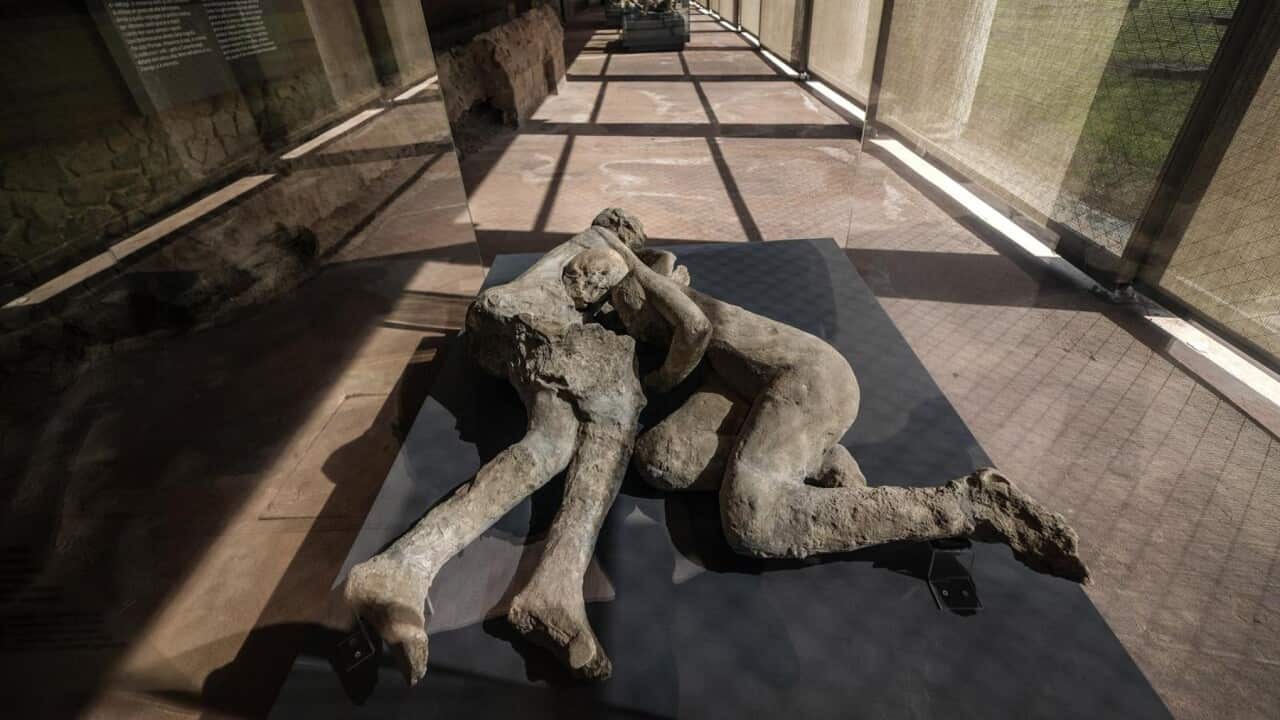

A new permanent exhibition on the ancient Roman city of Pompeii has showcased an arresting image of the moment when a catastrophic volcano eruption destroyed the city in 79 AD. Over 20 casts of bodies of residents in the city will be displayed at the exhibition, along with other findings such as plants and food that remained buried for centuries under metres of ash and lava.
Listen to Australian and world news and follow trending topics with SBS News Podcasts.
TRANSCRIPT
For many fans of the ancient Roman Empire, the city of Pompeii has been a mirror where they learned about daily life two millennia ago.
In 79 AD, a catastrophic volcanic eruption from Mount Vesuvius buried the city of over 20,000 people with ash and lava.
For years, archaeologists have recovered parts of the ancient city and bodies of residents who failed to escape the tragic moment.
Now, for the first time, a new permanent exhibition at the Archaeological Park of Pompeii will display over 20 casts of bodies that have been uncovered during archaeological research.
Gabriel Zuchtriegel is the Director of the archaeological park.
“Well, what we're trying to do is to expose for the first time permanently what makes Pompeii so special. And it's ultimately the tragedy of destruction and of many human lives that were lost.”
Mr Zuchtriegel says the displays are more than an exhibits at a museum.
“What we try to do is to find a way almost halfway between a memorial, a place of memory, and a traditional museum site where we have models and drawings and things that really help children, families, everyone to understand what has happened. I think...what we could think about is to expand this to other places in Pompeii and around the site.”
Pompeii is the only site in the world that allows the recovery of this type of evidence, enabling visitors to use see the objects that were destroyed and the people who lived and died at that moment.
“ So it's been very difficult, a huge challenge in terms of museography, how to give dignity to these people who are like us, women, children, men who died during the eruption, but at the same time make it understandable, inclusive, and somehow joyful to understand what really happened in Pompeii.”
But how did the team preserve so many details? They have adopted a technique invented in 1863, which allowed the team to faithfully preserve the position, expression of pain and clothing of the victims, making them unique testimonies.
Silvia Martina Bertesago is the Archaeologist at the Park.
“We still use the same technique in our excavations today. When we encounter a void in the layer being excavated, we check whether it could have been created by an organic remains and collect some liquid plaster, which is then used to fill the void in this extremely hard layer. Even today, it is still possible to obtain casts of victims or even of all the perishable material, such as furnishings, wooden doors, fabrics and so on.”
When the volcano erupted, many residents of Pompeii were trapped in their homes or shelters. Some were killed by the volcanic rocks, or by the collapse of roofs and walls.
For Ms Bertesago, what touches her most is the people's last reaction to death.
“There is the cast of the child (found in) the House of the Golden Bracelet, for example, and there are the casts, the first cast on display, of two figures that seem almost to be embracing, as if they had fallen at the same time, and another cast of an adult holding a child in his arms. In short, various moments of that tragic instant that caught everyone so suddenly and unprepared.”