

Global oil prices have surged and sunk as the US-Israeli war on Iran chokes major supply chains of oil and gas. With deep uncertainty and mixed messaging over the US timeframe for the war, world leaders are scrambling to ensure they're prepared for ongoing pressures.
Listen to Australian and world news and follow trending topics with SBS News Podcasts.
TRANSCRIPT
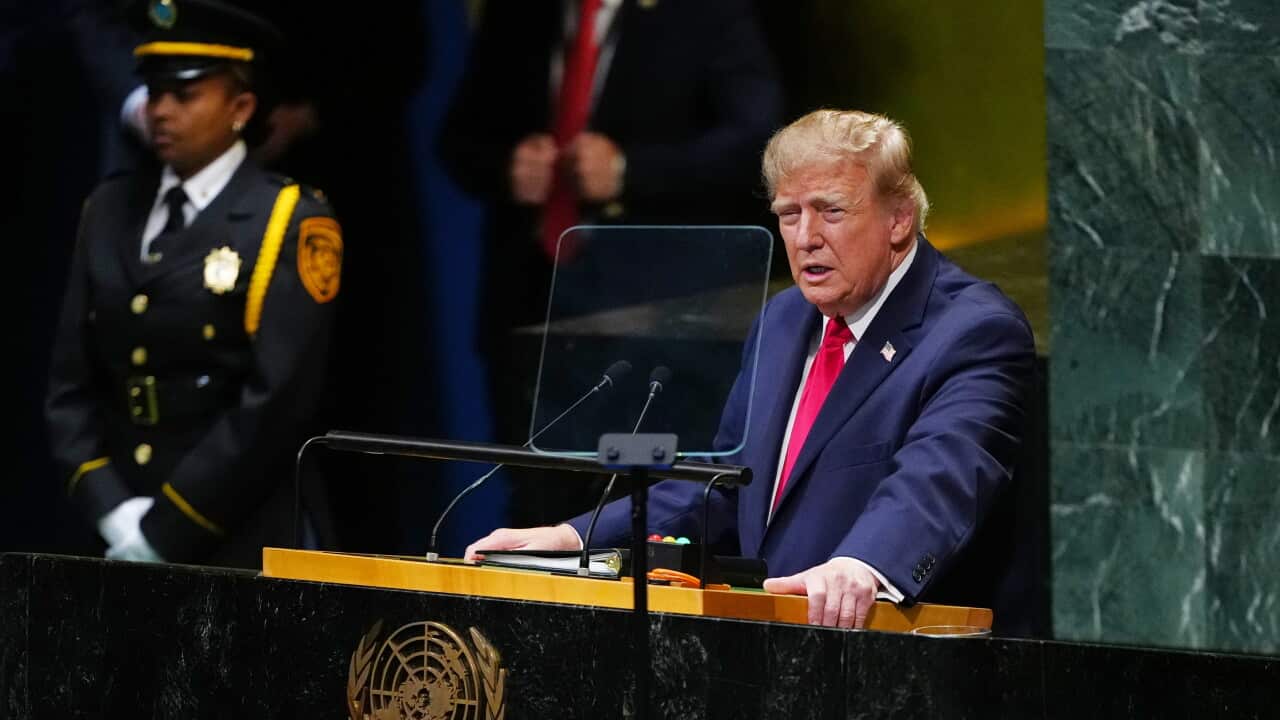
Upending oil production and shipping in the Middle East, the uncertainty of the US-Israeli war on Iran has sent shockwaves through the global economy.Surging to almost $120 per barrel on Monday, the price of oil dropped swiftly again on Tuesday morning as United States President Donald Trump suggested the war could soon be over.
“So with your help and hard work, we're making America great again, and we're doing it much faster than we thought. And it's, better, stronger. And our country is, doing really well. I mean, at a level that nobody thought. We took a little excursion because we felt we had to do that to get rid of some evil. And I think you'll see it's going to be a short term excursion.”
Entering its second week, the war has seen Israel, the United States and Iran all hit oil and gas facilities in the region.
Anxieties over the attacks have all but stopped traffic in the Strait of Hormuz, through which a fifth of the world's oil passes every day.
Head of Energy Research at MST Marquee Saul Kavonic says the current situation could have drawn-out consequences.
“It portends one of the biggest disruptions to oil and gas markets that has been saying potentially even larger in scope than the Ukraine war in 2022, when Russia turned off its gas to Europe. And we haven't seen any spikes really of this magnitude until going back as far as the 1970s. Even then, if you look at the scope of the passage and the importance of the passage of the Strait of Hormuz, a continued disruption to flows here would pertain to three times the impact to oil and gas markets that we saw during the oil shocks in the 1970s.”
In response to the soaring prices, some countries have resorted to austerity measures to cut their energy use.
In Pakistan, the government has announced that schools will close for two weeks and that around half of office workers in non-essential services will work from home.
In Bangladesh, which imports 95 per cent of its oil and gas needs, the government has launched fuel rationing measures.
Al Magruf bin Ataur is a student at Dhaka University, which has been closed as part of the government's efforts.
“Due to the fuel crisis, our university buses are also being shut down from today. Today will be the last day that the buses will be running for the universities. After today, I do not think that the buses will be running due to the fuel crisis that is going on in our country. So I do think that all of these factors are contributing to the fact that our universities are closing from today.”
In Vietnam, the government has announced it will be scrapping tariffs on fuel imports, bringing the levy from 10 per cent down to zero until the end of April.
Meanwhile, officials in the Philippines are warning against fuel hoarding as queues grow outside petrol stations.
65-year-old Ric Perez drives one of the Philippines ubiquitous modes of public transport, the jeepney, which is powered by diesel.
With diesel prices expected to surge in the coming days, he says people are desperate to stock up.
"Right now we're having trouble filling up on fuel because the prices are rising and there are a lot of people fuelling up. We've been hearing that prices would increase tomorrow so we're having difficulties. I even brought my own container so I can squeeze in and get some more fuel, since there's a lot of queue and I can't bring my jeep there.”
With cheap oil in high demand as supply from the Middle East tightens, European sanctions on Russian oil are back in the spotlight.
After the United States announced a temporary waiver allowing stranded Russian oil to enter the market last week, Donald Trump says several oil-related sanctions would also be lifted.
“We are also waiving certain oil-related sanctions to reduce prices. So we have sanctions on some countries, we are going to take those sanctions off till this straightens out. Then who knows, maybe we won't have to put them on there will be so much peace.”
The renewed energy pressures came as the European Union was trying to pass a new sanctions package tightening restrictions on Russia's shadow fleet, but the proposal was stalled after Hungary vetoed the plan.
With oil prices soaring to levels unseen since the 2022 Russian invasion of Ukraine, Russian President Vladimir Putin says European leaders are welcome to negotiate.
"Russia is, I repeat, a reliable supplier of energy. It has always been so. We will, of course, continue to supply oil and gas to those countries that themselves are reliable counterparties. I mean not only our partners in the Asia‑Pacific region, but also states in Eastern Europe such as Slovakia and Hungary. Even now, some colleagues informed me before this broader meeting, we are increasing supplies to our reliable partners.”
Hungarian Prime Minister Viktor Orbán, considered one of Russia's closest allies in Europe, has urged the European Union to lift sanctions on Russian fossil fuels.
But, European Economic Commissioner Valdis Dombrovskis says the E-U is not facing supply shortages just yet.
“It's important that we do not now ease the pressure on Russia and do not help Russia to fill its war chest using this situation of elevated oil and gas prices right now. So that's why it's important that we stay the course with our sanctions implementing the G7 a price cap moving towards a maritime services ban.”
Representatives from the Group of 7 nations also met to discuss oil price concerns, saying they are prepared to implement whatever measures are necessary.
While the meeting ended without an agreement to release strategic crude reserves, French Finance Minister Roland Lescure says it has been considered.
“I want to be very clear on the fact that we are ready to take necessary and coordinated steps in order to stabilise markets such as strategic stockpiling.”
In Australia, Energy Minister Chris Bowen has reiterated his plea to Australians not to panic-buy fuel and says Australia has 32 days of reserve petrol.
Oil companies have been accused of hiking up the price of fuel as the average price of unleaded petrol soared past $2 a litre in Sydney, Melbourne and Brisbane on Monday.
Mr Bowen says while petrol stations are seeing increased demand, supply levels are not down.
“We are seeing a big increase in demand, particularly for diese l, and I understand why Australians are concerned. But my key message is that every single expected arrival of diesel supply in recent days and expected in coming days and weeks has arrived on schedule as expected.”