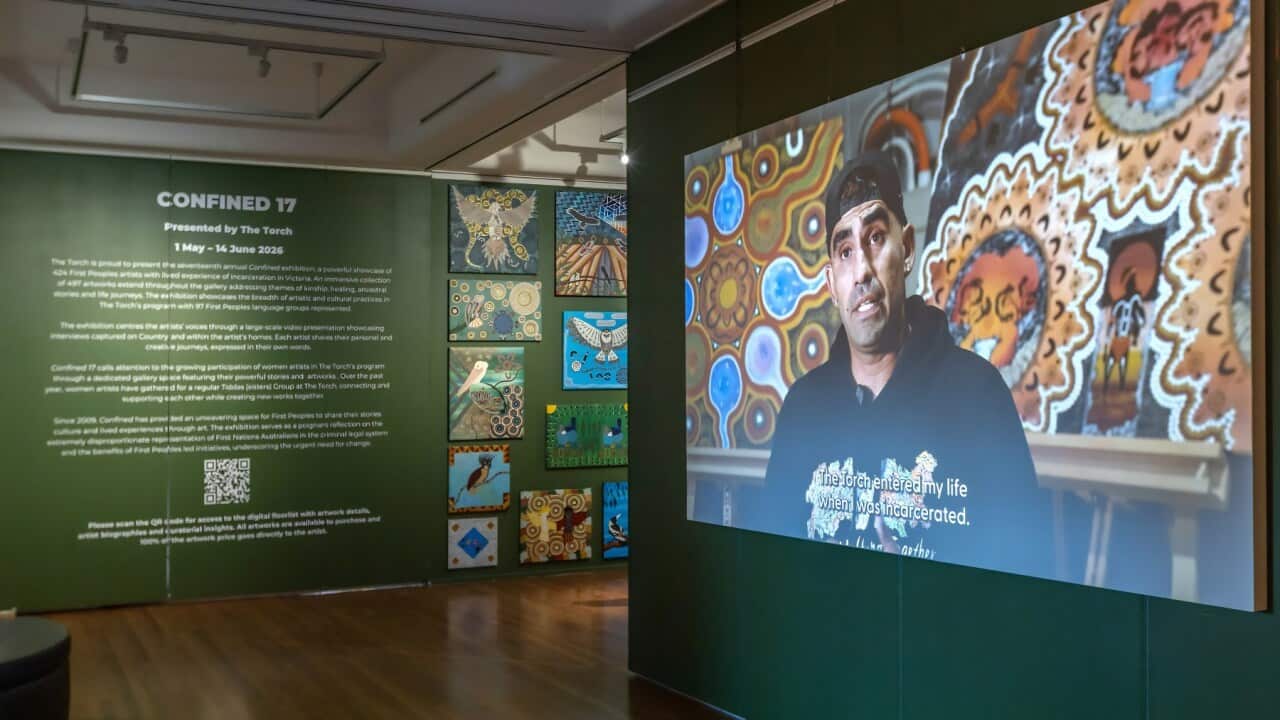

First Nations Australians who have lived experience of incarceration in Victoria are showcasing their work through an art exhibition. The exhibition, highlighting the artists' voices, has proved the ripple effect - where one event can cause a series of bigger effects - for some to take a new path beyond prison.
Listen to Australian and world news and follow trending topics with SBS News Podcasts.
TRANSCRIPT
“The Torch is our 15 year old organisation that works with First People who are incarcerated all across Victoria, so we work across the 17 prisons and we support artist in prison to connect to culture. And find a new pathway beyond their prison system. We're working against the systemic oppression of incarceration and the hyper incarceration of mob in this country.”
That's Susannah Day, the CEO of The Torch.
The Torch is a non profit First Peoples-led arts organisation that provides art, cultural, and arts industry support to First Peoples with lived experience of incarceration in Victoria.
The organisation employs Indigenous Arts Officers to deliver their statewide Indigenous Arts In Prisons and Community program to Indigenous men and women in Victorian prisons.
They also support participants who are transitioning back into the community.
Since 2009, their major annual exhibition has featured inspiring artworks by Indigenous people with lived experience of incarceration.
The theme this year is Confined 17, showcasing the work of 424 First Nations artists contributing an immersive collection of close to 500 artworks extend throughout the Glen Eira City Council gallery in Naarm.
The stories highlight themes of kinship, healing, ancestral stories and life journeys.
Ms Day says they try to give these artists economic justice, as they work against systemic oppression.
This allows for them to get 100 per cent of their income to hopefully start a new life and gain self confidence to take a new path beyond prison.
“Over 50 per cent Aboriginal staff and we know what we're doing works so we know the reincarceration rates of artists connected to The Torch is about 20 per cent compared to the national average which is 55 to 65 per cent. So we know that if you actually put change in the hands of the Aboriginal people and get them to design a programme, this is the results that you get. Something that is vibrant, that unifies our community, where allies and mob come out to buy people's work, and our artists are so so proud. And they have dignity, and they are better mums and they are better dads and they are better grandparents and better kids for it and we are really really proud of what we have created.”
Tegan, who's a Palawa woman, grew up on country and moved to Naarm when she was 13.
She references prison while talking about her artwork.
“My artwork I wanted to do water colour but in jail there was no watercolour. So I improvised with food dye, so it looks watercolour, but it's not. It's food dye. Cause I have done 13 months of my sentence and I was up for parole and I wanted more structure so I decided to accept drug court so instead of taking parole, I gave myself longer time and I took a drug court order, and it was about my struggle in my brain about whether I was doing the right thing, or whether I was going to fail at it and I'm currently succeeding so it's all good.”
Barkinji man former chief executive Kent Morris is the Program Founder and Creative Director at The Torch.
He's been there for 15 years.
“When I started back in the day it was me going out and about. We have 27 staff now and a whole team of First People's art mentors. Many who have come through the program who are delivering that program, and I get to kind of culturally oversee and provide all my knowledge and experience, as we do. As we gain to learn all that knowledge and experience. And that knowledge was handed down to me by our elders about how to get myself right and and through my culture and what that might do.”
Mr Morris stresses the importance of working together to achieve change.
“It's really critically important and it's our ten year anniversary of the Aboriginal arts policy that we change in Victoria after 40 years of advocacy of mob, and we're able to change it because of this program, but also because we're able to get bipartisan support in the parliament so we have to work together. Mob and non mob we got to do it together, not going to be able to do it separately, and we have to unite and connect each other. We've got enough of this divisiveness going on so I think everybody wants the solutions if it wants to see those gaps close particularly around incarceration.”
He stresses more needs to be done by the government.
Nationally, the age-standardised adult imprisonment rate for First Nations adults in 2022 was around 2,200.
According to the Australian Institute of Health and Welfare, that's over 14 times as high as the non-Indigenous ASAIR.
The National Agreement to Close the Gap target is to reduce the rate of Aboriginal and Torres Strait Islander adults held in incarceration by at least 15 per cent* by 2031.
Tupun Wultantinyeri, is an artist who was born in South Australia and raised in the Riverland till the age of 14.
He talks about where he was mentally in November last year when his painting came to fruition.
“I was in such a slump. I wasn't painting or I wasn't travelling too well mentally. And so I did a few small ones just to get ourselves moving, and then I got - there were two or three colours throughout then I got the motivation to jump on to this, which is a monster - 118 by 200 cm. incredibly knocked over in five days which is ridiculous”
He adds that it was inspired from within.
“Such a big canvas and I'm in a small apartment. So it was really rolling, I mean I tried to do like the old aunties will sit on the ground and paint and it lasted about 20 minutes. And then I had to set up on a table and unroll third by third. And to be honest, I got there half way through - like I've really been moving along and I got half way through and the story sort of emerged from it, which is just around longing for healing. And that's really what I was the entire process. And as you can see, you can really feel the vibrations in it and whatnot. There's a lot of movement in it, and I'd like to think that was coming from within, that's absolutely connected to it.”
The Confined 17 exhibition is open for the public at Glen Eira City Council Gallery in Caulfield, Naarm till Sunday, June 14.