
In 2016, the UK voted to leave the European Union, after a campaign led by Nigel Farage, Boris Johnson and Michael Gove. Though the margin was narrow, the vote has led to the most dramatic shake-up of the U.K. economy and society since World War II. Ten years on, the regret of Brexit has become more apparent - and the impacts of the vote are still unfolding in the UK, issues that a new UK Prime Minister will be expected to confront.
Listen to Australian and world news, and follow trending topics with SBS News Podcasts.
TRANSCRIPT:
These are the chimes of the Big Ben clock in London.
They rang out at 11pm on the 31st of January 2020, signifying that the United Kingdom had ceased to be a part of the European Union, the 27-nation free trade bloc with its market of 450 million people.
The UK had chosen this path four years earlier in a vote that came to be known as Brexit, the result hailed by main leave campaigner Nigel Farage from UKIP, the UK Independence Party.
"Let June 23rd go down in our history as our independence day."
Ten years on from the Brexit vote, and it's being seen as a move that has led to one of the most dramatic shake-ups of the U.K. economy and society since World War II.
The few gains from Brexit have been bespoke trade deals to regulatory independence over financial services and artificial intelligence.
John Reid and Sons managing director Simon Boyd was one of the backers of the leave campaign.
"No, it's not delivered everything that was said it would deliver on the tin, okay. But it is delivering."
Others - like tourist from Wales, Phil Wells, don't feel as positive.
"We were actually on holiday on Rhodes that day when we heard the devastating news that we were out. I just couldn’t believe that any country could be stupid or narrow-minded but we excelled at that, actually."
Much of the impact has been felt in the economy.
Curry restaurant owners - as an industry - backed the campaign to leave the E-U after assurances it would lead to more visas for South Asian cooks.
But celebrity chef and president of the Bangladesh Caterers Association UK, Oli Khan, has pointed to a significant number of restaurant closures - and he says they feel betrayed.
"Since the Brexit until now, we've lost nearly between 2,000 to 2,500 curry houses from the United Kingdom. So that is the result of the Brexit."
Others have noted it's more difficult to move around Europe as a traveller or potential migrant.
For those conducting business, there have been complaints that when Britain finally left the bloc, new rules governing trade in goods and services made it more expensive and time-consuming to do business with EU partners.
Kings College economics and policy professor, Jonathon Portes, says that's part of the reason why Brexit has had a significantly negative impact on the overall UK economy.
"The UK economy is clearly weaker and smaller than it would have been in the absence of Brexit. There's a lot of debate about how big that impact is, but it is certainly several percent of GDP, several percent of our national output. So we're, broadly speaking, several percent poorer as a result of Brexit."
Migration to the UK has also been a key focus.
A decade ago, backers like Farage had promised that once Britain was freed from the edicts of EU bureaucrats, the UK would regain control of its laws and its borders and the economy would boom.
"We want our borders back, we want our passports back, we want our country back."
Jonathon Portes says it has ended up having the opposite effect, with successive governments unable to stem the flow of irregular migrants who wash up on the English Channel coast in leaky inflatable boats.
"We took back control of immigration policy, we ended free movement. Those were the promises of the Brexit campaign. However, because of structural economic issues with the UK economy, because of labour shortages, because of the after-impact of the pandemic and the Ukraine war, we ended up with higher immigration than before Brexit, not lower immigration."
Another legacy of Brexit has been political turmoil.
There have been six prime ministers in the decade since the vote, and leave campaigner and former UKIP leader Nigel Farage has emerged as a force to be reckoned with in national politics, at the helm of the anti-immigration Reform UK party.
The economic woes and migration pressures have also fuelled an increasing sense of discontent with Brexit.
Opinion polls regularly show that a clear majority of the population think the departure was a mistake.
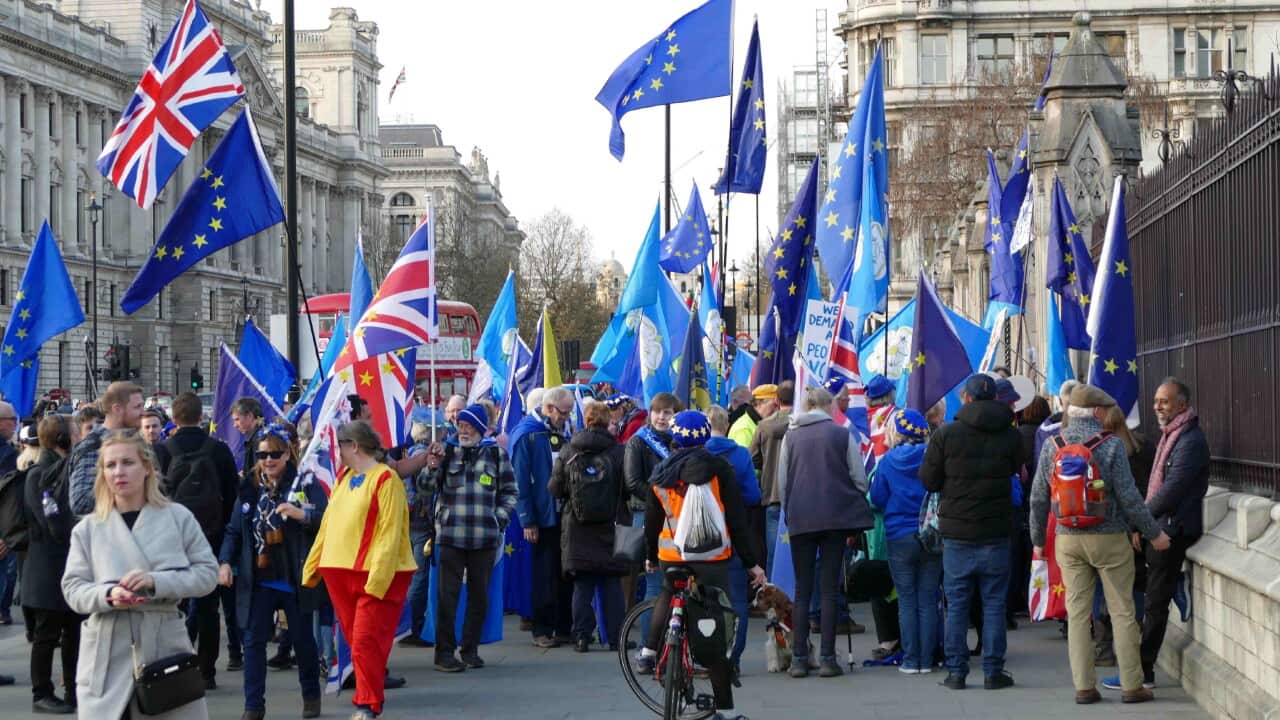
Londoner Jane Jarvis is part of a group who holds regular protests, demanding the UK rejoin the EU.
Yet fewer than 2000 people joined the latest march in central London last weekend, and she says people have lost confidence that things can be different.
"I think it is a lack of hope. Let's put it that way - why there’s a lower turnout. When we had the people’s vote marches in 2019, we got a massive turnout. But I think people then hoped that something would happen. Now, they haven't got that hope."
Negotiations have however been quietly underway for a reset of the European Union.
Efforts to improve ties between Britain and Brussels began under former prime minister Rishi Sunak in 2022 and were stepped up again once the more pro-EU Labour government of Keir Starmer was elected in 2024, helping to rebuild trust.
But the same tensions that existed throughout Britain's membership exist today.
Even pro-EU British officials see it as an inflexible, legalistic bureaucracy, while their EU counterparts will not forget the sight of Farage haranguing and insulting EU politicians during his 20 years as a Member of the European Parliament in Brussels.
Charles Grant from the Centre for European Reform says the political turmoil is complicating those discussions.
"They look at the UK and they see Nigel Farage doing very well in the opinion polls. And they worry that if they give concessions to the British and negotiate a special deal with the British in the next months or years, then Farage comes in as prime minister and undoes it all, tears it up, which he said he'll do. So that limits the ambition for the EU, for the reset, I think."
There is also still support in some quarters for the UK to stay out of Europe.
Matthew Elliott was the chief executive of the official Vote Leave campaign group.
"I would say in a world which is rapidly changing, it's useful actually to have your independence. So you actually have the right deals for your country and do the right alliances at any one time."
Into this picture enters Andy Burnham, the former Greater Manchester Mayor who is poised to take over from Keir Starmer as Prime Minister after winning a by-election in convincing fashion against the Nigel Farage backed candidate.
The task that Starmer had begun with the EU about rebuilding closer relations now falls to him.
So too does the task of confronting voter concerns about migration, both for those who feel immigrants and asylum seekers should be kept away, and those like Amber Wilson from Hertfordshire who feel it's caused unnecessary grief.
"I think with immigration it's started a lot of animosity. I feel like racism has gotten worse. It has divided people a lot more than it was intended to I think. I feel like it has given people an excuse to air opinions that are just not kind."
British pollster John Curtice says Andy Burnham is seen as someone who can successfully challenge far right parties like the Nigel Farage Reform UK outfit - and the even harder line Restore Britain party, which wants mass deportations.
Curtice says Burnham had a strong showing in Makerfield against the Reform candidate.
“Mr Burnham has provided as much evidence as any Labour MP could expect from a by-election as to his potential ability to take the challenge to Reform and to fight an electoral strategy and frame an appeal that enables Labour to be competitive with Reform. And that, above all, is what many a Labour MP is seeking."