
Rescue and recovery efforts continue in Nepal, where one teacher is being praised for a snap decision that saved hundreds of students' lives. As the death toll and list of missing people in the flood devastated region grows, the search for survivors becomes increasingly desperate.
Listen to Australian and world news and follow trending topics with SBS News Podcasts.
TRANSCRIPT
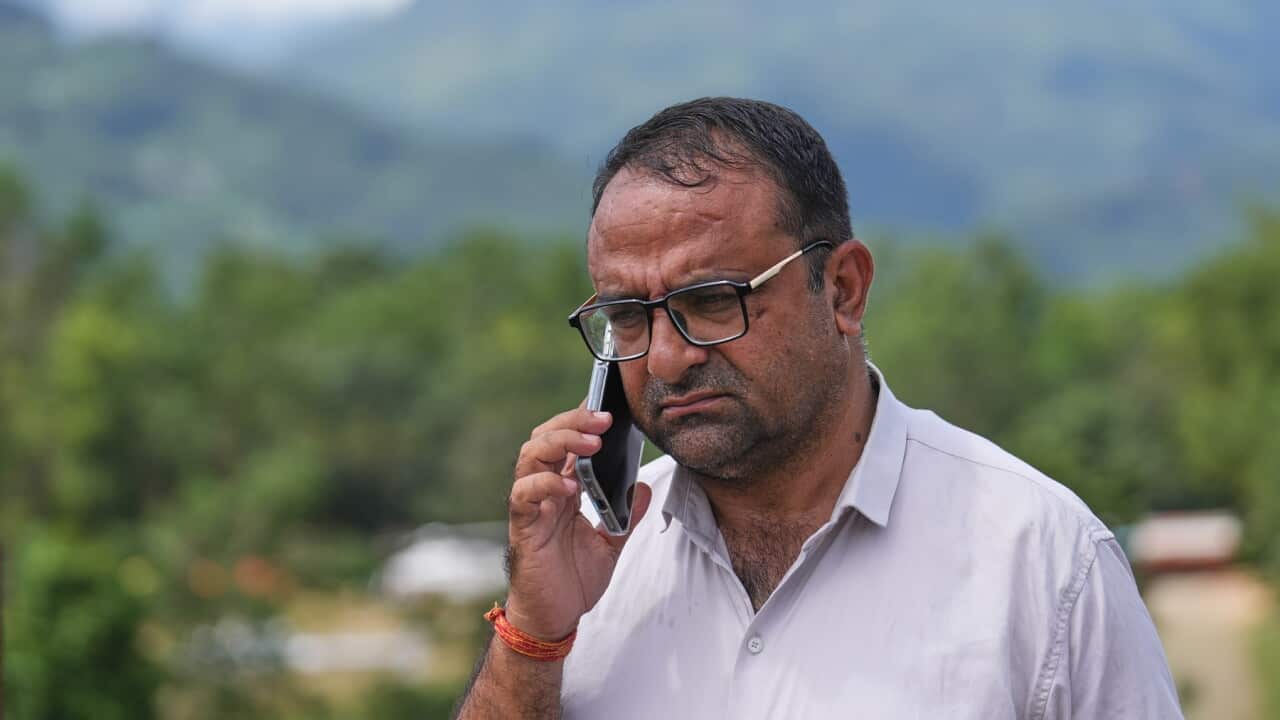
Rajendra Dawadi, the head teacher of Tribhuvan Trishuli Secondary School in Nepal, was inside the classroom when he got the warning.
“That day, as a normal day, then when I was at that time, I was inside my classroom. One of my colleagues, one accountant came there and he said that the flood is coming, the flood coming, all areas washed away.”
With 900 students already on campus that day, he was forced to act fast.
“Then I decided that if I stop the children, teaching there, then if the information was wrong then one day education will be lost. If the information will be right, then the whole life will be lost.”
Without hesitation, he rang the school bell, immediately evacuating classes and making calls to the incoming bus drivers - urging them to turn back now.
“And I telephoned some bus drivers also to stop their bus on the... where they were, in the safe places. To remove the bus in the same places. On that time, one bus came inside the school with full loaded students. Then I told the driver, you return back very immediately if some people are on the way.”
As some 900 students and staff made their way to higher ground that day, the floodwaters rose behind them - engulfing the school that Rajendra himself had once been a student.
“When I reached the top and then I turned back, then I found that the school is washed away. Then I sat here. I have no words. Because it's the emotional attachment with this school, because I learned at this school, I get education from that school, and I give education to that school, and I being the head teacher of that school.”
Rajendra Dawadi's story has emerged as an example of foresight and courage amid the devastation of the flooding in Nepal, but the destruction of his school was not an isolated loss.
Across northern Nepal, Save the Children says at least 69 schools were destroyed and nearly 19,000 students have been left without classrooms to learn in.
Reluctant to accept the title of hero, Mr Dawadi says he is hopeful the government prioritises rebuilding the schools.
“I request to the Nepali government, to the people of Nepal, to the people of the world that we are from the side of education sector and we are one of the educationists, and our motto is to educate the people, so establish the school.”
As rescue efforts continue, the latest confirmed death toll from the flooding has reached almost 940 people, with nearly 4,500 still missing.
As well as deploying 18 response personnel to the region, the Australian Government is providing $8 million in humanitarian support for Nepal, including supplies transported by the ADF.
Among those missing are 43 Australians, with the first death of an Australian man confirmed by his partner.
Michael Keats from the New South Wales South Coast was hiking in the region when the disaster struck.
His partner, Emily, says she's still grappling with the news.
“I'm just scrambling, trying to get passports updated and visa applications, and looking at flights and whatnot, in and amongst trying to just navigate grief and messages from hundreds of people around the world, and journalists and media, and just yeah, honestly, it's been the craziest time of my life.”
Meanwhile, rescuers are still racing to free hundreds of workers believed to be trapped in tunnels at hydropower sites.
A private sector association representing power companies in Nepal says at least 900 workers remain unaccounted for at 12 different hydropower projects.
With around 500 still believed trapped six days after the flooding, fears are growing that they may be running out of oxygen.
Australian tunnelling expert Professor Arnold Dix is remotely assisting with the rescue mission.
He has told Channel Nine he's hopeful more people will be found alive.
“We've got, we've still got time on our side, but of course we want to get there quickly. One of the problems when you're underground is is of course water and water building up. So we're we're busy pumping water out just in case water levels are rising in areas people are trapped. But we're we're on it. Is there a simple solution? No. Is there a textbook? Definitely not. And with each, literally with each hour, we we get new information, have to adjust ourselves, and keep trying.”
With key roads still blocked and dozens of bridges destroyed, some of the hardest hit areas remain cut off from power and support.
Nepali Foreign Affairs spokesperson Lok Bahadur Poudel says the recovery operations are more complex than people understand.
“Minister for Foreign Affairs Mr. Shisir Khanal visited some flood impacted areas to observe the ongoing ground reality of search, rescue and relief operation yesterday. He shared that the ground reality is much more complex and devastating than what we have seen and understood through different mediums. Even the word 'flood' can hardly capture the actual experience and reality during this difficult time.”
The United Nations says survivors in the devastated region are in need of emergency assistance and psychological support as they deal with the aftermath.
As mortuaries overflow with the bodies of those recovered from floodwaters, Nepali authorities are appealing for freezer units to store them.
Police Inspector Anil Thapa says they desperately need more DNA kits to identify the remains of victims.
“We found the dead bodies, those are already decomposed, they are already in the state of decomposition, so it was very difficult to put them inside the city area. That’s why we have to do this.”