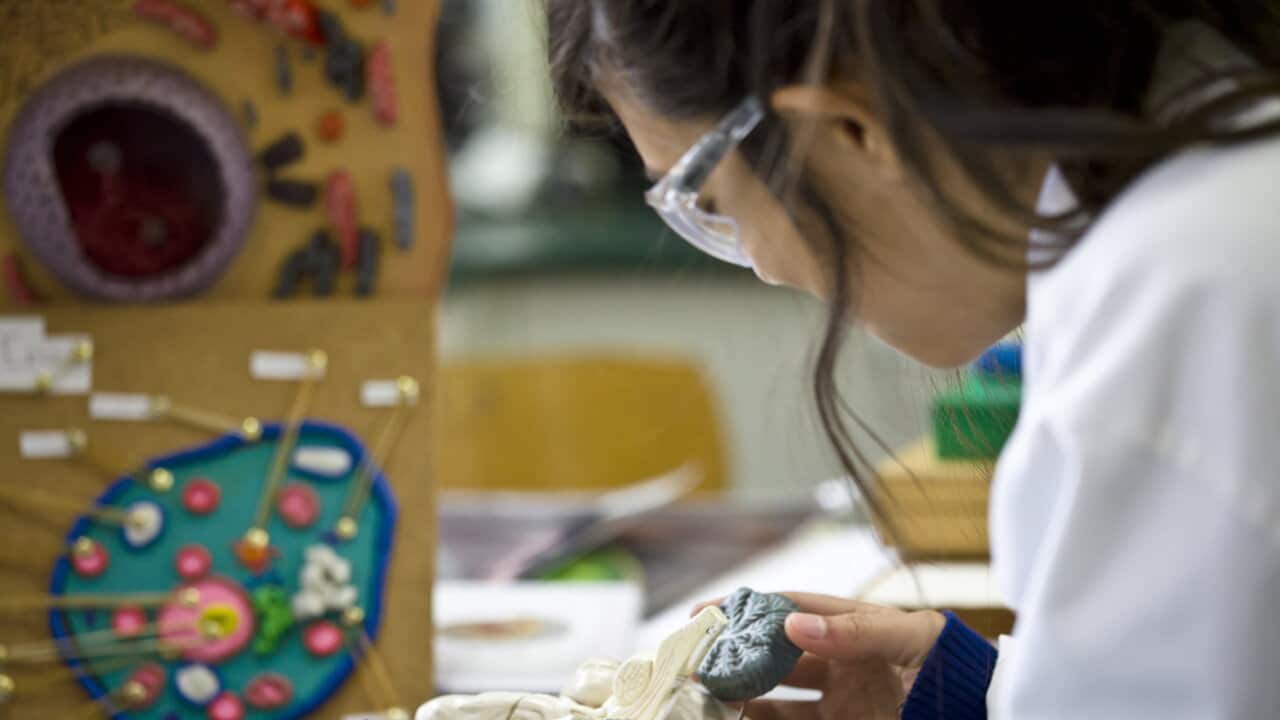

Refugee students are rebuilding new lives in Australia through a new settlement pilot program that connects their university study with industries where there are critical labour shortages like nursing. It has been achieved with the partnership of non-profits, Australian universities and businesses.
Listen to Australian and world news and follow trending topics with SBS News Podcasts.
TRANSCRIPT
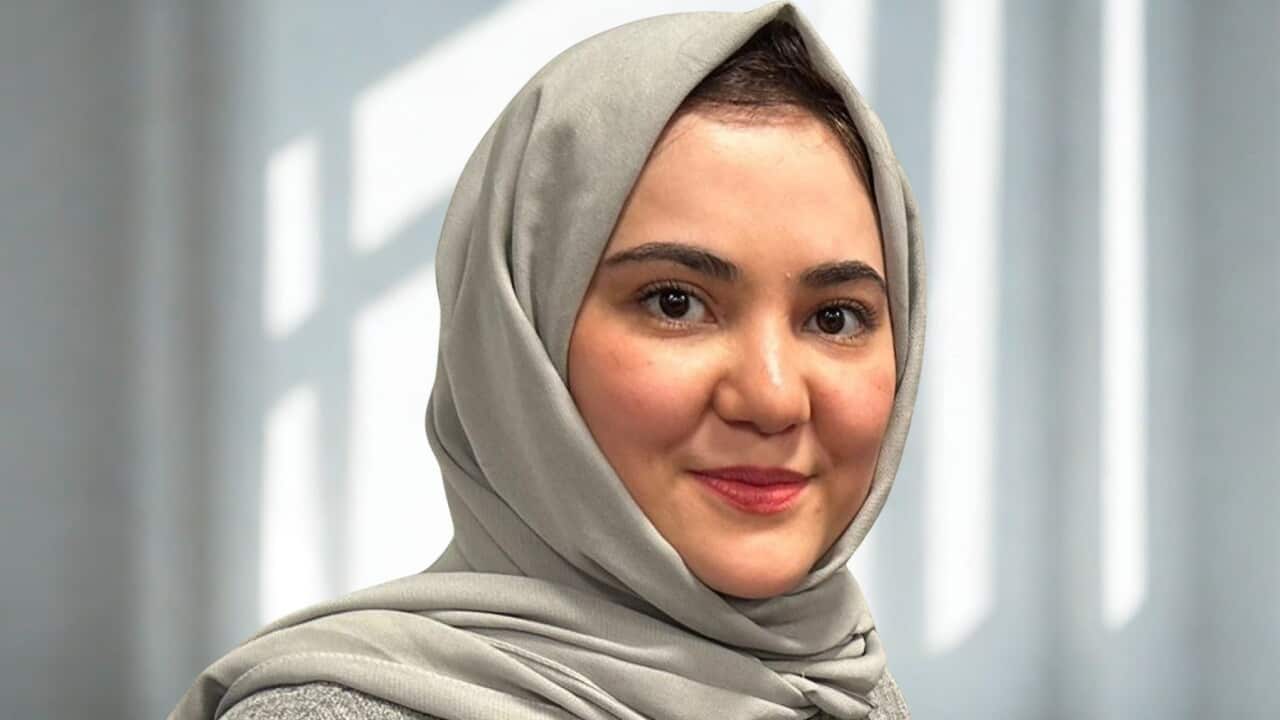
Education has been a lifelong dream for Alina Ahmed Shah.
As a member of the Hazara community in Afghanistan, schooling beyond grade six wasn't an option.
"Education in Afghanistan is not available for women and girls because in Afghanistan it's only until class six. All the decision makers, they are the male members and of course the governments being the Taliban, they don't allow the girls and women to study. In Afghanistan, the burqas, hijabs, how you wear your scarf, that's more important than the freedom and education of women. When a girl is fifteen years or sixteen years old, the family members, they prefer to ask the girl for a marriage proposal rather than focusing on her education."
But that dream continued, nurtured by her father a primary school teacher.
"He supported me. He said, "Yes, you can go. I'll support you till the end." Without my father's support, it was not possible because in, in my society, the male members, when their female members, they go to study, it's like a shame for them. They take it like an insult."
The 27-year-old's refugee journey saw her spend seven years in India, awaiting an opportunity to move forward.
India is not a signatory to the 1951 Refugee Convention and has no domestic legislation outlining the protections for refugees.
That in practice has resulted in limited work and study rights for refugees.
Alina says that experience left its mark.
"Refugees are mentally broke down. Thousands of them are suffering from depression, anxiety. They cry every night just to make themselves sleep. When they go to UNHCR premises to ask for the resettlement, they're not giving them. Malaysia, Thailand, India, these are the three top countries where Afghan national moves. But again the biggest barrier is the refugee identity we have. With refugee identity, you cannot work, you cannot study properly."
But then she received the news that she had been accepted to be part of the first group of students to take part in a new visa program to help refugees abroad come and study in Australia.
The Refugee Student Settlement Pathway pilot program connects refugee students with universities in Australia in preparation for a career in sectors with labour shortages.
Five months in - and Alina says it has been an eye-opening experience.
"Education gives you freedom. You can be financially stable on your own feed. You can earn for your family. I discussed this with my other classmates also. If I am aiming to do bachelor's or masters, the next generation of my family will also follow the footsteps. And they will, of course, go for the same path that I'm doing too. So it's like encouraging them and also like giving confidence to them."
Sally Baker, the CEO of national charity Refugee Education Australia, helped to co-design the pilot program, inspired by the 50-year success of Canada's Student Refugee Program.
"It is a beautiful initiative that allows us to kind of celebrate what happens when we work together. When we really think carefully about what welcome means and how universities, and we hope in the future, TAFEs and other registered training organisations will also get involved in offering that kind of welcome for talented young people who are displaced - by no fault of their own - and who are unable to work or study in those contexts because it's illegal for them to do so. So the Refugee Student Settlement Pathway is a really good news story."
The program exists separately to the scholarship programs offered by universities.
It involves a six-month period of transitional support with free accommodation provided by the university, a stipend, and access to study cost reimbursement funds. But from that point on the students take on loan debt or HECS - like domestic students.
Dr Baker says it is early days for the pilot program, and universities are showing growing interest.
"We've seen a significant increase in the number of universities who are excited to sign up. We had 8 pioneering universities who took a punt on us last year and some of the 19 students who arrived in January this year to start their studies in semester one. I'm sure we'll see something close to a doubling of that number as we move through the next couple of years."
Administering the pilot program is Steph Cousins, the CEO of NGO, Skill Path Australia.
She says what is being achieved here solves a number of challenges - when it comes to access to education for refugees, but also the skills shortages in key sectors Australia's economy.
"When refugees are given the opportunity to contribute, they can make an incredible impact for our country. So it's about recognising that is a potential win-win. And this visa program is really opening up a new avenue for young refugees who would otherwise not have the chance to really fulfil their potential. And at a time when Australia has massive skills shortages, in areas of demand where we don't have enough graduates, and we also just don't have enough young people moving into the workforce in these areas. I'm thinking, yeah, service economy, um, things, you know, healthcare roles, technology based roles, engineering."
She says the first group of students come from diverse backgrounds. And they are a reminder of the courage refugees demonstrate in seeking to rebuild their lives, after being forced to flee their home country to escape conflict or persecution.
"The World Cup, the Socceroos really demonstrate that, there's such diversity in that team. And you can see the success that comes when you're all band together and act as one, you know, despite people's different backgrounds. And I think that, that's what's happening with our program as well with skill path with the refugee student settlement pathway. It's a really diverse group. You've got people like Alina and Beheshta, who are now really close and working together with other refugees from Myanmar, from Yemen, from Congo. There's something really beautiful that happens when we work together. And I think especially this week, Refugee Week, like, let's actually celebrate the amazing contributions that people from all walks of life are making to our country to make it better."
This year marks 40 years since Refugee Week was first celebrated in Australia, with this year's chosen theme 'a million stories'.
It recognises the milestone of Australia having issued one million humanitarian visas since the refugee resettlement program began after World War Two in 1947.
Helping to remove one of the barriers holding refugees back, is English-language test provider, Pearson.
The multinational company has announced during Refugee Week [[15-21 June]] that it will be providing language tests and practice exams for refugees involved with Skill Path Australia and Refugee Education Australia for free, or at a discounted rate.
Alina is among the people who have already benefitted.
Pearson's Australia country head, Taha Haidermota [[Hah-dee-moh-tah]], says the decision removes a barrier preventing refugees from contributing more broadly to society.
"One of those friction points and one of those hurdles in getting people into that role is being able to demonstrate language proficiency. If we can get people into work where they are into roles that match their talents where they can contribute back to society, I mean, that's a huge boost to them, it's a huge, it's life-changing. It's a small little tweak in giving them free access to this test. The change that it can bring upon in those people's lives is exponential."
For Alina, the future is looking a lot brighter.
She says the theme of this year's Refugee Week, 'a million stories' is a reminder of the plight refugees face - and the need to provide people a chance to thrive.
"I see my future clearly. The hope is that one day I'll be that successful where I can help my community, my Australian community."
A big part of that will be taking steps towards becoming a nurse.
"I love to take care of people. In my life, I was a medical attendant once. I was surrounded by paediatric cancer patients, and so many of them told me that why you don't want to pursue this as your career, even the nurses over there. They ask me that if you pursue this as your career, you will be successful in your life. And the best part is I don't want to accept this as my career. I want to do this as a human being. I just love to take care of patients."
[[BACK ANNOUNCE]]
That story by Biwa Kwan ((Bee-wah Kwuhn)) for SBS News, produced by (in language broadcaster) for SBS (in language program)