
The Federal Government has authorised a temporary 60-day easing of sulphur standards to inject high-sulphur petrol into regional communities facing critical fuel shortages. While Energy Minister Chris Bowen maintains that national reserves are stable, critics and analysts warn that Australia’s decade-long failure to meet international stockpile obligations leaves the country vulnerable to prolonged geopolitical shocks.
Listen to Australian and world news and follow trending topics with SBS News Podcasts.
TRANSCRIPT
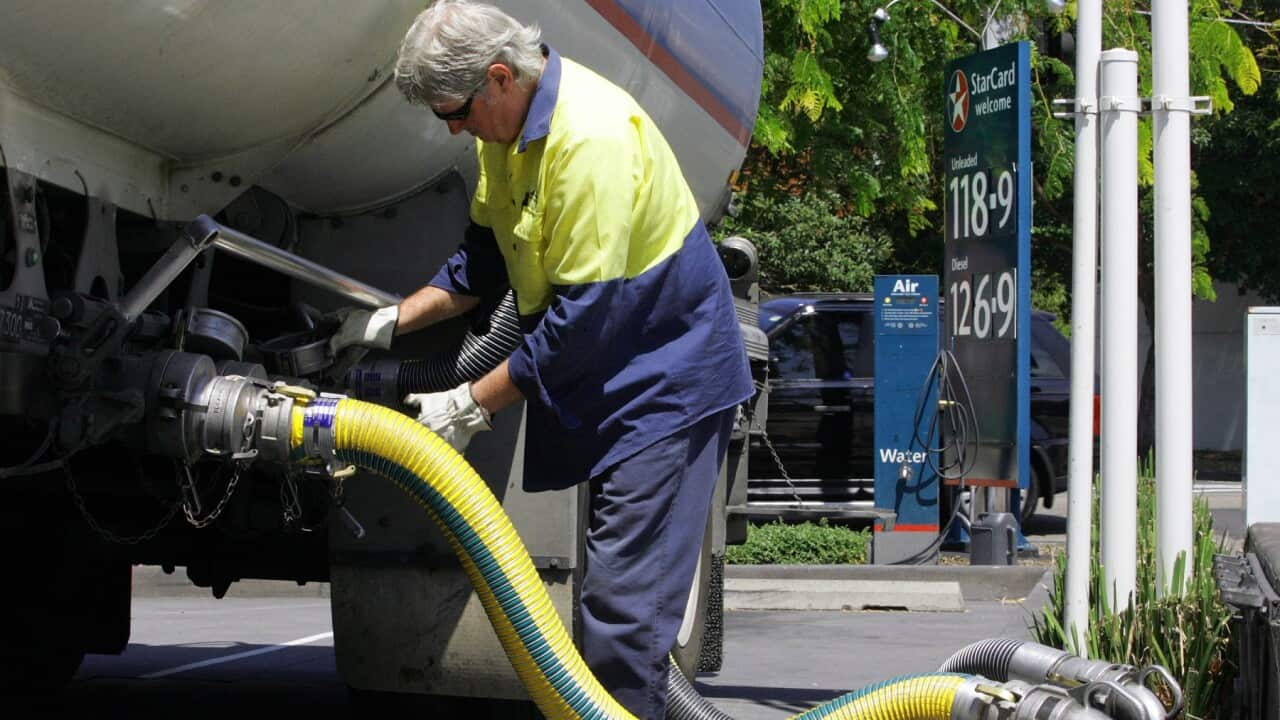
The Australian Federal government is approving a temporary, 60-day easing of fuel quality standards to allow the sale of higher-sulfur petrol to address supply shortages.
To ease the pressure on regional motorists, the government is proposing a rollout of high-sulphur fuel from Brisbane to help stabilise spiralling prices.
This type of fuel is normally exported to countries with lower fuel standards.
Environment Minister Murray Watt told Channel Seven releasing this high-sulphur petrol is necessary to deal with shortages.
"We're working around the clock to make sure we can get the supplies where they need to be right across Australia. We shouldn't lose sight of the fact Nat that we now have 37 days reserve of petrol and 30 days reserve of diesel. We recognise though that there are parts of Australia that do need to get supplies and that's why Chris Bowen and the government as a whole has put in place these measures so we'll be getting that petrol out to people as quickly as we possibly can. "
New South Wales Premier Chris Minns is throwing his support behind the decision to temporarily ease sulphur standards for fuel.
"The public would expect us to take steps if we're in a dire situation. We're not there yet. This is really about getting ready for the weeks ahead given we don't know what the geopolitical conflict situation in the Persian Gulf will be or when it will be solved or stopped or ended."
However, One Nation MP Barnaby Joyce is questioning the logistics of the rollout.
He says he fears the fuel won't actually reach the communities that need it most.
"Obviously what we have - we've got to clearly define where that fuel can be used. Can be used in certain engines and can't be used in others. Most - Most people know that. High sulphur content engine type. What we have is when the Labor party continues to say the oil refineries closed down. Yeah they did, it was really stupid but it was under a safeguard mechanism which the Labor party supports."
Energy Minister Chris Bowen is reassuring the country that fuel supplies are stable, with 37 days of reserves in the tank and shipments arriving on time.
In addition, up to 762 million litres of petrol and diesel will be released from domestic reserves.
That's despite filling stations in some regional communities running dry.
Shadow Defence Minister James Paterson says he doesn't think rationing is necessary yet, Australia needs to pivot toward Asian refineries to shore up the nation's supply lines.
"Look, I don't think we're at that point yet, but the reality is that the Strait of Hormuz is not going to be reopened anytime soon and the crude oil that comes from the Middle East to Asian refineries in places like Singapore and Korea and Japan is ultimately the source of a big proportion of the petrol and diesel that we use in this country. So, unless that Strait can be reopened, unless that oil can flow, we will start to draw down on those stock holding obligations, those minimum obligations."
Energy analyst Kevin Morrison says Australia has been flouting the International Energy Agency’s 90-day oil stockpile rule for over a decade.
He says Australia's reliance on imported oil has increased due to the closure of refineries in the 2010's, which left only two operational.
The IEA's recent release of 400 million barrels equates to about four days of global supply, which is insufficient for a prolonged crisis.
Mr Morrison is emphasising the need for diversifying transportation fuels, particularly to electric vehicles, to reduce dependence on oil imports.
"We've kept our stockpile to a minimum and so we've got this double problem of dependence on oil imports at the time when we really have inadequate stockpiles and so this is why Australia could be one of the most vulnerable in this current energy crisis."
As the first shipments of high-sulphur fuel begin to move from Brisbane, the crisis has reignited a fierce debate over Australia’s long-term energy security and its reliance on a volatile global supply chain.