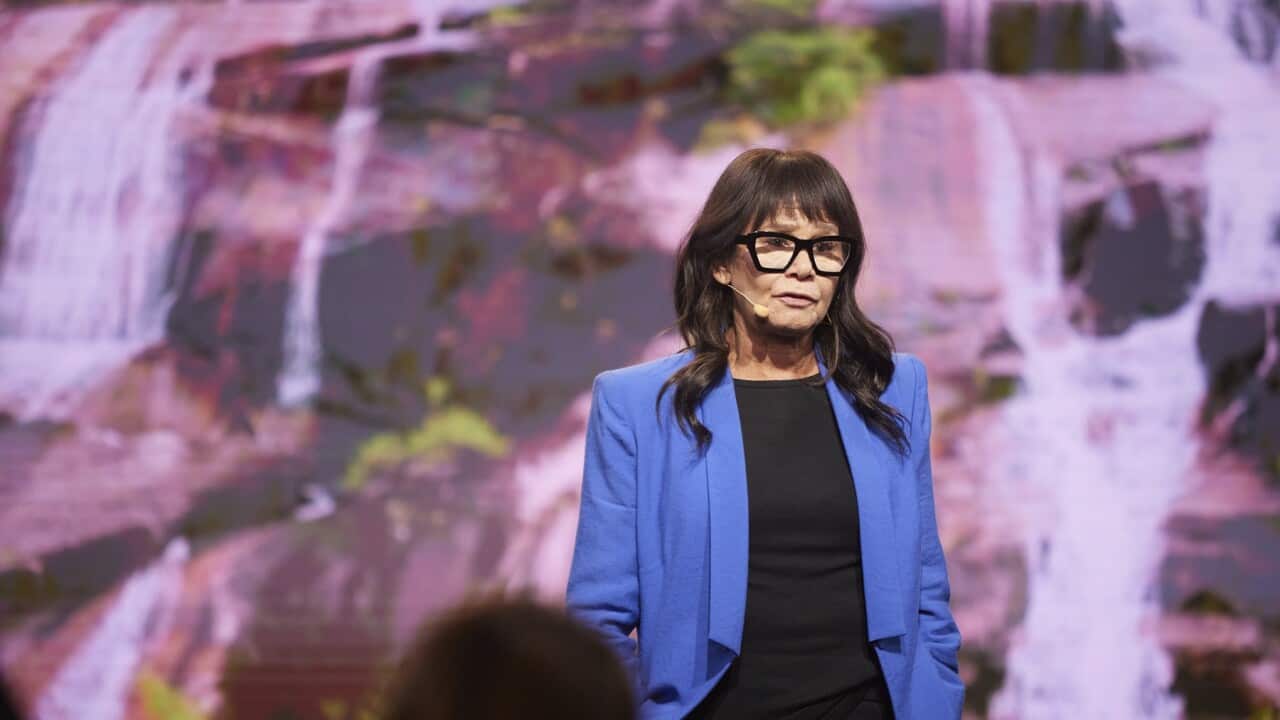

Tributes are being made to SBS Elder-in-residence and Widjabul Wia-bal woman, Auntie Rhoda Roberts, who has died at the age of 66. Her short battle with a very rare type of ovarian cancer ended on Saturday afternoon on her country surrounded by family. The decorated writer, actor and director was awarded an Order of Australia in 2016 for her service to performing arts and immense impact on and off the stage and screen. Rhoda Robert’s family has granted permission for SBS to broadcast images and audio, to honour and celebrate her life and enduring legacy.
Aboriginal and Torres Strait Islander listeners are advised the following story includes the voice of a deceased person.
Listen to Australian and world news and follow trending topics with SBS News Podcasts.
TRANSCRIPT
Long before she earned the honour of the title, "Auntie" - Rhoda Roberts knew she would have to forge her own path.
"50 years ago, at 16. I was asked about my dream. I said I wanted to be a writer, a journalist. And I was told I was a dreamer."
And her family feared racism would make her dreams impossible.
They didn't know it then, but nothing would be impossible for Rhoda Roberts.
One day, their daughter would be thanked by the Prime Minister of Australia.
And in late 2025, Anthony Albanese, would not be the first Australian leader to acknowledge her.
"Rhoda, thank you so much. For everything you have created, inspired and shared. We honour your extraordinary career and the pathway you've carved for all who follow you."
But long before that, she trained as a nurse in the 70s, working in London in the early 1980s, before returning to Sydney to study performing arts.
Acting roles in TV shows and plays soon followed.
"I saw you playing footy this afternoon."
"You were being told lies"
"Let me tell you, we're on for a bit of a ride."
Those years propelled her into a career as a producer, director and actor of screen and stage - and one dream, became another.
Before she became Australia's first Aboriginal prime time television presenter in 1989.
"Good evening, I'm Rhoda Roberts... and I'm Michael Johnson. Welcome to First in Line.
"By the time marches reached the local member's office, Barry Steggall, it became quite obvious and all too clear, the racist attitudes and racial division that had occurred in Swan Hill over the development site."
Auntie Rhoda spoke with SBS for the broadcaster's 50th anniversary - reflecting on her first days there.
"Hearing those first radio shows that began at SBS and then walking into Milsons Point where we used to have our office and then going into that studio where so many groundbreaking shows were being put to air, was pretty astounding."
The prominent role was the first of many firsts in a life that defied expectations.
But her life was also marked by tragedy.
In 1997, her twin sister, Lois, was murdered in Lismore on the New South Wales mid-north coast - she disappeared while hitch-hiking and her killer was never identified.
Lois' mother and Rhoda have since raised her children.
Auntie Rhoda co-founded Australia’s first national Aboriginal theatre company, founded and directed the Festival of Dreaming and was Head of First Nations Programming for the Sydney Opera House for a decade.
Her talents gained global attention in her production of the Awakening, a performance choreographed for the Sydney Olympics Opening Ceremony.
Rhoda was still a dreamer - and she was sharing hers and her peoples' with the world.
A proud Widjabul Wieybal Bundjalung woman, her heritage was at the heart of everything Rhoda Roberts did - including as a director.
"I was able to employ language interpreters, and we were able to translate one of the most studied plays in the western world, Waiting for Godot, or Nundalaya Godot Gay into the Bundjalong language. And for me, that was something that had never been done."
It would be near-impossible to name every instance in which she broke new cultural ground - before and after 2016 - when she was awarded an Order of Australia.
She has been credited with starting the tradition of acknowledgement at public events and coining the term "Welcome to Country".
The ceremony takes place at the beginning of an event and is performed by the traditional custodians of the land to formally welcome people onto Country.
It came about when she was running the Aboriginal National Theatre Trust in the 1980s and they wanted to introduce the protocol from communities to the arts community.
Rhoda Roberts AO was also S-B-S' elder in residence.
In 2022, she spoke with N-I-T-V about what she described as an emerging new era for First Nations Australians.
"We are actually being heard. We have platforms now where we can voice our opinions. And I guess, you know, we wanted to report news like every other news service, of course. You know, here has to be a certain distance, there has to be the story told and the balance of the story. But I think now, more and more Australians are coming, or becoming aware that First Nations culture is a thriving culture. It is ancient, but it also fits in this world."
50 years after sharing her ambition of becoming a writer and journalist - Auntie Rhoda spent 2025 on her many pursuits, including a one-woman show, My Cousin Frank.
The play was a tribute to another remarkable member of her family - the first Aboriginal person to represent Australia at the Olympics.
Rhoda's beloved children and partner gave perhaps the most important review of a life well lived, standing in her dressing room backstage at the Sydney Opera House [[2025]].
"It means just so much, for our people and our family.
"Mum has always been, kindness, always be kind. And sometimes I've been like, 'no you've got to stand up to people. Don't let people walk all over you'. But at this stage, I see what her kindness has brought her.
"It's just a beautiful play, those aboriginal stories are amazing. I couldn't be more proud of her."
SBS Chair, Dr Nicholas Pappas AM says Rhoda Roberts led with bold, visionary leadership, conviction and a deep sense of cultural stewardship that has left an enduring mark on Australia’s creative and cultural life.
He says her contribution set a benchmark grounded in culture, integrity and purpose.
He says she strengthened the connection between First Nations cultures and contemporary multicultural Australia and will always hold a special place within SBS.
Dr Pappas says she expanded what is possible in Australian media, and her influence will continue to guide the SBS network, and the broader arts and media sector, for years to come.