
The second block of hearings for the Royal Commission on Antisemitism and Social Cohesion is underway in Sydney. Among the focus of this block of hearings, the various circumstances in the lead up to the Bondi terror attack in December last year, and what was known about the shooters and what was done with that information. The conduct of security, intelligence and law enforcement agencies will also come under scrutiny. But much of it will take place behind closed doors, to avoid prejudice to national security or the criminal proceedings arising from the attack
Listen to Australian and world news, and follow trending topics with SBS News Podcasts.
TRANSCRIPT
In opening today's fresh round of public hearings for the Royal Commission on Antisemitism and Social Cohesion, counsel assisting Richard Lancaster described the Bondi terror attack as a surprise attack.
"There is no evidence that any intelligence agency or law enforcement agency had any actual knowledge or specific information to suggest that there might be an armed attack on the Hanukkah celebration at Bondi on 14th December 2025. In that sense, it was a surprise attack."
This block of the hearings is expected to continue for three weeks, but only about two-and-a-half days will be open to the public and some of those who give evidence will do so under a pseudonym.
Commissioner Virginia Bell addressed this in her opening remarks, saying it will ensure the commission conducts its work in an efficient and procedurally fair manner.
Director-General of Security in charge of the Australian Security Intelligence Organisation, commonly known as ASIO, Mike Burgess, was the first to give evidence this morning.
He told the commission antisemitism was left unchecked.
Mr Burgess says the ongoing war between Hamas and Israel was a factor, but not the direct reason, for increasing the terrorism threat level in August 2024, from possible to probable.
"There is no doubt that the war in the Middle East invoked a range of emotions in Australia and actually those strong reactions and some of those violent aspects of that and those behaviuors including antisemitism that, in our view, that were left unchecked, were therefore normalised and gave more permission for violence through late 2023 and through 2024 to August when we raised it and that was of concern to us in that environment where violence is more permissible of course it can go through to politically motivated violence or promotion of communal violence and Jewish Australians were on the receiving end of that."
Before 2024, the threat level had been dropped to possible in 2022.
At this time, he said there was a pivot from the security service from counter-terrorism to espionage and foreign interference.
"Less intelligence coming in, less calls to the national security hotline for example, so there was a reduction in effort required, but at the same time, every rock we lifted up, we found espionage or foreign interference that need to be inquired and investigated and so resources we moved over there. Of course, again, I reiterate that at no time do I believe we had any serious inquiries that was left uninquired or uninvestigated. So yes, we were pivoting resources across because that's where the leads took us and where we were required to put effort but of course at the same time were always making sure we're not leaving serious threats uninquired or uninvestigated, that's part of our day job."
He revealed two attacks on Jewish businesses in 2025 may not be the only ones the Iranian Revolutionary Guard Cor ps played a role in.
[["We do believe there are more, we just can't quite get there in terms of our level of assessment - but not all of those cases - that Iran, the IRGC was behind those and beind those we mean they use their network of proxies and agents to do their bidding, and that is to bring harm to Jewish people wherever they are in the world."]]
Mr Burgess says the public can be assured ASIO has sufficent resources and powers to respond to antisemitic conduct and terrorist threats.
"I believe they can be assured that my agency puts its resources where it needs to and if we have a resource issue, I will ask government and government will consider that through the budget process and as we've seen recently we had an ask of government to deal with the online radicalisation problem and the government had given us and the federal police investment to provide resources to address that growing threat."
The Australian Federal Police's Assistant Commissioner of the Global Operations Command, Stephen Nutt, also gave evidence, and says after October 7, 2023, they saw an increase in violent extremism.
"What we started to see was through protests and other activity, what has been described to me as that increase in the temperature in community where we saw protest activity, which is a legitimate part of a functioning democracy, turn into violence protests, we saw an increase in antisemititic chants, we saw gatherings where praising around the attack was occurring, and we also saw an increase in the open display of prohibited hate symbols."
Questioned by counsel assisting the commissioner, Zelie Heger, he said when there were instances of vandalism directed at the Jewish community in Sydney, it raised a deeper concern.
ZELIE HEGER:
"At this point in time, January 2025, was your concern just about threats of vandalism and abuse towards the Jreish community or also a concern about the physical safety of the Jewish community?"
STEPHEN NUTT:
"Well it's a combination, it's all part of potentially religiously motivated violent extremism, ideologically motivated violent extremism and also politically motivated violent extremism. There was absolutely a concern that the antisemitism could escalate to actual terrorist acts."
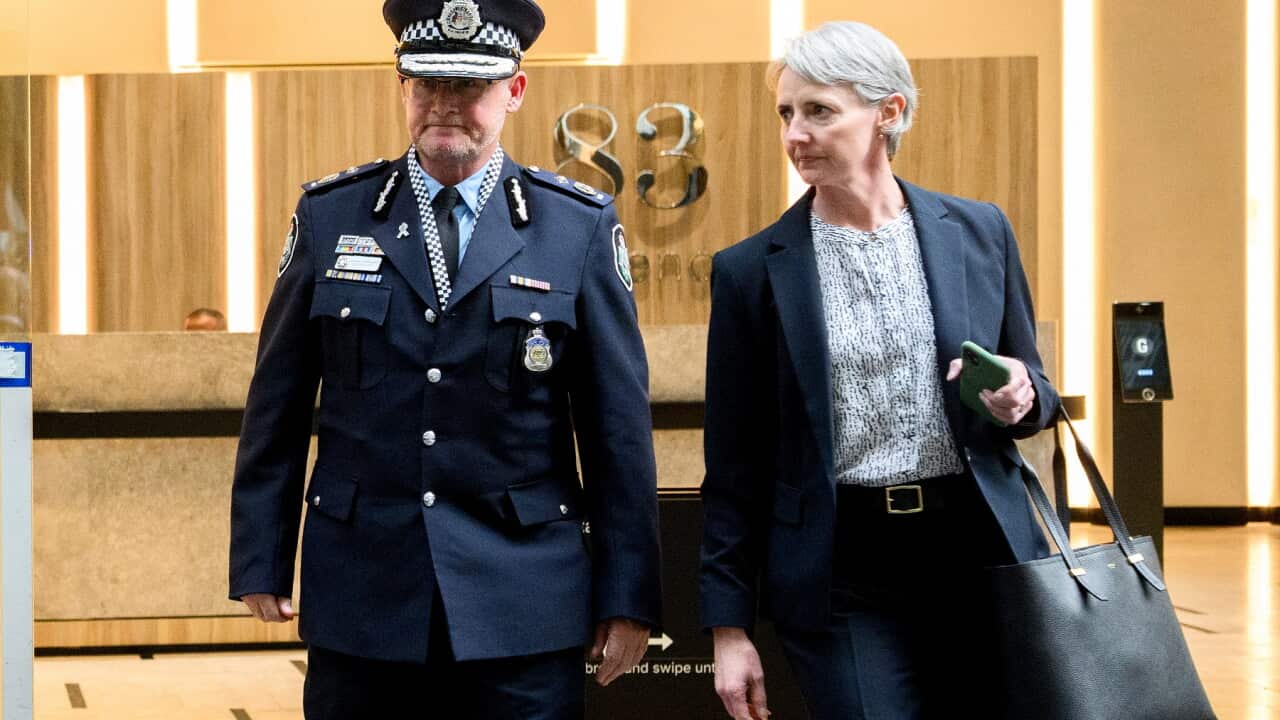
In her evidence, the Commander of the Counter Terrorism & Special Tactics Command at NSW police, Assistant Commissioner Leanne McCusker said in the months leading up the December attack, the threat to the Jewish community was at a concerning level.
But a threat assessment was not prepared for the Chanukah by the Sea event.
HEGER: As you sit here now, and perhaps with the benefit of hindsight, do you think it would be a good idea for your command to prepare threat assessments for Hanukkah events?
MCCUSKER:Yes, I see no reason why a threat assessment could not be completed for that event.
HEGER: But do you see it as a good idea?
MCCUSKER: Yes I do.
HEGER: Why is that?
MCCUSKER: I think it ensures that the current threat environment is provided for that particular event.
There's a recommendation for NSW Police to conduct such threat assessments for Hanukkah going forward.
The commission also heard from two witnesses from the Community Services Group, a private organisation which offers security for the Jewish community.
Their identities protected by a pseudonym.
One of them told the commission an event like Chanukkah by the Sea is uniquely challenging by being held in a public place.
Just a week before the attack, the group sent an email to NSW Police, saying they believed a terror attack against the Jewish community was "likely," and requesting police assistance.
There was also a phone call with local police, requesting a "static police presence" at two Hanukkah events.
Richard Lancaster asked the witness what the response was to that request.
"His response to my recollection was that they do not believe a static presence is required based on the risk assessment they would have undertaken internally."
The witness says he told local police it would cause unease in the community to not have a static police presence.
Tomorrow the commission is expected to hear from Assistant Commissioner Peter McKenna from NSW Police.
Mr Lancaster says his evidence will address questions about deciding police resources for events.
He says events on Jewish high holy days in September and October last year were considered the highest level "tier three," meaning they were managed by the major events group rather than local police commands, with liasion with the Counter-Terror and Special Tactics commands.
"By contrast, the Hanukkah events at Bondi and Dover Heights in 2025 were each regarded as tier one community events in which the management of the police resources was the responsibility of the local area command in this instance, the eastern suburbs PAC. The management of tier one events did not require any liasion with the major events group or the counter terrorism and special tactics command and it presently appears to the commission that there was no such liasion."
The Royal Commission is still accepting submissions from members of the public and institutions until mid-June, on all aspects of the Commission’s terms of reference.