
It is a history that was buried for many years. Now the stories of Stolen Generations are being told through artworks in a new exhibition. Warning: this story contains content listeners may find distressing.
Listen to Australian and world news and follow trending topics with SBS News Podcasts.
TRANSCRIPT
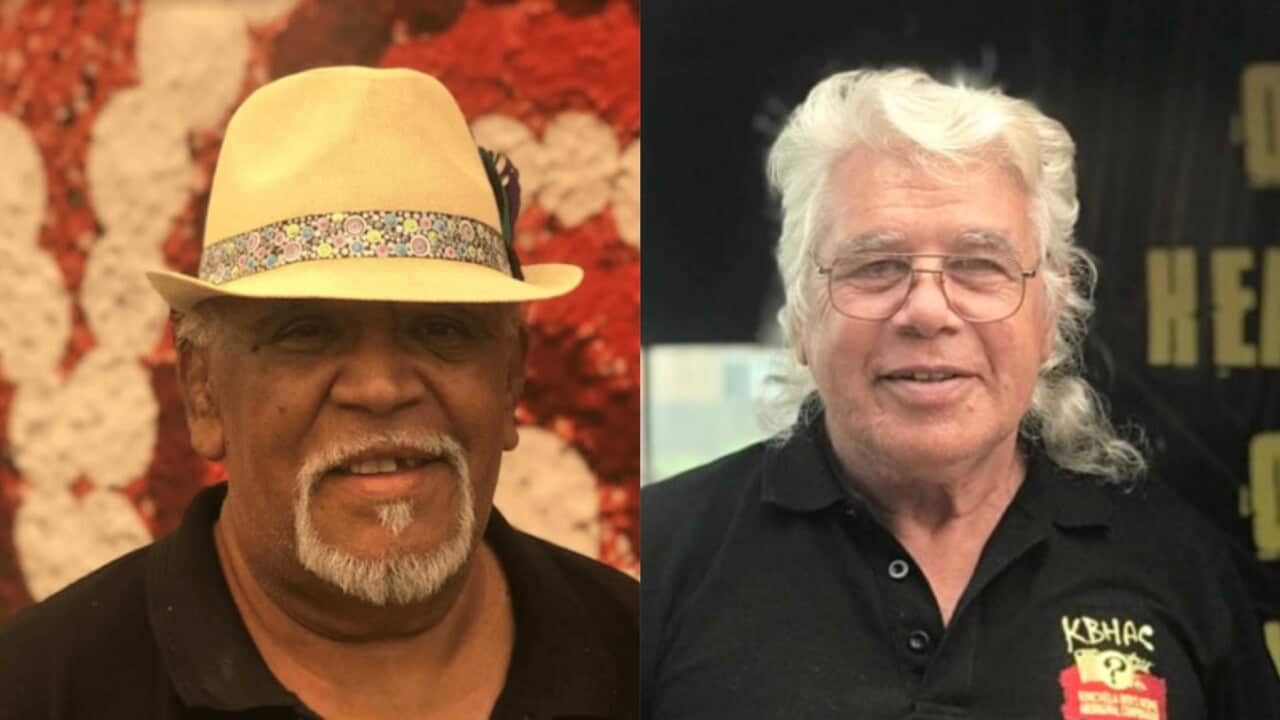
It’s a medium that Uncle Richard Campbell has spent his whole life using to communicate and tell his own story.
Making sense of the dark years of the government's policies of forcible removal of First Nations children from their families.
Art was a constant - even though the administrators at the Kinchela Aboriginal Boys Home exacted punishment.
"I used to do a lot of art before I went to the boy's home. Once I get there, I kept doing art. Drawing on walls and on concrete. They used to punish me for it. Bash me across the knuckles. It didn't stop me. I just kept practising you know. I used to win prizes at school at Kempsey. Different prizes, you know."
Six hundred Aboriginal and Torres Strait Islander children - aged between five and 15 - were detained in the institution on the mid-north coast of New South Wales, after they were forcibly removed from their families under race-based government policies.
The institution was run by the state government authorities for five decades until 1970 when it was closed.
Accounts of the brutality inflicted on the boys was documented in the landmark Bringing Them Home report in 1997, which included the testimony of more than 500 First Nations Australians from a national inquiry.
Uncle Richard says that time left a lasting impact - separated from his brothers and parents at the age of 10 and then years later, at the age of 18, meeting his mum again.
But re-establishing a connection was difficult.
"She knew me, but she didn't recognise my voice, because I was speaking as a man, young man. Then, you know, I went as a 10 year old kid, and your voice changed,you know, since I think eight years later that I hooked up with Mum."
Reconnecting with other survivors from the home led to the formation of the support and advocacy group the Kinchela Boys Home Aboriginal Corporation - with the mission to put suvivor perspectives front and centre.
"There were 600 of us, now there's sadly only about 44 of us left, but you still got us, you can have that have that voice for us, you know, and a lot of other boys that get up and speak about what happened to themselves in the boys home, and like I keep saying, it's their history, they create that history."
There were 83 recommendations in the Bringing Them Home report to support healing and reconciliation; through reparation and the need to recognise what the report calls "the history of gross violations of human rights".
Almost 30 years on, more than 90 per cent of the recommendations have yet to be implemented.
Advocates have also expressed concern Aboriginal and Torres Strait Islander children continue to be removed from their families at a very high rate.
Data from the Australian Institute of Health and Welfare finds First Nations children are 9.6 times more likely to be in out-of-home care and on third-party parental responsibility orders - than the wider population.
Uncle Harry Ritchie says the years he spent at he Kinchela Aboriginal Boys Home were dehumanising.
"And, as soon as I walk in the gate, all my clothes, everything, was thrown in a incinerator, and then I was showered, dusted, powder threw all over me. Then we went to the storeroom and got our clothes, which had a number on them, and 56 was my number, and I was called 56 until I got out at the age of 14. So all them years, I was 56. Everyone had a number."
He says housing for survivors and stopping the increasing rates of child removal are issues of top concern.
"Housing would be the main thing. Regional housing, probably in cities, but regional mainly because there's nothing out there for them. I'm lucky, I'm renting a house now, but it's privately owned. But some other, they're out in the streets, which is hard to see. It makes you want to cry sometimes seeing them."
Government propaganda produced at the time justified the internment of the children as being part of efforts to turn out, quote, "clean and healthy boys who will develop into useful citizens".
The children's artwork was also featured in posters describing the institution as a country club.
Dr Tiffany McComsey, the CEO of the Kinchela Boys Home Aboriginal Corporation, says dispelling the lies and replacing it with the truth of what happened has been driving force of the grassroots and community-building initiatives the Uncles have led - whether it be five years running an oral history bus travelling to schools, or this latest art exhibition.
"The Aborigines Welfare Board had this magazine called Dawn and New Dawn, and in the Dawn magazines they promoted these Stolen Generations institutions as places of well-being for the Aboriginal boys, girls, and babies that were kidnapped and taken there. And many of the Uncles' artworks have featured in that magazine with headlines saying, Kinchela, just like a country club, when we know it wasn't a country club, it was a site of incredible abuse and torture, and yet they were shown to the state and the country as being model places for the development of Aboriginal boys and girls, so that they could become citizens of Australia. And it's that constant being forced to see a lie and knowing that your truth isn't being told, and now reclaiming that truth."
Uncle Roger Jarrett says the last 12 months producing his latest paintings and carvings has been therapeutic.
"This is one about the cheeky one, a little fellow that did rock paintings, and he went inside, and he scribbled all over, and the elders got mad, and they gave him all the rocks on the outside of the cave for him to scribble all over, which he did for a while, and eventually then he came back in and destroyed all that. So the elders then said, the clever man and turned him into a little grub, and they put him on the tree, and every time the bark falls off this gum tree, you'll see his family with all little squiggles on the tree, that's that one."
Along with the physical beatings, there was also the brainwashing.
"They just flogged us, belted us and said we were little white soldiers. They'd say to you, "You're different, you're not black, you're white." And you have a look at yourself, like, "Good God, I'm brown." You know what I mean? And that was something they drum in the head, like they call it every day. They keep telling you, so in your head, you don't know whether you're coming or going."
It was finding other survivors and working together to dispel the lies about what happened that helped the healing process.
"And the brothers were very strong as a brotherhood, and we're from all different, all different tribes, you know, but we are a big family. And thank God we got something, because they took us away from our biological family and they say when they take the kinship, you lose your love and you lose your heart, there's nothing there to feel - you see a girl and you're supposed to go wow, there's fires and all this stuff. Nothing happened, you know, you're just running around and next minute you're father and you had no idea how to be a man, because no guidance in there, you come out you don't know what to do or how to do."
The exhibition is called 'Truth-Telling: Our Past, Present and Future' and marks the launch of the Coolamon Arts Hub, the home of future exhibitions online and in galleries.
Uncle Richard Campbell's art work entitled 'the Coolamon' points to the multi-purpose nature of the bowl and carrying dish - carved out of wood and used by First Nations women to carry water, fruits, and seeds, or act as a portable baby cradle.
He says the motif is one that speaks to hope and creating a better future.
Only women carry the Coolamon, you know. It's all about my mother, like I explained to him the other day, and it's all about my mother, and the mothers of all the boys and girls that were taken away because they had their kids taken away, you know. And the Coolamon, it's a vessel of life, you could carry your water in it, you carry food in it, and also they used to put the babies in it as a little cradle. So it's about everyone because we are a multicultural country, and everybody's got to bring together to make this country a great thing. And part of this Coolamon is just a fraction of bringing this country together, you know, in harmony.
The exhibition 'Truth Telling: Our Past, Present and Future' continues throughout the month of July at the Kinchela Boys Home Aboriginal Corporation in Sydney; and also online at coolamon.org.au
First Nations listeners seeking support can contact the crisis hotline 13YARN (13 92 76.
24-hour support can also be found at Brother to Brother on 1800 435 799, and Yarning SafeNStrong on 1800 959 563.