
More than 800 people have been killed, and over 3000 missing in Nepal after devastating floods swept the region last week. With 43 Australians still unaccounted for, experts say the threat of further flooding makes rescue efforts trickier.
Listen to Australian and world news and follow trending topics with SBS News Podcasts.
TRANSCRIPT
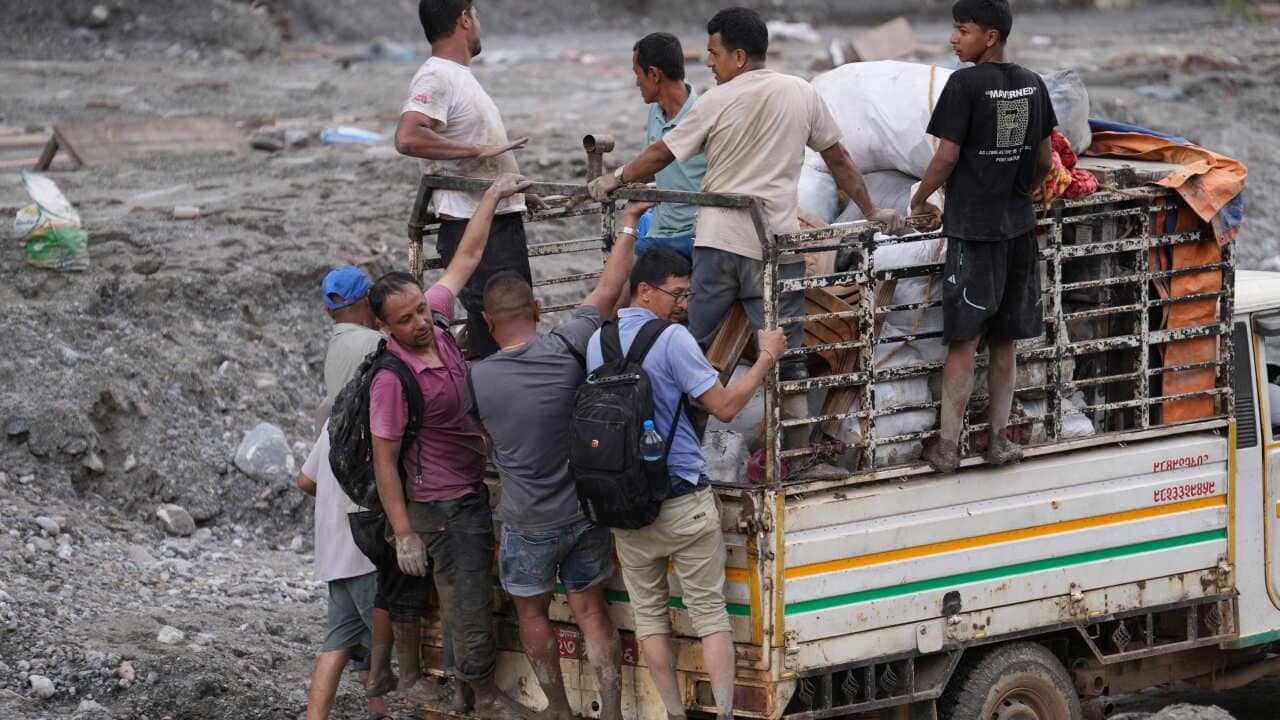
Scanning through lists of names plastered on the walls of an army base in Nepal, desperate relatives look for information about missing loved ones.
With thousands still unaccounted for after tsunami-like flooding along the Nepal-Tibet border last week, the chance of finding survivors grows slim.
44-year-old Bhakta Raj Thapa is searching for members of his village
"It's already been four days. It's one thing if we were able to contact the missing, but there is no connecting road to our village, there is no electricity, and mobile phones can't be charged. Residents of our village remain missing. Now we are here hoping to find them, dead or alive. Others have gone to Jugedi and Chitwan to search and look for them.”
The Red Cross says the severe torrent of ice, mud, rock and debris that swept through the mountain valleys and rivers last Wednesday has impacted more than 90,000 people.
Authorities say the death toll has risen to nearly 800 people, with more than 3000 still missing on both sides.
Nepal's Foreign Secretary, Amrit Bahadur Rai, says their focus is clear.
“To save lives, locate missing persons, rescue them and provide urgent relief to survivors, and ensure that affected Nepalis as well as foreign receive appropriate assistance and support.”
With officials estimating the cost of reconstruction could run into the billions, Nepal is appealing for international financial assistance, as well as specialised rescue support such as DNA testing kits and body freezer storage units.
“We have already received relief materials from India, China and UAE and other countries and essential items are also being received from USA, Japan, UAE, Qatar, Singapore, Australia, Malaysia, Myanmar, Bangladesh, Pakistan and other countries and partners. As relief operations continue, further assessments are being made and we will reach out to our neighbours and international partners for additional assistance and support as needed.”
Nepal has deployed almost 20,000 security personnel to support search and rescue efforts, while Chinese state media says China has deployed over 2,000.
Specialised teams from India, China and South Korea have also joined efforts to rescue around 100 workers believed trapped inside multiple hydropower tunnels.
Nepal's Minister for Science, Mahabir Pun, says China has provided material and technical support.
“Right now, there are several hydro-power stations which were under construction. So in those hydro-power sites, the entrance of those tunnels has been blocked. So we're working very hard and [with] the support that the Chinese government sent yesterday and today will be very helpful to open up the entrance of the tunnel, because there are many people who have been trapped there.”
43 Australians remain unaccounted for, with 14 Australian response team personnel in Kathmandu to support rescue efforts.
In Australia, a joint call for aid from the Emergency Action Alliance has raised more than $3.5 million, including $2 million in contributions from the federal government.
In addition to support for the alliance, the government says it will commit a further $2 million in aid to be delivered directly to Nepal.
The President of the Nepalese Association of Victoria, Sudip Shrestha, says he hopes Australia will help to reduce the impact of possible future disasters.
“We would definitely raise with the government is whatever financial aid they can now commit for rebuilding of Nepal. Like for some research funding for why the glaciers are melting and what are its risks to Nepal, and probably early warning system, developing those things for Nepal, and probably reestablishment of those colleges, schools, I would say, as well. So, we would do some lobbying for the Victorian government as well. And for the longer term, of course, yeah, there will be a lot of rebuilding work, which we will do fundraising campaign as well.”
Experts say the flash flooding was most likely caused by a sudden glacial collapse, warning of a growing threat from climate change in the region.
With challenging weather already hampering rescue efforts, the formation of a new lake caused by a landslide is sparking concerns of additional disasters.
Dean of the School of Energy and Environment at City University of Hong Kong, Benjamin P. Horton, says climate change likely played a leading role in the floods.
“It's a little bit like when you have a large magnitude earthquake and then you have aftershocks as a result of this. Here we've had a large volume of water with a variety of debris within it moving down the valley that has caused further complications, further backing up of water, which may lead to further disasters further downstream. And this is just part of a long-term problem in the Himalayan regions. When you have a warming climate, the probability or the likelihood of these large debris flows increases.”
Despite contributing less than 0.1 per cent of global carbon emissions, Nepal is among the countries most affected by climate change.
Benjamin Horton says large emitters have a responsibility to invest in the protection of those bearing the brunt.
“One of the reasons why we don't fully understand the mechanisms that cause the landslide is that we have a lack of data. So there has to be this investment in the science, there has to be this investment in society, and we have to solve the problem. I think one of the things that I find so tragic is that the people who lost their lives and lost their livelihoods didn't contribute to this problem. They're not the polluters of carbon dioxide. We know who are the polluters, and they are responsible.”