
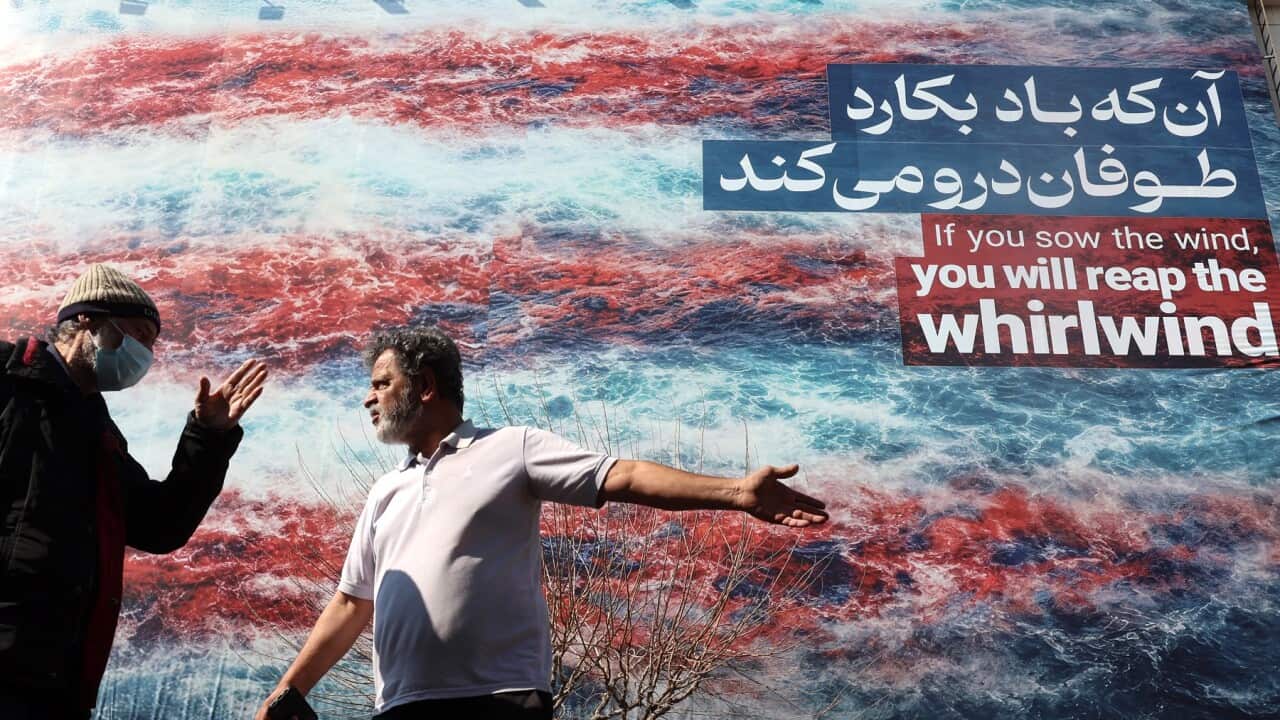

As the United States amasses more warships and aircraft in the Middle East than the world has seen in decades, the possibility of a regional war appears ever-more threatening. There are fears the dispute between the two nations could flare up into a far-reaching conflict, on the eve of a third round of talks between the United States and Iran in Geneva over the Islamic Republic's nuclear program.
Listen to Australian and world news, and follow trending topics with SBS News Podcasts.
TRANSCRIPT:
On the eve of a third round of talks between the United States and Iran in Geneva over the Islamic Republic's nuclear program, there are fears the dispute between the two nations could flare up into a far-reaching conflict.
U-S President Donald Trump, using his first State of the Union address of his second term, has said that while he prefers to reach a deal through diplomacy, he isn't willing to budge on an outcome.
It was the same forum in which former president George W Bush laid out the case for an invasion of Iraq in 2003.
"For decades, it had been the policy of the United States never to allow Iran to obtain a nuclear weapon. Many decades. Since they seized control of that proud nation 47 years ago, the regime and its murderous proxies have spread nothing but terrorism and death and hate. They've (Iran) already developed missiles that can threaten Europe and our bases overseas and they're working to build missiles that will soon reach the United States of America."
The U-S conducted military strikes on Iran last June and claimed to have totally obliterated the country's nuclear enrichment capabilities, while Iran downplayed the damage and the impact.
Now, Mr Trump claims the country is rebuilding its nuclear arsenal.
In his speech, he said that would never be allowed to happen and accused Iran of having sinister ambitions.
"We are in negotiations with them. But we haven't heard those secret words: 'We will never have a nuclear weapon. My preference is to solve this problem through diplomacy. But one thing is certain — I will never allow the world's number one sponsor of terror, which they are by far, to have a nuclear weapon. Can't let that happen."
Mr Trump has threatened military action unless the regime's military leaders can make a deal.
Yesterday, satellite photos analysed by The Associated Press appeared to show American vessels usually docked in Bahrain all out at sea.
Iran has repeatedly denied it is seeking a bomb, but insists it has the right to use nuclear technology for peaceful purposes.
And in the event of an attack by the U-S, it has threatened to retaliate ferociously and strike U-S bases in the region.
But on Wednesday, Iran pushed back against Mr Trump’s pressure tactics, saying an agreement may be possible through diplomacy.
As Iran's Foreign Minister Abbas Araghchi and his team arrived in Switzerland, President Masoud Pezeshkian was relatively upbeat.
“Regarding the talks, we see a good outlook. In tomorrow's meeting involving (Iran's Foreign Minister Dr Abbas Araqchi in Geneva, we have endeavoured, under the guidance and directives of the Supreme Leader, to manage the negotiation process in a manner that, God willing, moves the country beyond the state of 'neither war nor peace'.”
But Mohammad Bagher Qalibaf, Iran's parliament speaker, sounded more threatening.
"We will continue to take part in the upcoming negotiations. But if your decision is to repeat the last experience through deception, lies, flawed analysis, and false information, and to strike at the negotiating table in the middle of talks like before, then without a doubt you will feel the forceful punch of the Iranian nation and our defense forces, and you will certainly regret that choice."
Across the world, there are now fears the dispute could spiral into a regional war, as the embers of the years-long Israel-Hamas war continue to smoulder.
The Australian government has directed the families of its embassy staff and officials posted in Israel and Lebanon to leave in response to escalating regional tensions.
The U-S has also ordered non-emergency personnel to leave its embassy in Beirut.
And Lebanon's foreign minister says his country fears its infrastructure could be hit by Israeli strikes if the situation with Iran escalates.
The head of the International Atomic Energy Agency (IAEA) suggests these fears are justified.
Rafael Mariano Grossi told Colombian public broadcaster RTVC that while a deal without violence is possible, the uncertainty over Iran's nuclear material could expand to a conflict beyond the nation's borders.
"Let's not forget that when previous military episodes occurred, when Iran responded to that fire, there were targets hit in Qatar, for example, because there are U.S. military bases in many of those places, so the concern already goes beyond Iran's territory and becomes a subregional concern."
Mr Grossi adds that IAEA has been unable to reinspect Iran's enriched uranium since June 2025, which creates a dangerous information gap.
Meanwhile in Iran itself, Iranians are trying to stock up on food, daily essentials and emergency supplies such as flashlights, small gas ovens and tape for securing windows against explosions.
To make things worse, prices have soared — due to uncertainty over recent protests and US military threats combined with years of inflation and an economic pressures due international sanctions.
Retired civil servant Ebrahim Momeni, says talk of war is everywhere.
"Yes, they are extremely (worried). Wherever you go now people are talking about war. If you go to a bakery to buy bread you see people talking about war, you see someone saying they (the Americans) are going to attack tomorrow or the day after tomorrow. This state of limbo is worse than war."
The limbo continues.









