

Traditional owners in Far North Queensland have come together with scientists for the first time to help tackle threats against human-induced climate change. The inaugural conference with leaders from seventeen different Torres Strait Islands is helping shape Australia's next State of Environment Report due in December this year. Reporter Josh van Staden travelled to Thursday Island with support from the Pulitzer Center.
Listen to Australian and world news, and follow trending topics with SBS News Podcasts.
TRANSCRIPT:
Against the turquoise ocean and coconut palms on Waiben Thursday Island...
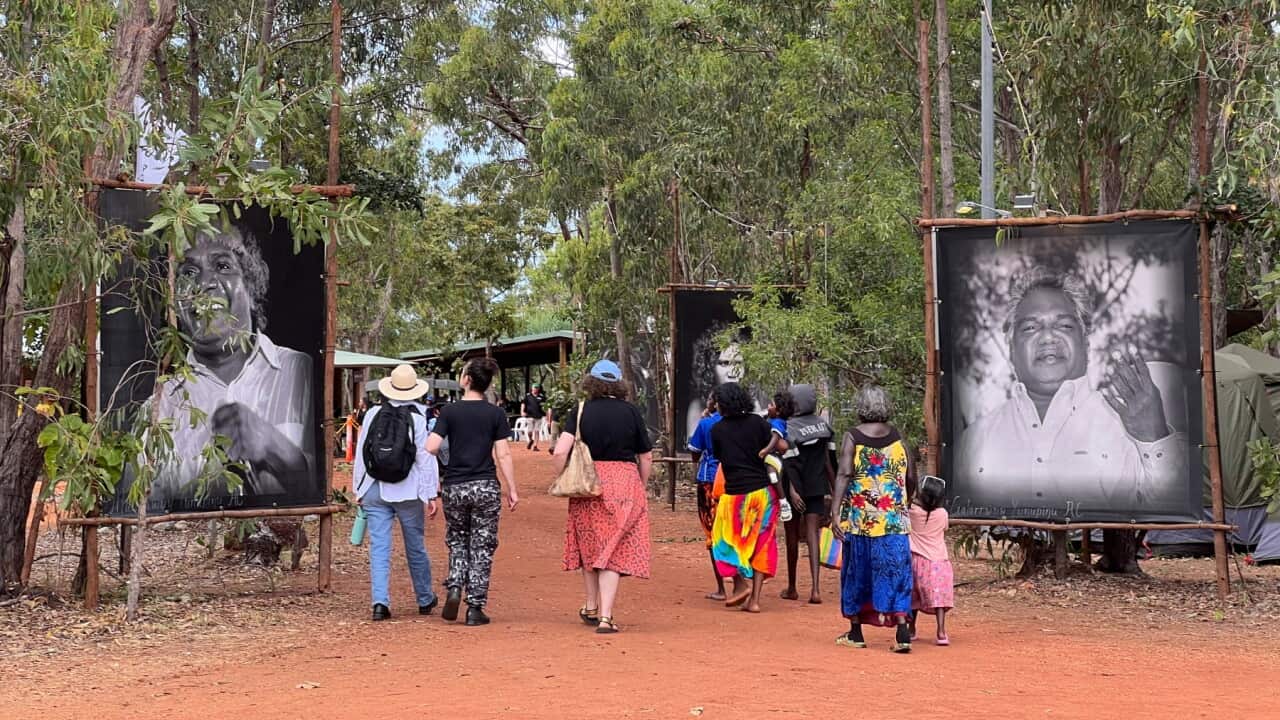
More than 70 Elders, leaders, scientists and academics have gathered to discuss the region's vital marine resources.
Including Ella Kris, who is a People and Culture Manager as part of the Torres Strait Regional Authority's Environmental Management Program.
"The sea, the land and the people that walk upon it, we're one system, there is nothing that separates us. We can't put science first, it's the traditional knowledge that needs to be there. It's the traditional ecological knowledge, the TEK that we're recording and that we're capturing."
The Torres Strait is home to 270 islands, 17 of which are inhabited, and where six of the world's seven marine turtle species exist.
As George Nona explains, the ocean's value, is integral to the way of life.
"For so many years we've just been living on the salt water and depending on the sea, and you will see the differences in age with the elders, that they are more contempt with what they get on the table, and it's all because as I mentioned all our reliance. The sea is like the money maker, today right now that's the biggest income for the people, especially on the outer islands. Their dependency is getting more products from the sea."
George Nona is from Badu Island and fears words in local language describing the environment are being lost.
Traditionally, knowledge in the Torres Strait has been passed down orally through stories, art, dance and song.
Ella Kris hopes news ways will be found to preserve that knowledge.
"So Zenadth Kes is our land, is our sea therefore it's our responsibility, so that's how I see the symposium, weaving together traditional knowledge and science."
The 2016 to 2036 Torres Strait Land and Sea Management strategy identified 16 key values of the region, including dugongs, seagrass meadows and coastal bird habitats.
Traditional Owner's and scientists agreeing that both ancient and modern wisdom are key to finding better solutions to protect those key values.
Patrick Mooka is from Dauan Island close to the Papua New Guinea border.
"We come together to learn and understand exactly what it is that is happening to our environment. What is changing in the sea and what is changing on our islands, and what is changing in the skies – the weather."
One workshop identified the need to up-skill local rangers about the use of drones so they can better document hard to reach mangroves.
George Nona again.
"Climate change, to me, sometimes I can see that at home and can get very emotional it's taken a lot of things, the high rise temperature of the water, the water sea level coming up. For example on one of the islands, human remains are being exposed."
Some islands in the Torres Strait lie just two metres above sea level and are facing uncertainty due to coastal erosion and flooding.
"The changes that affect our land and sea also affects our people on our islands. We need to learn to adapt to these changes."
The gathering, facilitated by the Torres Strait Regional Island Authority, is the first of its kind in the region where First Nations knowledge leads discussions.
Ella Kriss is hoping access to scientific data about human-made sea walls will help Traditional Owners understand if its working.
"So as we move through the symposium, to me we move forward with clarity and a purpose, to protect, to restore and to lead using everything that's been given to us, so that is our cultural knowledge and science."
The symposium will inform the Torres Strait's input into a nation-wide State of the Environment Report due in December 2026.
The report is released every five years under federal environment law, which helps encourage more informed decisions.
The group celebrating their gathering, with a commitment, to centre First Nations knowledge on climate change issues.
Patrick Mooka says that's key for the region's survival.
"With the great knowledge that has been passed down to us, comes great responsibility and today we must document our traditional knowledge, plan and put it into action for our future."
That Traditional knowledge now walking in partnership with the new.