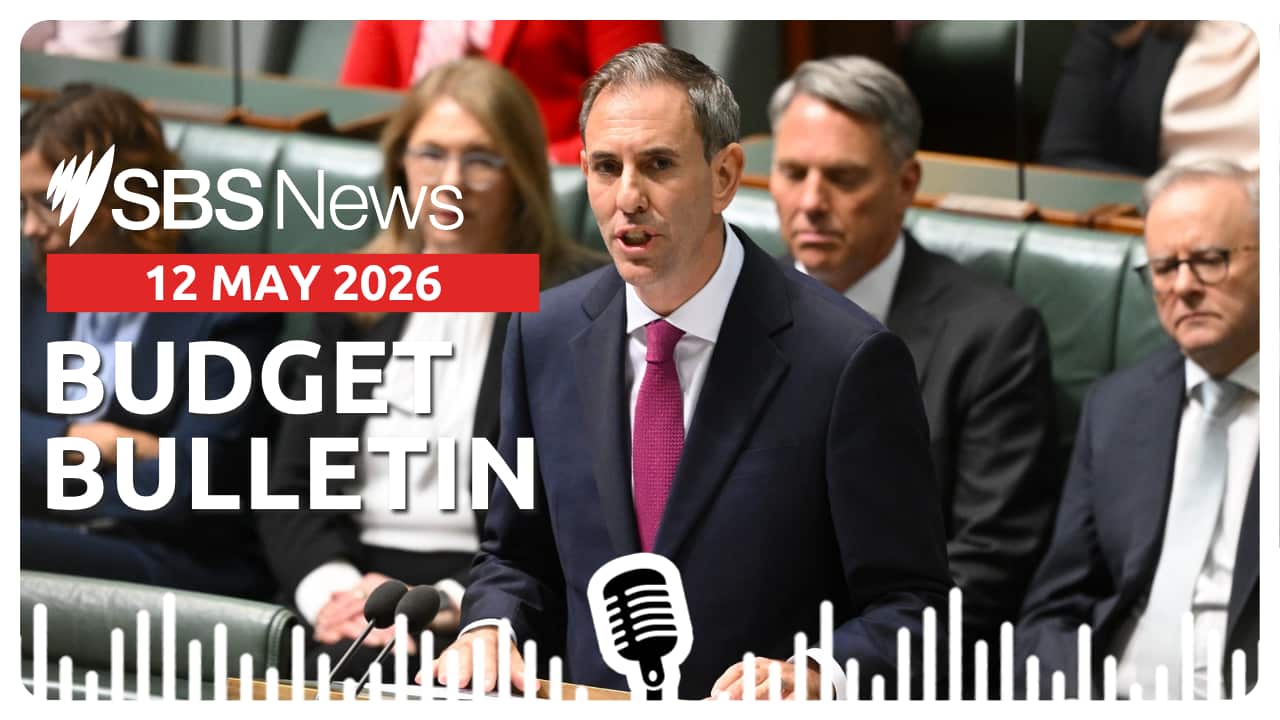

The Treasurer reveals changes to capital gains tax and negative gearing, an income tax offset is announced, to help with cost of living pressures and inflation forecast to peak at five per cent midway through this year.
Key Points
- Capital gains and negative gearing reforms come into effect
- Income tax offset to ease cost of living pressure
- Inflation forecast to peak at 5%
Listen to Australian and world news and follow trending topics with SBS News Podcasts.
TRANSCRIPT
After weeks of speculation, Treasurer Jim Chalmers has detailed how the government plans to reform tax arrangements for housing.
Negative gearing will be limited to new builds on residential property from July next year, but current arrangements will be grandfathered for investments made before today.
The existing 50-per-cent capital gains tax discount will be replaced with inflation-adjusted indexation on a prospective basis.
Those changes will be subject to a minimum 30 per cent tax on capital gains from July 2027, although, in line with the government’s push to increase housing supply, new builds will continue to attract a discount of 50 per cent.
Dr Chalmers says the changes are about increasing fairness for young Australians.
“This is about better aligning the taxes paid on these types of income with the taxes paid on wages. These changes will level the playing field for workers and first home buyers, and support investment in productive assets, including new housing supply.”
—-
Treasurer Jim Chalmers has unveiled his fifth budget, a plan he says is based on spending restraint and careful choices.
Treasury is now forecasting inflation will peak at five per cent mid-way through this year, due to the impact of war in the Middle East.
Oil prices are expected to say around $100 per barrel until the end of June and then begin easing back towards $80 per barrel over the following year.
Dr Chalmers has told Parliament that while Australia has no control over the direction of the war, the government can decide how it will respond.
"This Budget is ambitious in the face of adversity. It’s a responsible Budget and it's a reforming Budget which builds resilience and bolsters our economy, responding to the pressures of the here and now while embracing our intergenerational responsibilities."
A more severe scenario considered by Treasury, where the oil price peaks at $200 and takes three years to fall back down, could see inflation peak above 7 per cent.
—-
Treasurer Jim Chalmers has announced a round of tax cuts to help with the cost of living in this year’s Budget.
He says a $250 Working Australians Tax Offset will begin in the second half of 2026, which will come on top of the $1,000 instant tax deductions that Australians can claim, without producing receipts, coming into effect at this year’s tax return.
Social services groups say it won’t help those most in need - including those unable to work or generate an income.
But Dr Chalmers says the offset represents the most meaningful, permanent increase to the effective tax-free threshold since Labor last increased it a decade ago.
“Altogether our five different tax cuts will benefit the average worker by up to $2816 in 2028. Averaged out over the year, our three tax cuts, instant deduction and the new offset are the equivalent of up to $54 back in the average earner’s pocket each week.”
—-
Fewer Australians on lower incomes will need to pay the Medicare levy at tax time this year.
The federal Budget on Tuesday revealed that the government had increased the threshold by 2.9 per cent from the first of July 2025.
The new thresholds are $28,011 for singles, $44,268 for pensioners, and $47,238 for families.
—-
Millions of dollars will be spent on support for families and individuals impacted by gambling harm. Treasurer Jim Chalmers says $39 million has been set aside over the next four years to improve the availability and reach of financial counselling services, while $28.7 million dollars will be spent on BetStop, in part to strengthen data matching systems.
The government plans to spend $22.4 to develop a national online awareness campaign to encourage people affected by gambling harms to seek support. $22.6 million will also be spent over five years to enforce advertising reforms, and boost enforcement against illegal gambling services and consumer protections from harmful online lottery products.
ACT Senator David Pocock led criticism of the government's long-awaited response to the review, saying it didn't address its 31 recommendations and was "both cowardly and disrespectful".
"Cowardly because they are not willing to actually just front up on a day when journalists aren't literally in budget lock-up. To most Australians, that means they have no phones on them, they are locked up for the whole day with the budget papers. They are not able to report on things. That's the day the government has decided to say to Australians, we had 31 recommendations to say gambling is a public health issue this is how you address it. The Government has said yeah nah, we're just going to do what the gambling companies want us to do."
—-
The Federal Government says it’s investing 1.2 billion in First Nations communities and Closing the Gap over five years as part of Tuesday’s budget.
New funding includes $299 million for the Remote Jobs and Economic Development Program – aimed at doubling the number of remote jobs from 3- to 6,000.
There is also $218 million towards ending gendered violence; $144 million in new funding for health infrastructure across Aboriginal Community Controlled Health Services; and $113 million for programs aimed at improving educational outcomes.
The culturally informed mental health support line 13-YARN is set to receive $18.9 million in new funding to help develop a text line that can help engage younger people.