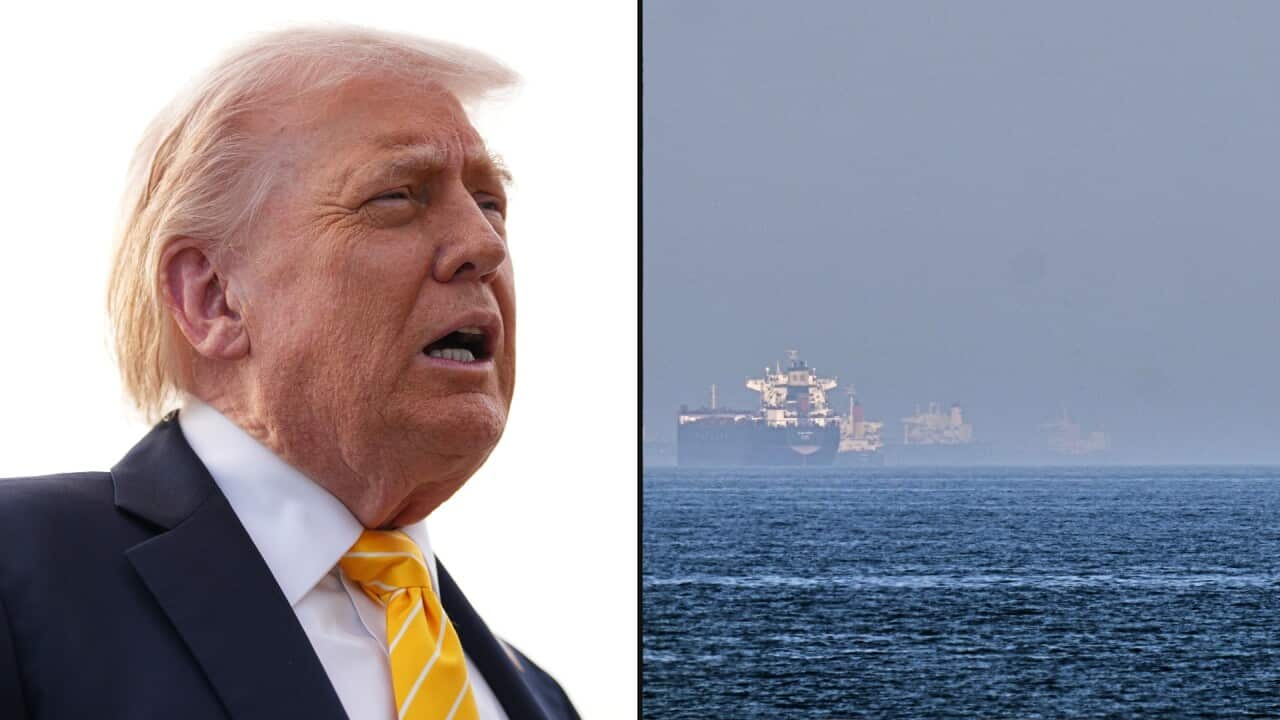

President Donald Trump has again raised hopes the United States and Iran are moving closer to an initial agreement to end the war in the Middle East. But he has also struck a more sinister tone, saying that if they don't agree - the bombing will start anew.
Listen to Australian and world news, and follow trending topics with SBS News Podcasts.
TRANSCRIPT:
For US President Donald Trump, peace in the Middle East is imminent.
"We're doing very well in Iran. It's going very smoothly, and we'll see what happens. They want to make a deal. They want to negotiate."
Pakistan Foreign Minister Ishaque Dar says as mediators, his country remains determined to broker an agreement.
“We are endeavouring to convert this ceasefire into a permanent end to this war.”
For its part, Iran is said to be reviewing a new US proposal to end the conflict.
The one-page memorandum reportedly proposes a basis to end hostilities, and leaves tricky issues such as Iran's nuclear program for later.
An Iranian foreign ministry spokesperson, cited by Iran's ISNA news agency, says Iran will convey its response soon via Pakistan - but for now, Jessica Genauer from the Public Policy Institute says the two countries remain at an impasse.
"We're a little bit stuck with both the Iranian regime and the U.S. military trying to get control over the strait, not really succeeding, to get full control and push the other actor out. But at the same time, you know, not really managing to kind of secure that control or to withdraw. So I think what we're going to see going forward is there will overall be a ceasefire that holds, but there'll be ongoing tit for tat around the Strait of Hormuz."
Within the last day, the United States has fired on an Iranian oil tanker in the Gulf of Oman, which US Central Command says was trying to breach the American blockade of Iran's ports.
And while Trump himself has again raised hopes the United States and Iran are moving closer to an initial agreement to end the war, he has also struck a more sinister tone, saying if they don't agree - the bombing will start anew.
"And now we're doing well. Now we have to get what we have to get. If we don't do that, we'll have to go a big step further."
Those remarks came just days after Secretary of State Marco Rubio declared the end of hostilities in Project Fury - and the successful launch of Project Freedom to escort commercial ships through the waterway -
"The U.S. military is deploying the necessary assets to extend this defensive umbrella over commercial shipping. But there should be no mistake. And as I said this already, this is a defensive operation."
- and then Trump announcing hours later he was pausing the Freedom project at the request of Pakistan.
Jennifer Genaeur says there's a lot at stake for Trump.
"Trump wants to say that the Iranian regime has to commit not to enrich uranium at all. And the Iranian regime says that's a red line for them and they absolutely want to retain the ability to enrich uranium up to a certain level. So the two sides are sitting really far apart. But Trump has an added complexity that there was a deal with Iran under the Obama administration. And so he also wants to be able to say any deal that he strikes with Iran is going to be better than what, you know, Obama succeeded under his administration.”
For Europe and the rest of the international community, there are pressing economic imperatives as hundreds of merchant ships remain bottled up in the Persian Gulf.
France has already deployed its carrier strike group to the Red Sea as part of planning for a potential mission to secure the Strait of Hormuz, part of a proposal the country has been working on for weeks with Britain, to lay the groundwork for safe transit - once the situation stabilises or the conflict is resolved.
China’s foreign minister has also called for a comprehensive ceasefire, following a meeting with Iranian Foreign Minister Abbas Araghchi, who was visiting Beijing for the first time since the war with the U.S. and Israel started on February 28.
Huizhong Wu from the Associated Press says that call is significant.
"China as a top importer of Iran's oil has emerged as an unofficial mediator to this conflict, even though it is not the one hosting the official peace talks."
Israel also remains a major player in the negotiations.
Despite a ceasefire, Israel has carried out its first strike on Beirut’s southern suburbs since a ceasefire with Hezbollah was announced last month.
Israeli Prime Minister Benjamin Netanyahu and Defence Minister Israel Katz say the target was a commander of the militant group's elite Radwan force in the city's southern suburbs.
Prime Minister Netanyahu says the US remains a close ally.
"We maintain continuous contact with our friends in the United States. I speak with President Trump almost on a daily basis. My people and his people speak on a daily basis, including today. And I will also speak with President Trump later tonight. We have full coordination, there are no surprises."