
Ukraine is marking its 35th Independence Day anniversary, as the European Union commits to further increase pressure on Russia to end its war. So what does independence mean to Ukrainians in a years-long battle with no end in sight?
Listen to Australian and world news and follow trending topics with SBS News Podcasts.
TRANSCRIPT
(Ukrainian tranlated to English) "It is not easy for Ukrainians today. It is difficult. There is accumulated pain, there is accumulated fatigue, but at the same time we preserve the light within us. We preserve humanity, mutual support, the key to national unity, the ability to forgive each other. Forgiving is not weakness, it is an important condition, because only a Ukraine that is not divided will be able to gain its strong peace."
That's Ukraine's President Volodymyr Zelenskyy speaking at a special commemoration of the country's 35th Independence Day anniversary - more than four years into Russia's full scale war.
For Ukraine, Independence Day is supposed to mark a celebration.
But in 2026, independence is also something Ukrainians are still fighting to preserve.
Russia's President Vladimir Putin recently said Kyiv had "opened a Pandora's box" with its recent strikes on Russian economic infrastructure.
Ukraine says it desperately needs a stronger line of defence against Russia's ongoing ballistic missile attacks.
United States President Donald Trump’s special envoy for Ukraine and Russia, Keith Kellogg, says the country's independence is important.
"35 years ago, you chose freedom. Today, you defend it. Tomorrow, you will build upon it. Ukraine's independence is not a gift. It is a promise kept by every man and woman who stood when it mattered most."
Former US Vice President Mike Pence also marked the anniversary, saying it is in the vital national interest of the US to continue providing Ukraine with the support it needs to defeat and repel the Russian invasion.
And the anniversary is not only being commemorated in Ukraine.
Across Australia's Ukrainian community, Independence Day is also a moment to reflect on what the country has endured, and what its independence means to Ukrainians now.
Ukraine's Ambassador to Australia, Vasyl Myroshnychenko [[vass-ill mirosh-ni-shenk-oh]] spoke to SBS Ukrainian, commending the local community.
"On this special day of Ukraine's independence, 35th anniversary, I would like to congratulate Ukrainian community of Australia. I'd like to thank you very much for supporting Ukraine, for standing strong with Ukraine in these hard times for our country, raising money for Ukraine's humanitarian and military needs, your advocacy, your hard work in making sure that Ukraine's voice is heard. Thank you for preserving Ukrainian identity."
For Australia's Ukrainian community, the idea of an independent Ukraine goes back long before 1991.
Dr Michael Lawriwsky, a former chair of the Ukrainian Studies Foundation at Monash University, tells SBS Ukrainian from the early 1950s, the Ukrainian diaspora in Australia celebrated the short-lived renewal of Ukrainian statehood - declared on the 22 of January, 1918.
"There were still veterans around who fought to defend it, and who dreamed of a future independent Ukraine that thought they wouldn't live to see it. However some did. Ukrainians declaration of independence on 24 of August 1991 hastened the destruction of the Soviet Union."
On the 24 August 1991, Ukraine declared its independence from the Soviet Union, months before the U-S-S-R officially collapsed (later that year).
A referendum in December that year confirmed overwhelming public support for independence.
Dr Lawriwsky says the referendum prompted Australia's Ukrainian community to immediately urge the Federal government to recognise the newly independent state - which it did - on the 25th December, 1991.
"A year later, on the first anniversary of independence, Australia's foreign minister Gareth Evans delivered a speech at a community function titled Australia and Ukraine, new country and new partnership. That partnership has been demonstrated in a much appreciated support that Australia has provided since Russia's full scale of invasion of Ukraine."
But why does the date matter beyond the post-Soviet era?
The meaning of independence has changed dramatically since 1991.
For many Ukrainians, Russia's annexation of Crimea and its backing of separatists in eastern Ukraine in 2014, transformed the idea of independence.
And Russia's full-scale invasion in February 2022 pushed that idea even further, with independence no longer being simply about having a sovereign state.
According to the United Nations, civilian casualties in Ukraine reached their highest monthly level in July - at least 437 civilians were killed and 2,610 injured last month.
UN monitors report civilian casualties in Russia also increased in July, with 79 civilians killed and 601 injured.
As Russia's war on Ukraine continues, Australia's Ukrainian community continues to call for military aid and support for Kyiv, and for Australia to close sanctions' loopholes that allow Russian-linked fuel to enter the country.
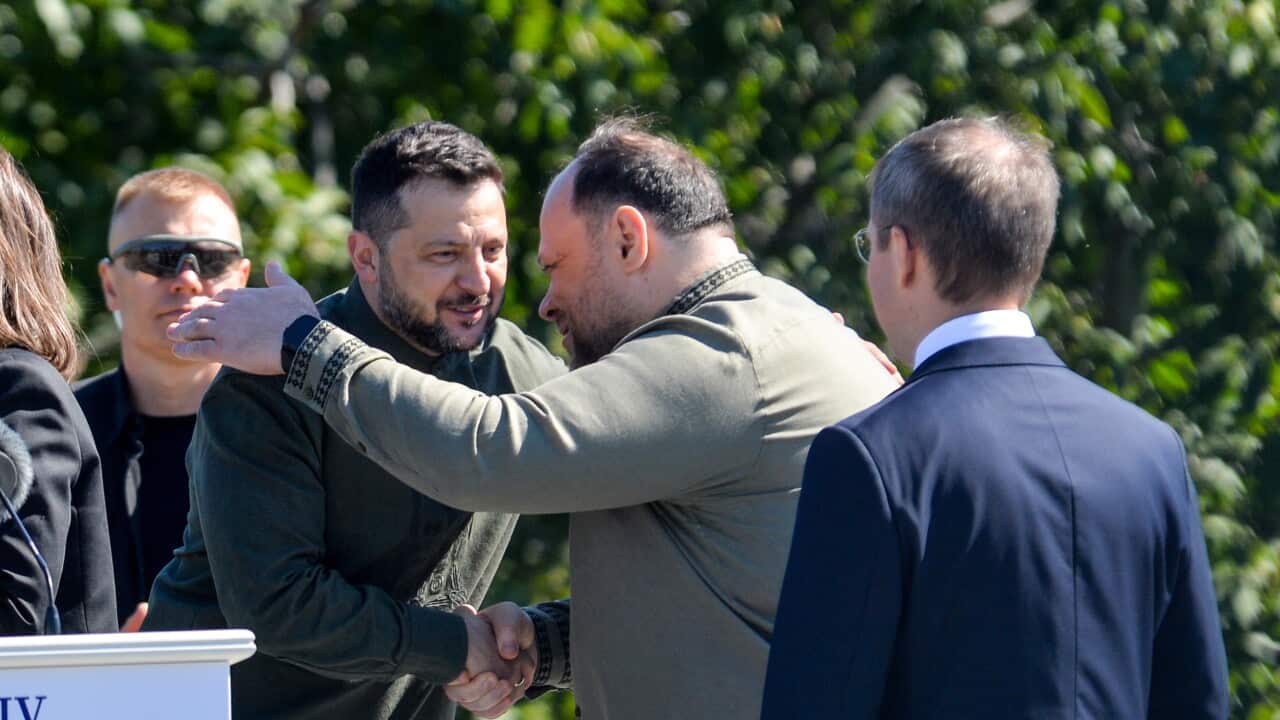
Meanwhile, on the eve of Independence Day, Nordic and Baltic leaders travelled to the Ukrainian capital, Kyiv to mark Flag Day and for talks with President Volodymyr Zelenskyy.
Ukrainian Foreign Minister Andrii Sybiha welcomed leaders of Denmark, Estonia, Finland, Latvia, Lithuania and Norway, along with other senior representatives.
Norway's Prime Minister Jonas Gahr Støre said his country would maintain military, humanitarian and financial support for Ukraine in 2027 at more than A$12 billion dollars.
"Norway's support will continue, backed by all parties in Parliament. In 2027 we will maintain support at the same level as this year, approximately nine billion US dollars. The support is broad: military, humanitarian and financial. It will follow Ukrainian priorities. Ukraine defines the needs and we do what we can to respond to them."
Denmark's Prime Minister, Mette Frederiksen [[mad-de]] has also pledged further support, including on air defence.
"And now that you urgently need a strong air defence, we have to promise to deliver. We have jointly committed to develop a new missile system. Quickly, to shield your cities and to strengthen Europe's defence."
Finland's President Alexander Stubb says Ukraine's fight is also a defence of democratic values across Europe.
"But the actual reason we want to support Ukraine is simple and two-fold. One is about values. The values that you stand for in defending democracy, freedom, the rule of law. And the second one, of course, is interests. We believe that you stand as the strongest security guarantee for all of us."
Earlier, France also promised to strengthen its support for Ukraine, including the delivery of interceptor missiles, following talks between President Emmanuel Macron and President Zelenskyy about Kyiv's shortage of air defences.
For Ukrainians marking Independence Day in Australia and around the world, those commitments matter.
Four years after Russia launched its full-scale invasion, Ukraine is still defending its country.
And for a nation celebrating 35 years of independence, it remains unclear whether the end of war is in sight.