
A US naval blockade on all maritime traffic through Iranian ports in the Strait of Hormuz has come into effect, after a deadline passed for a ceasefire deal and reopening of the passage. US President Donald Trump says any Iranian ships that challenge the blockade will be sunk, as Iran blames excessive demands from the U-S for stalling a resolution to the conflict.
Listen to Australian and world news, and follow trending topics with SBS News Podcasts.
TRANSCRIPT
"There is no god other than the god, and US is the god’s enemy”
Thousands of voices unite in Tehran, condemning the United States as God's enemy.
It's a measure of the depth of feeling in this crisis that has transfixed- and nearly crippled- the world.
Protesters gathering in the Iranian capital as the U-S began blocking all ships entering or leaving Iran's ports.
Their message, defiant and firmly directed at U-S President Donald Trump.
(Farsi to English VO) "First, you make many threats and carry out none of them. And even if your threats are carried out, we know that our country’s armed forces will fully respond to them. We are present in these streets to support our country’s system and its armed forces, and under our support they will fully carry out their duty."
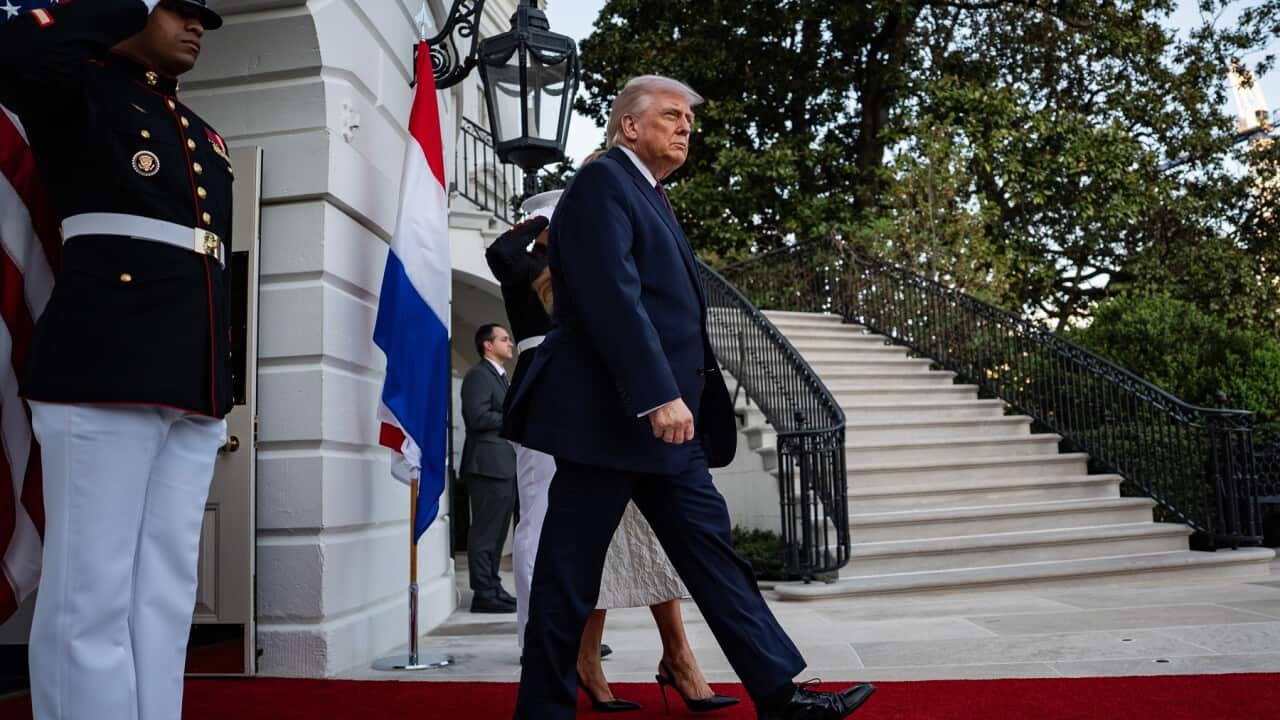
After a U-S imposed deadline passed without a ceasefire deal or plan to reopen the Strait of Hormuz, the U-S Commander in Chief issued another threat via social media, warning any ships that come close to the naval blockade will be eliminated and it will be quick and brutal.
The maritime block is the latest effort by the U-S to force Iran to open the Strait of Hormuz and accept a deal to end the war that has raged for more than six weeks.
Iran has responded with threats on all ports in the Persian Gulf and the Gulf of Oman, taking aim at American-allied countries.
Talks aimed at permanently ending the conflict, failed to reach an agreement this past weekend in Pakistan.
There has been no word on whether negotiations will resume.
Mr Trump would not comment on whether he will uphold his promise to end Iranian civilisation if its government does not reach a ceasefire deal with the U-S, but says the consequences would not be pleasant.
"Right now there's no fighting. Right now we have a blockade. They're doing no business. I didn't like seeing boats come out if they were doing business with Iran, but if there weren't, no boats came out. So now they're doing, Iran is doing absolutely no business, and we're going to keep it that way, very easily."
The leader has criticised NATO allies for not assisting in the Strait's reopening, recently voicing disappointment in nations, including Australia.
Prime Minister Anthony Albanese is in southeast Asia [[Tues-Wed]] to shore up fuel and fertiliser in the face of a national supply crisis caused by the war in the Middle East.
Meanwhile, his deputy Richard Marles, has told ABC's Radio National that Australia's help to reopen the Strait is conditional.
"We are working with all of our partners around efforts that are being taken forward in respect of the Strait of Hormuz and how Australia can best contribute. But, what I'd say about that is that all of those are predicated on when conditions allow that to occur and right now that is very uncertain. And we really need to see what plays out throughout the remainder of the ceasefire."
This week, Britain and France will co-host talks with dozens of other nations, as British Prime Minister Sir Keir Starmer re-iterated the U-K will not be drawn into the conflict.
"And let me be very clear, this is about safeguarding shipping and supporting freedom of navigation once the conflict ends."
Mohammed Islami is a research fellow at Tehran University.
He says the U-S may be selective in the vessels it targets, after a request from Beijing.
"The main export, the main customer of the Iranian oil is China. And China right now, their finance ministry declared that we do have a bilateral relationship with the Iranian government and asked the US government not to make problems for the cargo going from Iran to China. So, I am not sure if the Americans want to attack the VLCCs and supertankers from Iran to China."
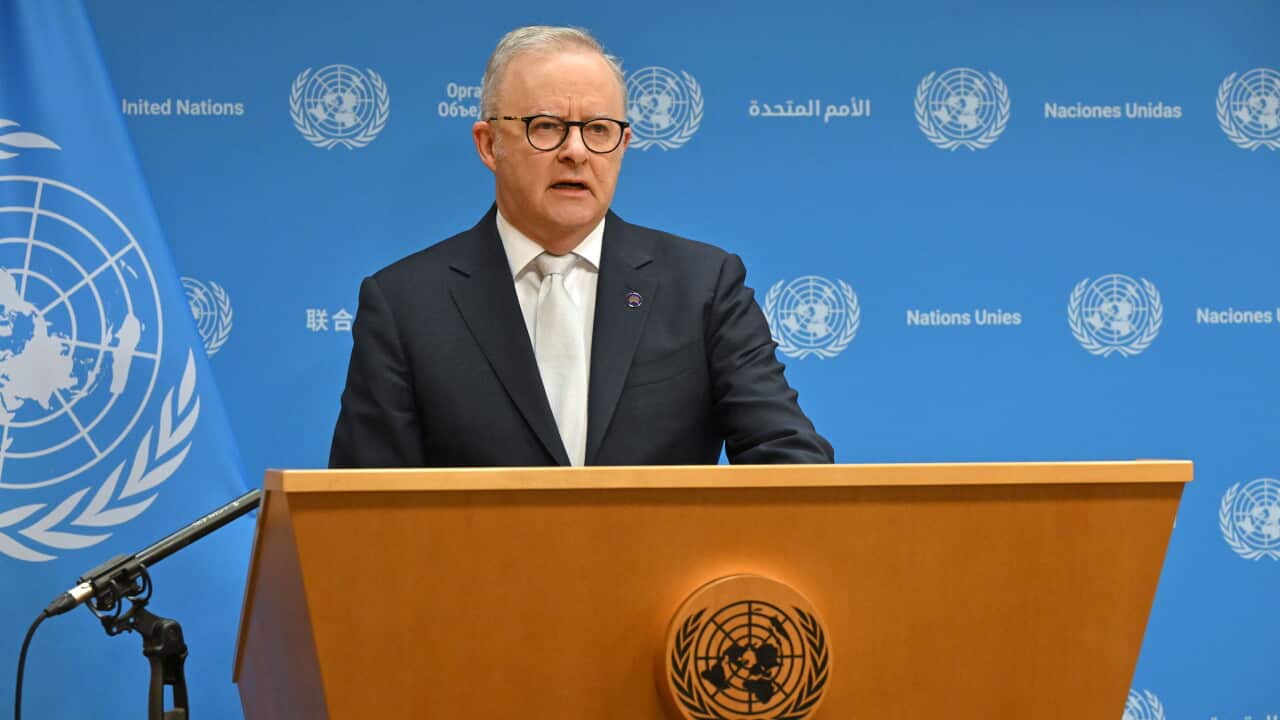
The United Nations Secretary General has warned both parties over breaching international law, stressing the need for freedom of navigation through the strait, via his spokesperson Stephane Dujarric.
"We need to remember that some 20,000 seafarers have been caught up in this conflict and are currently stranded on ships, with hardships increasing daily. Disruptions in the maritime trade through the Strait of Hormuz have already had a direct impact well beyond the immediate region, with increased global economic fragility and insecurity in many sectors. The disruption of fertilizer and related raw material is already having a very negative impact on agriculture, worsening the prospectives of food insecurity."
Various U-N delegates are engaging with the International Maritime Organization (IMO) and the International Chamber of Commerce to design a possible mechanism through which the strait can be reopened for global trade.
Iran wants to impose a toll on maritime traffic through the passage.
Addressing an audience in Washington, Finland's President ,Alexander Stubb described the conflict as a war of choice by the U-S and Israel, which has ultimately made Iran's position stronger.
"I just, I guess, wonder what will happen if they will be at loggerheads with China on this. So there are just so many different complicated aspects to this, and we're all trying to find an off-ramp right now. Which is not going to be easy but at the end of the day usually is doable, but Iran holds a lot of the cards right now, I'm afraid that is the reality."
The European Union is meeting in the coming week to discuss how to manage the fallout of the crisis, with an electrical energy package to be unveiled as part of its response.
E-U Foreign Policy chief , Kaja Kallas, says it will reject any arrangement that limits free and safe passage through the Strait.
"Protecting the freedom of navigation is not only challenge today. Submarine cables and pipelines are already targets for sabotage. For this reason we should step up, work towards a new multilateral agreement to establish legal certainty and develop the tools to address these threats."
Germany's Foreign Minister Johann Wadephul [[yo-hahn vah-de-full]] has voiced his support of the US in pushing Iran to commit to abandoning pursuit of nuclear weapons, but says the world is suffering from the Strait's closure.
(German to English VO)"We have crisis negotiations here about the need to lower gasoline and diesel prices. On the African continent, we are now worried about a widespread famine this summer because the necessary fertilisers cannot be transported. In large parts of Asia, there is an acute shortage of fossil fuels."
The head of the International Energy Agency, Fatih Birol, has told an Atlantic Council event in Washington more than 80 oil and gas facilities across the Middle East have been damaged.
He says a long-term solution needs to be found to end the global fuel crisis, and another release of oil reserves would provide only temporary relief.
He says the agency is prepared to approve a second release of global oil reserves, but hopes it won't be needed.
"This is not a solution. This is just reducing the pain, even though it was the biggest oil stock release that I announced 11th of March. It is only 20 per cent. Still we have 80 per cent in our pocket. And if we are going to release again. This will be depending on our assessment and discussion with our member countries. I very much hope we don't need to do it. But if it is needed, we are ready to act immediately."