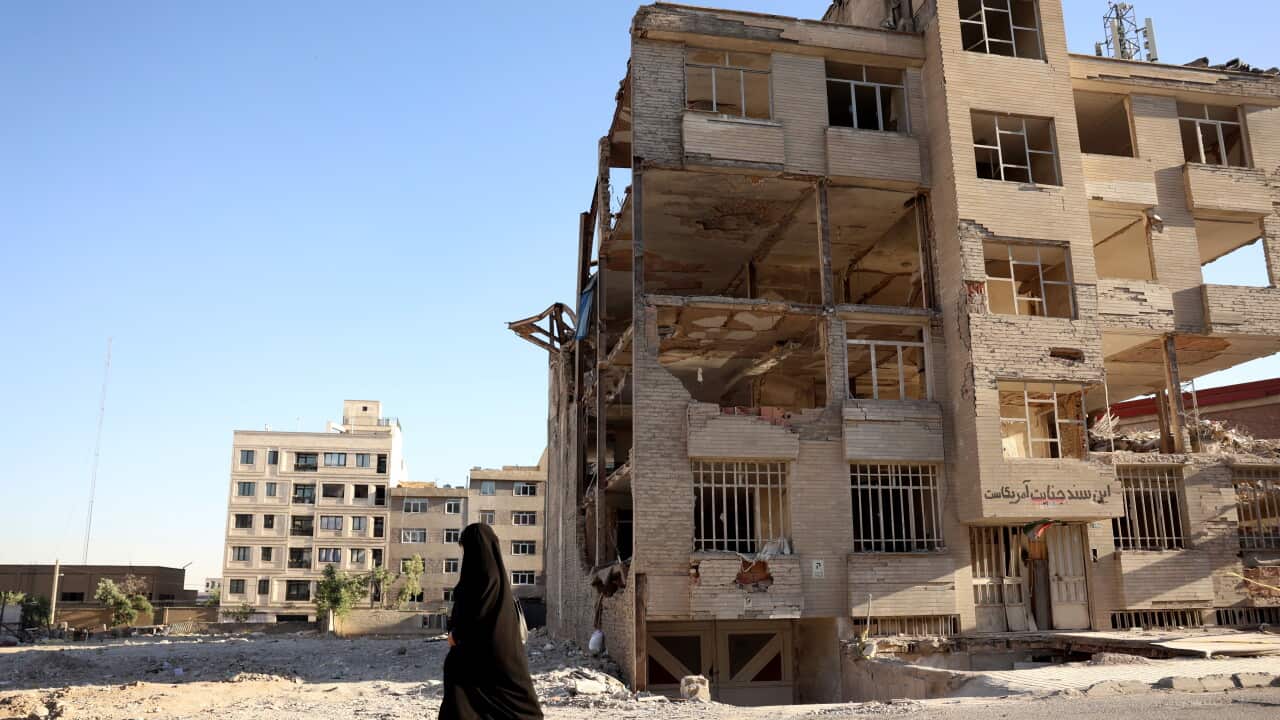

The fighting between Iran, Israel and the United States may have eased, but the political battle over what comes next is only intensifying. From Washington to Tehran, Lebanon to Gaza, negotiations, accusations and ongoing violence are shaping the region's future.
Listen to Australian and world news, and follow trending topics with SBS News Podcasts.
TRANSCRIPT
The missiles may have stopped, but the arguments haven't.
Months after the United States and Israel launched strikes against Iran, the political battle over the war is intensifying - not in Tehran and not in Tel Aviv, but in Washington.
In the US Democratic Senator Chris Van Hollen has opened a new line of attack this week, accusing President Donald Trump of blindly following Israeli Prime Minister Benjamin Netanyahu into an escalating Middle East conflict.
His criticism was aimed at the policy, but it quickly became personal.
"Netanyahu said he's been waiting 40 years to do this. It turns out he finally found a president who was both stupid and reckless enough to join him. The war has killed 14 American service members, wounded hundreds more, and killed thousands of civilians. It's driving up the price of gas, food and much more. ... Let's face it, Mr. Secretary, the Trump foreign policy has become a dumpster fire."
The Trump administration sees things very differently.
US Secretary of State Marco Rubio argues the war achieved something previous administrations could not.
It brought Iran to the negotiating table.
“For the first time, certainly in my memory, they have agreed to negotiate aspects of their nuclear program that just a month ago, just a year ago, they were refusing to even mention, much less enter into discussions about. That is not a guarantee that ultimately will lead to a deal that's acceptable to the Senate or acceptable to the American people, but we will be able to engage them in a process to truly test the proposition of how far they are willing to go."
That opportunity is now shaping decisions across the region.
News outlet Axios reports it has also created tension between President Trump and Prime Minister Benjamin Netanyahu, with Mr Trump reportedly confronting the Israeli leader over military action that risked undermining negotiations with Iran.
Neither side has confirmed the report.
At the centre of those talks is the Strait of Hormuz, a vital route for global oil and gas supplies.
Iran tightened its control of the waterway after the conflict began in late February, but Iranian media says ships can again apply for transit permits, with the Revolutionary Guard claiming 24 vessels have already passed through.
Reopening the Strait remains a key U-S objective.
But diplomacy surrounding a possible deal extends beyond Iran.
Lebanon.
While negotiators discuss Iran's nuclear program and the Strait of Hormuz, fighting continues along Israel's northern border.
Lebanon says Israeli strikes this week killed at least ten people and wounded more than 130 others.
Israel says it is continuing operations against Hezbollah targets, after a Hezbollah drone attack injured four Israeli soldiers.
At the United Nations, U-S ambassador Mike Waltz outlined what Washington sees as a path towards ending the conflict
“President Trump, who cares deeply about Lebanon personally, has proposed a clear sequence to end the conflict. Hezbollah, which started the fighting, must stop its attacks in Israel. This will create space for a gradual de-escalation, as my colleague from Somalia just mentioned, and ultimately a cessation of hostilities. Yet Hezbollah has repeatedly rejected this offer. Today, again, thanks to President Trump's personal intervention, we'll see if they choose differently.”
Whether that happens may determine how far the negotiations can go.
It also brings diplomats back to another unresolved issue: Iran's nuclear program.
The war may have slowed Iran's nuclear activities, but questions remain about what comes next.
Any future agreement would require independent verification, a role likely to fall to the International Atomic Energy Agency.
Director General Rafael Grossi says no deal can work without inspectors.
"It is obvious that the IAEA (International Atomic Energy Agency), would have an indispensable role, in any type of agreement, because it's not conceivable that you will have one without, a very robust verification and monitoring of the terms. And we have been, trying to help and trying to contribute in the previous iterations of these conversations."
Mr Grossi says many activities linked to uranium mining, processing and enrichment have stopped since the war.
Whether that pause becomes permanent remains unclear.
But while attention focuses on Iran and Lebanon, many Palestinians say their own crisis is being overlooked.
In Gaza, residents say the war never stopped.
Street vendor Hassam Faqaawi says the world's attention has shifted elsewhere.
“Here in the Gaza Strip, we are forgotten. Of course, there is war. Whoever says there is a truce, it is a lie. We have no truce, everyday there are strikes. Here, we can die at any moment. Gaza is totally forgotten. The entire world is looking at Lebanon, and Iran, and talking about the U.S. Here in Gaza, no one knows about us like they used to do. The strikes. Every day, we have martyrs in Gaza.”
While politicians continue to trade fire in Washington, many families in Gaza are still focused on something far more basic - getting through another day.
And for some Palestinians, the violence is not confined to Gaza.
In the occupied West Bank, a Palestinian family says Israeli settlers attacked their vehicle while they were driving home from visiting relatives.
Several children were injured when stones were thrown at the car.
Twelve-year-old Yehia suffered a skull fracture.
His father, Yousef Mazahem, says the attack unfolded in seconds.
“The children started screaming, my son Yehia was covered in blood, a stone hit his head, and my other son Abdullah started shouting: ‘Dad, my brother is covered in blood’.”
Israeli police say an investigation has been opened into the attack.
But for Mr Mazahem, the lasting damage isn't measured by hospital reports, it's measured by what happens to his family.
“My son who is one year and two months was crying all night, and Omar, what can I say, they are children. I was attacked by settlers in Jiljilya and Sinjil more than once, so it is not our first time. My children are living in fear both at home and outside the home.”