
The World Health Organisation has declared an Ebola outbreak in the Democratic Republic of Congo and Uganda is a public health emergency of international concern. The WHO says it does not meet the criteria of a pandemic emergency, but that countries sharing land borders with the DRC are at high risk of further spread.
Listen to Australian and world news, and follow trending topics with SBS News Podcasts.
TRANSCRIPT:
For residents of Goma in the Democratic Republic of Congo, there has been much to fear from the hostilities that have been raging between government forces and rebel fighters.
The city was the site of a rapid rebel offensive in early 2025, and the conflict between the Congolese armed forces and the Rwanda-backed M23 rebel paramilitary group has displaced hundreds of thousands.
Now, Goma resident Alain Bisimwa says there is something else to fear.
"In truth, we’ve been hearing about Ebola for several years now, first in Equateur province, then in North Kivu, and now here in Goma, which is truly heartbreaking. We are asking the government to implement measures because we don’t know what to do. The insecurity is already a problem. And now this disease has added to it."
Alain is referring to confirmation of the first case of Ebola in Goma.
The latest outbreak of the disease is largely being driven by the Bundibugyo strain of the highly contagious Ebola virus.
Overall, there have been more than 300 suspected cases and 88 deaths across at least three health zones.
But DRC Ministry of Health scientist Dr Misaki Wayengera says improved patient care standards have helped reduce fatality rates in recent outbreaks, and they're confident of applying what they've learned to this situation.
"Because in the past we would run away from Ebola patients. We leave people, we can't even handle them to give them some resuscitation, some infusions. These people need some support for their circulatory system. They are losing a lot of water, they are losing blood, they need to be supported. But now as our care has improved, we've learned that we can reduce the fatality rate."
The World Health Organisation remains on alert.
It has declared a public health emergency of international concern, a statement that Jennifer Mbabazi from the Ugandan city of Kampala says has caused considerable concern for the potential economic impacts as well as health.
"It worries us because the government might put a lockdown and stop us from working."
But the W-H-O says it does NOT want travel and trade restricted, for fear that will encourage informal border crossings that are not monitored.
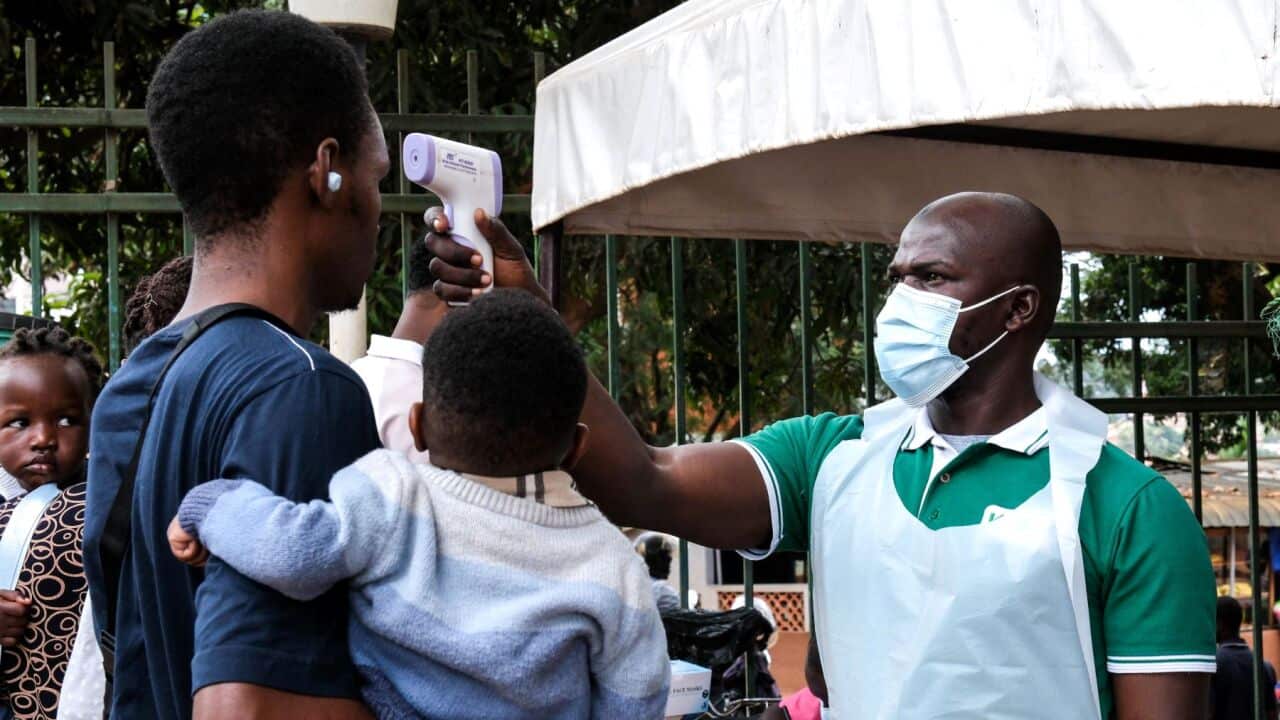
It's advised countries to activate their national disaster and emergency-management mechanisms and undertake cross-border screening and screening at main internal roads.
However, the larger issue is access to effective treatments, given that nothing currently exists to combat the Bundibugyo variant, and existing vaccines and therapeutics for other Ebola viruses are not made in Africa.
Dr Jean Kaseya - from the Africa Centres for Disease Control and Prevention - says that adds a layer of complexity and cost in an already challenging environment for access to vital resources.
"This is the equity issue. And Western countries, they don't understand that when Africa is affected, they are also at risk because people are flying every day. And it means building a strong system, supporting Africa. Investing in Africa to have the local manufacturing of our vaccine and medicine is also the way to protect Western countries."
Despite these challenges, the response within the D-R-C is proceeding.
DRC health minister Samuel Roger Kamba says government authorities have already selected sites in Rwampara and Mongwalu to establish new treatment centres.
WHO representative Anne Ancia says additional medical supplies are being airlifted into the country after emergency stockpiles in Kinshasa were depleted during the initial response.
W-H-O director-general, Tedros Adhanom Ghebreyesus, says the organisation is fully prepared to back the response.
"I have released $500,000 from WHO's contingency fund for emergencies to immediately support the response."
Some residents, like Ugandan resident Naome Kayondo say education is important as the outbreak unfolds, because some people don't understand how they could be affected.
"I would like the government to one, quickly spread awareness about Ebola and how it is spread, to break down this information even for the layest of people to understand. But also start to institute measures to avoid the spread of Ebola in Kampala and Uganda as a whole so that there is a feeling of safeness and security against this disease of Ebola."
Dr Misaki Wayengera says early detection is also vital.
He has called for affordable point-of-care testing and automated systems to help clinicians quickly identify suspected cases.
But violent conflict with militants, some backed by the Islamic State group, as well as constant population movement because of mining within Congo and across the border in Uganda, have posed a major challenge to the response.
Still, Benjamin Mbonimpa from the AFC-M23 Congo River alliance rebel coalition says the group has everything in hand.
"Two meetings have been held and the means have been provided. Medical staff are in place, technical teams are in place. Everything is already under control."