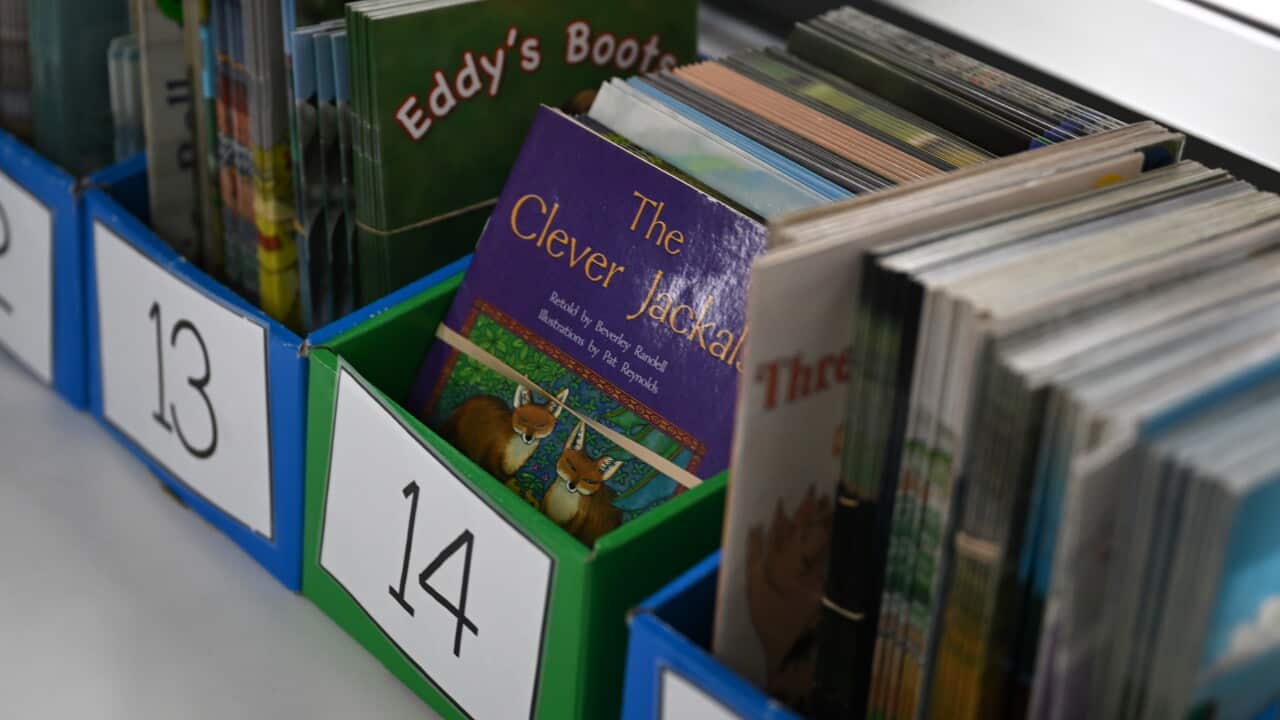

From the page to the playground, annual Book Week celebrations have long brought Australian children’s stories to life. Now, as national recreational reading rates decline experts and authors say engaging young people with literature is more important than ever.
Listen to Australian and world news and follow trending topics with SBS News Podcasts.
TRANSCRIPT
What makes a good man?
It’s a complex question but one that writer, Barry Jonsberg decided to confront after speaking with his wife one night.
“My wife, who’s an English teacher, and I was an English teacher for 38 years ... so, she said to me, I had a strange conversation with a Year 10 boy today and he came up to me and said, ‘Miss, I’ve tried all my life to please my dad, but I don’t think I ever will’.”
Like many of Barry’s stories – which are inspired by everyday interactions or small ideas – he found himself turning to the page in search of answers.
"And so, this notion of a boy who had a story, an untold story about his father and how he was disappointing him, that stayed with me overnight and I started the book the following day.”
Barry has since penned and published the young adult novel, Darkest Night, Brightest Star, which examines notions of masculinity and parental expectations.
It’s proving popular with young readers too, recently picking up a prize at the Children’s Book Council of Australia’s Book of the Year Awards.
The ceremony marks the beginning of Book Week, an annual event which celebrates Australian children’s literature.
It’s a time when students swap out their school uniform for capes, crowns and colourful costumes at school Book Week parades and literary activities.
“So, I remember dressing in various costumes and parading through and having the opportunity to meet a lot of my favourite authors, right from a young age. I think I was totally spoilt as an individual about who I got to meet and the kind of book world I was able to inhabit.”
That’s Kate O’Donnell, the national communications convenor at the volunteer run CBCA organisation.
She believes that Book Week has become a distinctly Australian tradition but says the initiative originated overseas.
“The first book week was in 1945, and it was actually part of an international Movement from the Children’s Book Council in the United States ... with the theme United Through Books and it was part of this sort of global activity.”
In the aftermath of World War Two, books and libraries were often promoted as instruments which could contribute to world peace.
But 80 years ago, Australian children’s literature was few and far between, with the publishing market saturated with British titles.
The publishing industry has since expanded in Australia, with Book Week celebrated by schools, libraries and early learning centres alike.
But the event has also stirred criticism from some parents who say they feel pressured to buy or create book parade costumes during a cost-of-living crisis.
“In the past couple of years, we’ve had that backlash about the costumes and the parades and the pressure that it puts on families. It’s been really, really heartening this year to see some sort of counter arguments or counter celebrations to that ... it’s about celebrating books. It’s about that joy of reading.”
According to Anna Burkey, CEO of national not-for-profit organisation Australia Reads, national recreational reading rates are declining.
"We have seen a fairly progressive downturn trend over the last several years in terms of rates of reading, and that’s both the number of people who are reading at all, but also how often they’re reading and how long they’re spending reading."
But the number of South Australian teens who said they never read for fun increased from around 10 per cent in 2019 to more than 52 per cent in 2022.
That’s according to a survey of more than 14,000 children and teenagers in the state, published by the University of South Australia in November last year.
“Which is highly concerning and a significant jump on the previous stats we had from Deakin University which showed that about a third of young people weren’t reading. So, it seems to be increasing; it's an escalating situation."
Burkey says events like Book Week can help children discover new books, while normalising discussions about reading habits.
“So, when it comes to how we fit books into our daily life, showing other people how to do it is really effective ... is it something before breakfast that works in your household? It does for some; for other people, it’s bedtime and about a quarter of Australian children don’t get a bedtime story at the moment.”
Physical print books remain the most popular format for reading but audio books and e-books are on the rise.
Children’s information and picture books can also enhance storytelling for young people.
Ben Williams, a Warlpiri and Warlmanpa man and contemporary artist, was shortlisted for this year’s Book Awards for his illustrations in Caution! This Book Contains Deadly Reptiles.
It features vibrant illustrations, First Nations knowledge and traditional names for more than 60 different species of reptiles.
“It took me nine months to illustrate, so it was a very, very long time. I would do it on canvas sheets. I did the realism reptiles, so you see the gecko, goannas, snakes, pythons and lizards on there ... So, it would start off looking like you know, Play School kids painting and then it developed from there when I applied more detail in.”
It’s the first time Williams has ever completed book illustrations, and he’s received a positive reception from young readers.
“Getting to sign some books for young ones and how they really you know love how cool our reptiles are, I think that’s really exciting to hear all the feedback ... It’s important that we get to re-educate everybody about our diverse reptiles in Australia, as well as the traditional landscapes of each reptile.”
Williams has fond memories of Book Week events as a child.
He hopes his recognition at this year’s awards will inspire young people to keep creative and keep reading.
“We are producing works not just for the sake of producing a work but to inspire and create a ripple effect when people are reading our books. So, representing all these young Aboriginal and Torres Strait Islander kids as well as for me, a desert young fella, my Mum’s from NT, so I get to also show that desert mob can also achieve this amount of success.”