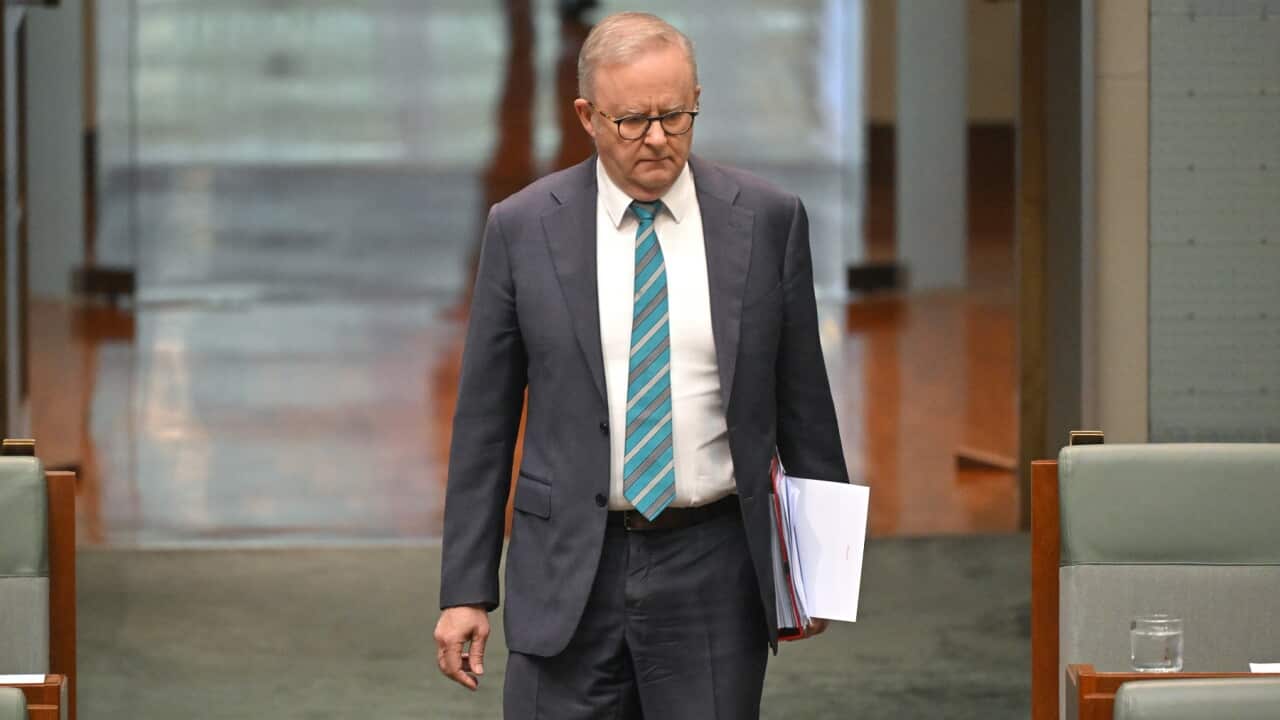
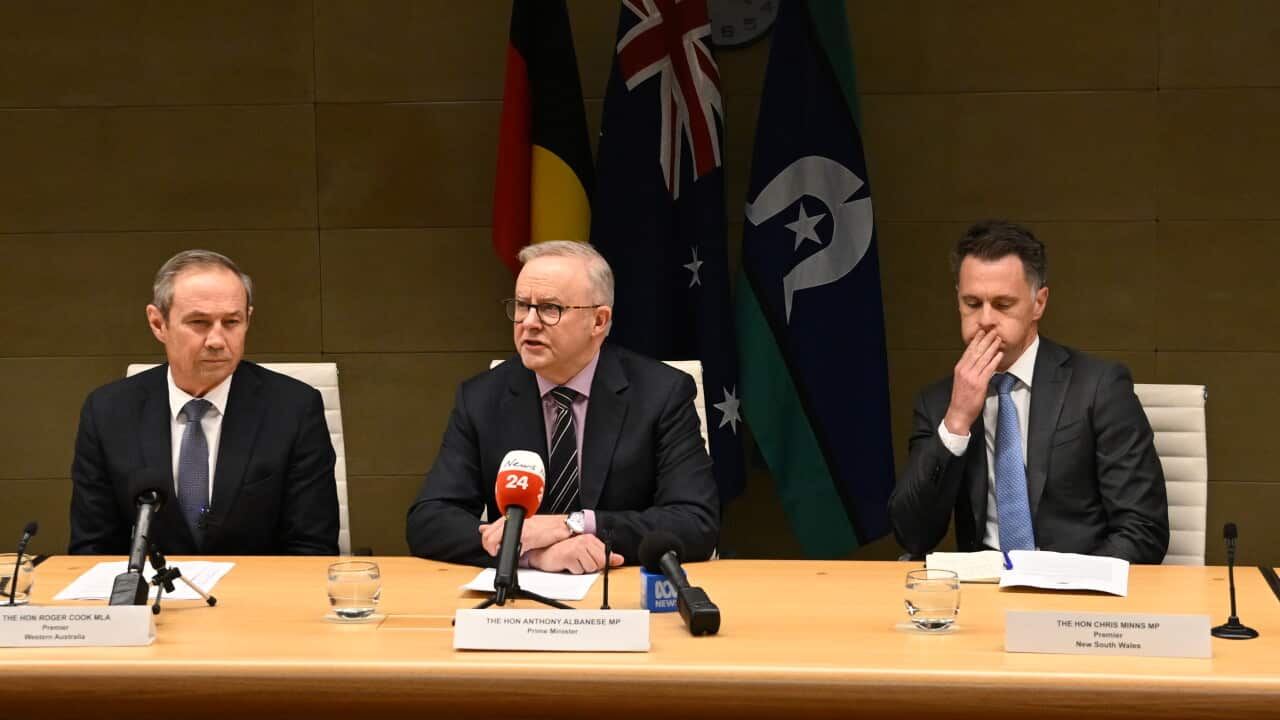

A meeting of federal, state and territory leaders left Prime Minister Anthony Albanese conceding on a renewables mandate for data centres. Also on the agenda: a national response to a domestic violence risk framework, gun reforms and an extra $125 million for the ongoing response to bird flu.
Listen to Australian and world news and follow trending topics with SBS News Podcasts.
TRANSCRIPT
The meeting ran long, with contentious issues on the agenda.
Tensions remain over laws on artificial intelligence, with Prime Minister Anthony Albanese conceding states may have to be treated differently, with some opposed to a proposed ban on new data centres being powered by coal and gas.
"We have buy in on Australia's national AI laws, I certainly understand different states have different issues but we know the priority is keeping our energy costs low and making sure it doesn't add to the development of data centres losing social license, and there's agreement across the board from all jurisdictions that we need to ensure that social license has occurred."
Adopting a more "flexible" approach as Queensland and the N-T have forced the prime minister to back down on a major policy proposal requiring all new AI data centres be powered by renewable energy.
The final national agreement failing to mention renewable energy directly.
Queensland Premier, David Crisafulli, says the situation is different in his state, because t he state government owns the electricity generation, transmission and distribution networks.
"That enables us to control that energy mix and we've done that well and our energy plan shows that so what this does is enables us to send messages and states can absolutely participate as the PM says in that social license, each state will have a point of difference, and we believe that we can control our data sovereignty, protect our local communities and enable that energy mix to bring those data centers on and that comes with the point of difference we have in our situation."
Greens Senator, David Shoebridge, remains unconvinced.
"What benefits are they delivering to communities and the public, large foreign owned data centres sucking down our data, sucking down our water, sucking down our power and offshoring the profits and the control to a handful of US tech billionaires, there's a reason the prime minister is not talking about that, its because they are frightened of a US response if we try to put some controls on US tech, but I can tell you now this Prime minister and premiers who sign off on this, they should be far more worried about the community's response."
Another hot topic was gun reforms.
Gun licences will be restricted to Australian citizens as part of measures to limit access to firearms following the Bondi mass shooting.
The national cabinet saw an agreement on some parts of the federal government's proposed reforms after the Bondi attack.
"There are three elements to this: one sharing commonwealth criminal intelligence with states and territories, secondly, making Australian citizen ship a condition of holding a firearms license, subject to agreed exceptions, and thirdly, prohibiting the manufacture of 3D printed firearms and the possession and distribution of material for manufacturing 3D firearms."
But with Liberal and National governments in the Northern Territory, Tasmania and Queensland declining to sign up to the federal scheme.
The Prime Minister says his door remains open, pointing out that WA had already launched a buyback prior to the Bondi attack.
"The offer is open to states and territories but we intend to proceed, if states and territories are responsible for their own decisions, but today this agreement, three part agreement is really important and every state and territory has signed up to it."
The states also agreeing to a new national and domestic violence risk assessment framework.
States and territories agreed to speed up work on policies aimed at reducing gender-based violence such as improving backing for victim-survivors, enhancing support for children, and countering harm online.
A risk assessment framework will also be developed to improve safety for people who experience domestic violence, and will be provided to police, GPs and hospitals to identify warning signs.
But advocates say the measures in addressing domestic violence do not go far enough to address the issue.
The meeting also confirmed a Federal Government boost to bird flu response funding of $125 million.
But the $60 billion question was the carve up of the GST, of which WA is the big winner.
"I think that Western Australia deserves its fair share, people are aware of my position on that, but I support every state and territory."
Asked if his home state - New South Wales - deserves a bigger cut of GST funding, Prime Minister Albanese highlighted two big projects in the Hunter region.
"Under my government, NSW will always get support, we were in Tomago last week with a $2.5 billion joint announcement, on Friday I'll be at Raymond Terrace for the opening of the extension there, a billion dollar commitment from the Comonwealth that will be open, we'll continue to work with every state and territory."
The Productivity Commission has called for an overhaul of the system, prompting WA Premier Roger Cook to label the body "east coast clowns" earlier this month.
Treasurer Jim Chalmers saying the comments were not appropriate.
"I think you can disagree with the conclusions of the Productivity Commission without denigrating them. I think it's important that even when those conclusions are contested as they often will be that we continue to respect the people of the PC and the really important work they do."