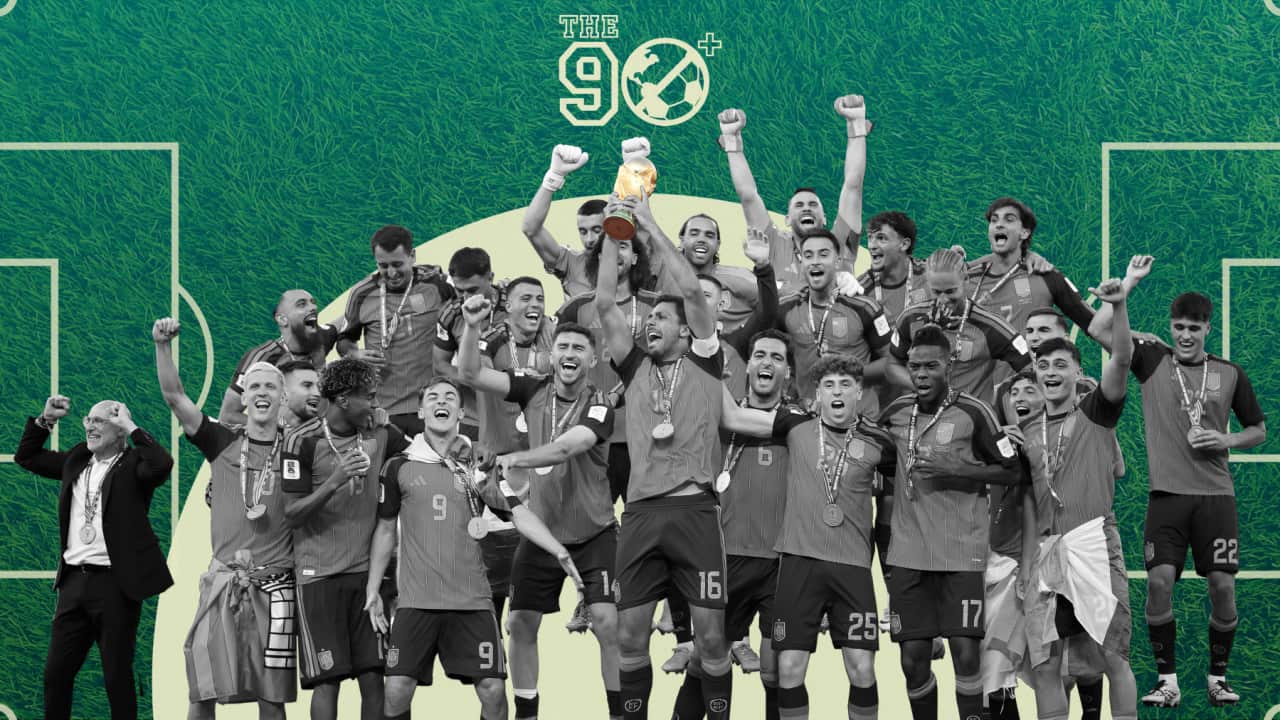
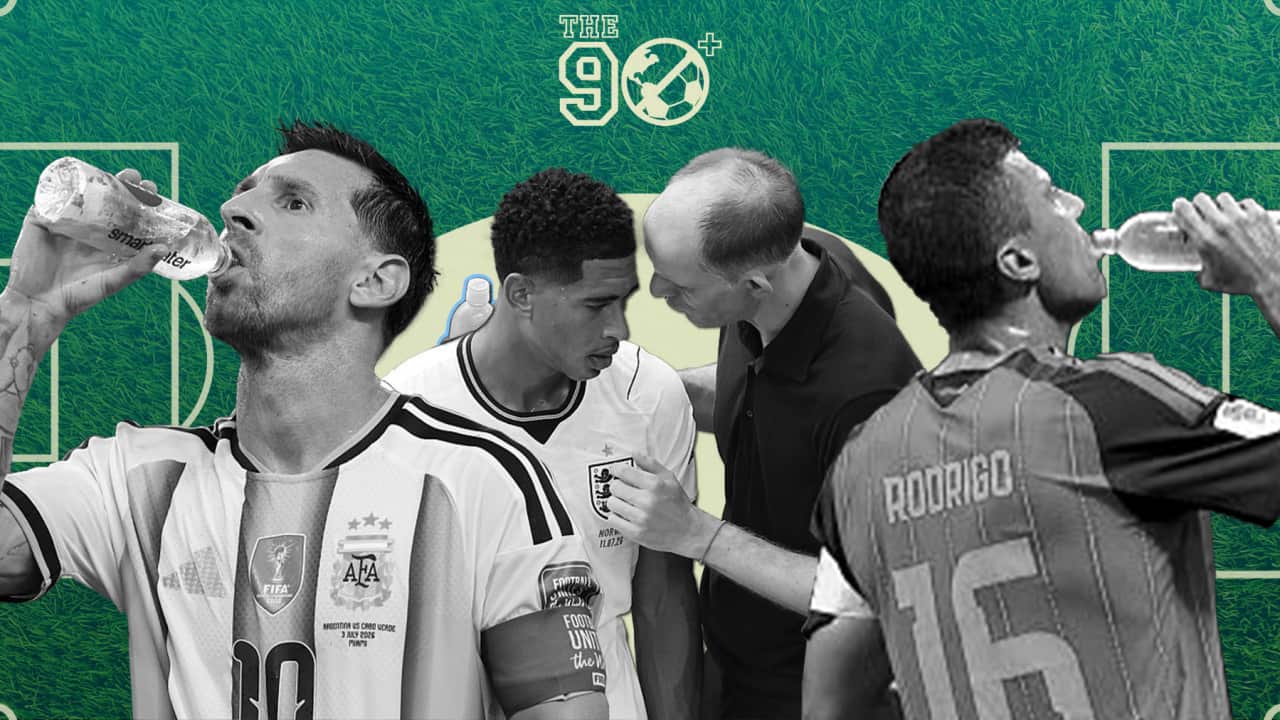

Join your host Haylena Krishnamoorthy for this bonus episode on World Cup Daily | The 90+ Podcast, as she chats to former players, a football coach, a sports academic and advertising expert to hear their perspectives on the controversial hydration break at this FIFA World Cup 2026™. Does the hydration break protect players in demanding conditions? Or is it disrupting the flow of the game? Will it stay? What does it mean for the future of football?
Listen to Australian and world news, and follow trending topics with SBS News Podcasts.
TRANSCRIPT:
Does the hydration break protect players in demanding conditions?
Or is it disrupting the flow of the game?
Will it stay?
And what does it mean for the future of football?
This is SBS News World Cup Daily, The 90+ Podcast, where we bring you the stories from on and beyond the pitch. And I'm your host, Haylena Krishnamoorthy.
FIFA's three-minute hydration breaks have become impossible to ignore at this tournament.
The new approach at this World Cup allows for referees to stop the match at 22 minutes into each half [[lasting 45 minutes each]] to allow players to rehydrate.
And this is regardless of whether the weather is scorching or not.
There’s been growing debate that the breaks disrupt momentum on the pitch, and that they exist to benefit broadcasters.
To find out what's really behind the breaks, I spoke to former players, a football coach, a sports academic and advertising expert to hear their perspectives on this.
"Ultimately no, not for me."
That's former Socceroo Harry Kewell.
Like Harry, not everyone is convinced the breaks belong in football.
He says if conditions are serious, that's one thing, but otherwise he's not a fan.
"It's not the way that we've been brought up on the game. But understand that if the temperatures are soaring hot, then yes, there needs to be a break in there that the players can get refuelled and up, it's not the one on the sidelines where the benches are, they can top up, it's usually the ones on the other side that struggle. So if the temperatures are soaring to a degrees where it's in a dangerous level for the players, then by all means have a hydration break. But I've seen majority of the games play in cloud, maybe in rain and in nice conditions where players don't need it."
He says it can shift the momentum of a match.
"The thought that having a break is a momentum killer, if you're winning the game and you have good momentum, the last thing you want to do is stop, but if you're in the receiving end of it, I can see the benefits of - I can regather my group, I can get them together, I can get more instructions, we've seen that in this World Cup that a lot of teams, have had momentum and then during the hydration break the managers come in, he's made his tactical change, he's given them a little bit of advice and you think the other team will come back to the game. So I understand in that sense if you're losing, you want the hydration break, if you're winning you want to keep them going."
Former Socceroo Tommy Oar echoes the sentiment.
"I think any footballer who's been in the game for a long time, doesn't like them, and it's not about the significance of the drink, the hydration of course if it's really high temperatures of 35-40 degrees and players need it of course in that situation players would understand, I think it's being called a hydration break, but in reality it's a commercial break."
For Tommy, it disrupts the flow and viewing experience for fans.
"Players aren't fools and fans aren't fools, and I think that the ... has been pulled over our eyes to some extend in that regard and I think that's where the frustration comes from, but when you're looking at a game and analysing it, a big part of football is the momentum of the game, you see a number of goals now being conceded or scored straight after these breaks because of the change in concentration, and I think the - part of the reason everybody loves football is the flow of the game and it's basically changed how that happens, so I think it's not something that football fans would come around to too quickly."
FIFA has said the mandatory breaks are to ensure equal conditions for all teams, in all matches.
Professor Geoff Dickson is a sports academic [[Director at Centre for Sport and Social Impact]] at La Trobe University.
He says most players understand the need to stop when temperatures become extreme, but he questions whether that's what is happening in this situation.
"On the one hand, they're all about player welfare, but on the other hand, they have been used to been used as it's created the opportunity for increased commercialisation of the game."
But just last month, FIFA President Gianni Infantino pushed back on criticism over hydration breaks.
He insists the breaks are about player welfare, not profit.
"I want to stress this because I hear as well, it's about money or things like, it is not. We don't make one dollar more revenues in FIFA with these hydration breaks. Because all our contracts were signed well ahead of the decision to have these breaks. Broadcasters maybe, they make, they generate more. I don't know, that's great for them. But for us, we make zero additional revenues."
Professor Dickson argues the biggest long-term impact may not be on the pitch, but in future broadcast negotiations.
"I have absolutely no doubt that FIFA will present this as a rationale for increased revenue generation for any future broadcast sales at future World Cups. I think it was a very weak defense on behalf of, FIFA to say that we're not making any money out of it this time. But the reality is this is now, I think the, the hardest part for FIFA was to introduce it the first time, and now that they have introduced it for the first time, the tournament has not collapsed because of it. These hydration breaks are here to stay, and they will be used to drive up the value of broadcasting rights in the future."
Professor Dickson says the conditions at many matches simply haven't justified the breaks.
"I guess the challenge or the opportunity for critics of the hydration breaks is to ensure that they stay at only three minutes in length, because I can see the situation getting a whole lot worse before it ever gets better. But the dam is broken, so to speak, and the, these hydration breaks will feature at, the next FIFA World Cup, and I suspect they will soon infiltrate the Women's World Cup as well as their underage events."
He says having transparency is essential in this scenario.
"There are certain circumstances where these hydration breaks would be absolutely justified in terms of playing in hot and humid conditions. But the conditions that the athletes are being exposed to, are not, are not meeting the threshold that would be of a concern to player welfare. I think FIFA was, is somewhat justified in saying, "Look, if we do it for only those hot and humid events and we don't do it for others, look, we're just gonna have a blanket policy, across all events. That way it's consistent." I think that is defendable, and it's a departure from what they've done in previous years where they left it at the discretion of the referee and or you know on a case by case basis. The good news now is that the athletes know what they're getting. They know that every, every match is being played under these conditions."
In the 2014 and 2022 World Cup, cooling breaks were allowed at the discretion of the referee.
And this was the same for the Euro 2020 tournament.
At the 2025 Club World Cup, there were calls for cooling breaks, as there were concerns among players, coaches, and fans about scorching heat.
The regional manager for advertising agency, AdRoll based out of Sydney, Kubhandren Padmanabhan says while he fully appreciates the sentiment of the hydration breaks being disruptive, it's important for the sport to evolve and meet more strenuous needs of the game.
"I'm in favour of the hydration breaks, and I think there's a couple of variables to consider. I think one is obviously the local conditions at the host nations. When the temperatures are higher, and I think we saw this in the previous World Cup in the Middle East as well in Qatar, when these temperatures are high, you wanna make sure that the players have an opportunity to hydrate, and they stay fit and reduce the risk of injuries. The other piece is, you know, when you have a larger sample size of nations at the World Cup, fitness levels are different across the different teams. Not everyone gets the exposure that, maybe the English or the Brazilian players might have throughout the course of the season leading into the World Cup, and therefore, a lot of them are coming in having played, at least 40 to 50 games, of regular season football leading into that."
He also points out that unlike sports such as basketball or American football, football offers very few natural opportunities for players to recover.
"Some of the top countries, the competitive ones, their star athletes, they've been playing an additional 20 games. So they're coming into this not exactly fresh. This would've been their summer break. So to go straight in from, playing competitive football into the World Cup, I think the hydration break under these extreme weather is necessary. And the other piece is, you know, unlike other sports like basketball or maybe American football, there are naturally more intermissions in the sport that allow the player to catch their breath. But in football you have a 45-minute block and then another 45-minute block, and then, extra time is, is two blocks there. It's a lot of, high activity or high heart rate activity, lots of legs required, and what, what the spectators and the spectacle doesn't want is injuries. So I think, it makes a lot of sense."
And says that doesn't necessarily mean FIFA is making that money directly.
"With regards to Infantino's comments around, FIFA not making any money there's some truth to it, but I think it's important to understand it in more depth. If we were to just look at the hydration breaks, there's, two of them in a game. They go from anywhere from two and a half to about three minutes. So if you look at a 30-second block, that roughly accounts for about four blocks in each break. And we consider buffer times as well before they go back to, showing the teams and then, resuming play. So we're looking at about eight slots a game. These slots, 30-second slots range anywhere from around 200 to 300,000 US dollars. So, the revenue generated in a game, in a group stage is about 1.5 to about $2.5 million."
But he shares with me that the commercial value is undeniable.
"This obviously naturally goes up as the games become more competitive. The round of 32, it goes up to about 4 million, and then the quarterfinals about 5 million, and then about five and a half, and then in the finals you're looking at about $6 million. So if, if we factor that in with the, expanded number of countries at the World Cup, you're looking at, 70-plus games in the group stage and 32 knockout games and then 104 total games. It's quite a bit more revenue that these broadcasters are generating. It can go up to about 600 million US dollars, for each broadcaster."
So to put that in perspective, it can go up to about 800 million AUD - but Padmanabhan says each broadcaster has varying arrangements.
"Some will utilise the breaks for ad placement, some will use it to go to the studio and have a bit of a discussion on what the first 20 minutes looks like. That's entirely up to how each, broadcaster chooses to use those slots. But let's just use the, the Fox example, for instance. So they will re- generate somewhere from around 400 to $600 million just from the hydration breaks. And in the previous World Cup, the agreement that they struck with FIFA was for about $485 million. So you expect that number to go up, but just from the hydration breaks alone, they're probably gonna break even on their investment. So there is a lot of value for the broadcasters in this. FIFA doesn't take this money. This is the broadcasters pay for the rights, and then what they do with that time is entirely theirs to, to decide on."
Padmanabhan believes the real benefit for FIFA comes later.
"But where this really helps FIFA is in the next round of negotiations when the Spain, Portugal, Morocco World Cup rolls around in four years' time. This puts a very powerful bargaining chip in favor of FIFA. They'll be able to understand these numbers better, and they'll be able to bring this to the table to increase what their broadcasting, fees are going to be to the respective, networks."
And that the expanded format is, is here to stay.
Former A-League [[Central Coast Mariners coach and Sydney Football Club assistant]] coach Phil Moss says regardless of the commercial argument, football's greatest strength is its uninterrupted flow, and that's what risks being lost.
"I'm not, not a fan because our game is all about fluency and, you know, as soon as you go into a break like that, it breaks the fluency of the game, and, we've already got issues around fluency because of VAR and the time that it takes to, to make decisions. So you add hydration breaks to, to VAR breaks and, all of a sudden, the beautiful flow of our football games has been adversely impacted."
And some of the game's biggest names have weighed in.
Newly-appointed Germany head coach and Former Liverpool manager, Jurgen Klopp, says two and a half minutes is unnecessary for a water break.
But he jokes at his age, it's a welcome break.
Netherlands captain and Liverpool defender, Virgil van Dijk said they're understandable in extreme heat but it's not something he'd like to see every match.
Former Matildas goalkeeper Lydia Williams says the breaks shouldn't be an indication, or false hopes for the younger generation that this is how every game's gonna be played.
"I think that's ridiculous. I think, I've had hydration breaks before when the weather's been like 38 degrees or 36 degrees, and fair enough. But to have it when it's, raining and, a cold night, and I think Mexico had a downfall, a pour, and they had hydration breaks. I think, there's no use for it in the game. It kinda, it adds more minutes on, and then you're kind of playing games of 22 minutes, per quarter versus, you know, two 45-minute halves."
She says the addition of hydration breaks, has in some ways, disgruntled teams and then the games aren't as exciting to watch.
"It's kinda taken a little bit of the bite out of the game a little bit, and it made it more tactical, when you kinda want it more free-flowing. I think everyone complained about VAR anyway- and referees because it stopped the flow of the game. Now this has kinda done that to a even greater degree."
Former Matildas player, and chief operating officer of the 2026 AFC Women's Asian Cup, Sarah Walsh says the breaks could help, or hurt players.
"I'd be surprised if we see it at the next World Cup and, I think what, what we're seeing is the unique, nature of what hosting a tournament looks like in the US and within CONCACAF, and it might not look the same in Europe, and it might not look the same in South America. And so, I mean, yeah, we really shouldn't ask the players 'cause it, it either helps or hurts them depending on the situation."
But she says it's a good opportunity for coaches to regroup with players.
"But it's another opportunity for coaches to get time with their players and the coaches that use that well. It's also for the, the less developed, nations I think can use it as an advantage to - you can break down the game in, in four quarters now, and if you're still nil all at the last hydration break, it's likely that you're pushing it to penalties 'cause you're able to kill that momentum."
Whether fans see them as a necessary safety measure or an unwanted commercial timeout, one thing is clear.
Besides VAR, hydration breaks have become one of this tournament's biggest talking points.
And with another World Cup just around the corner, the question now isn't whether the debate will continue.
It's whether these hydration breaks are here to stay.
I'll be back with you on Sunday for the match between England and France.
To catch up on the latest, you can head on to SBS On Demand.
Stay tuned for the latest at the World Cup Daily | The 90+ Podcast.
And to get the latest World Cup news, check out SBS News Headlines, wherever you get your podcasts.