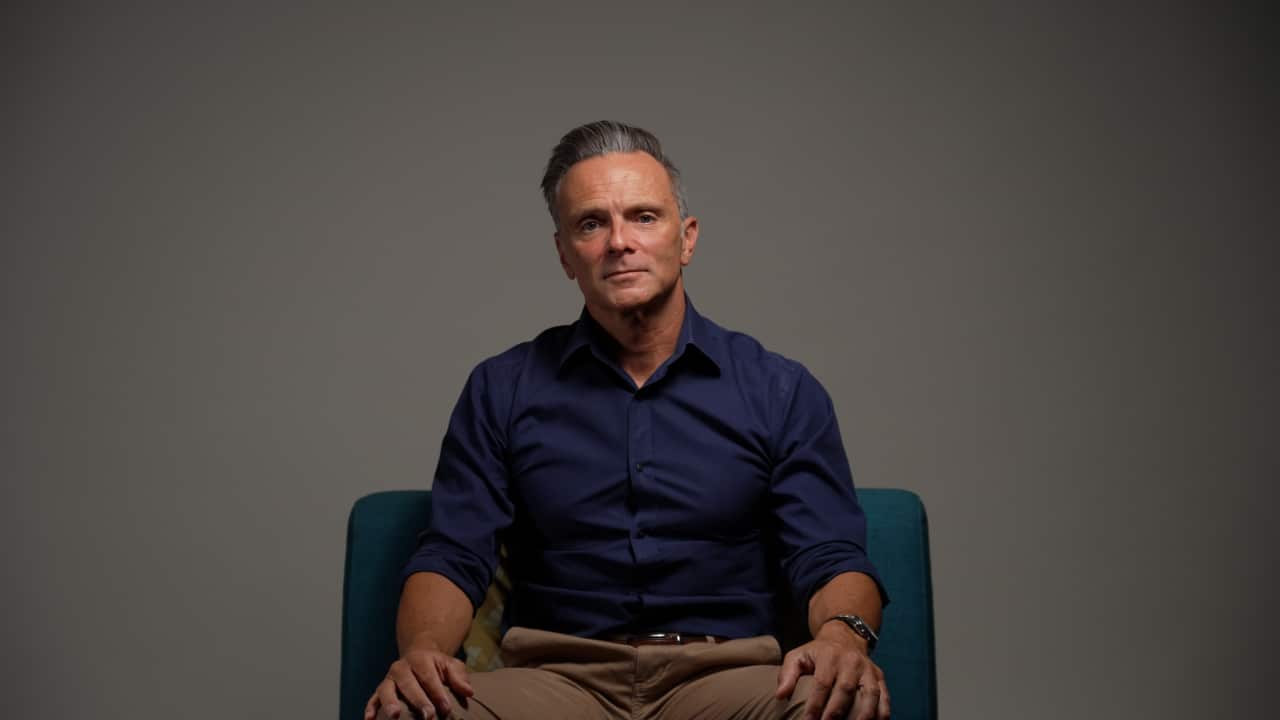
Tim Hewson vividly remembers the moment he realised the impact of the breakdown of his long-term marriage.
"I started scrolling through my mobile phone thinking, 'Who can I reach out to? Who can I call?'" the 52-year-old told The Feed.
"I realised there wasn't a single bloke in my life that I could really open up to. That's quite a lonely experience."
What followed for Tim was a loss of identity.
"I looked in the mirror and the guy staring back at me was someone I never thought I'd become. I was in my early 40s, separated and in the fast lane to divorce. And while I was trying to work out what my life looked like, my thoughts were spiralling out of control."
News that makes sense
Your trusted source for staying up-to-date with the world around you. Get free daily news updates and analysis, straight to your inbox.
One in four people who go through a relationship breakdown experience loneliness, according to a 2024 Relationships Australia report, which surveyed about 3,000 people.
But men who experienced a breakup are 82 per cent more likely to report suicidal ideation relative to men without a recent breakup experience, according to a long-term Australian study published in the Journal of Affective Disorders last year that surveyed over 16,000 men and analysed their experiences a year after separation.
One of the authors, Michael Wilson, a research fellow with the Movember Institute, told The Feed some of these negative mental health outcomes were reported by men who had not previously experienced poor mental health.

"Separated men relative to their married counterparts are at up to five times greater risk of suicide," Wilson told The Feed.
While Tim didn't experience suicidal ideation, he said the breakup took a major toll on his mental health.
"Relationship breakdowns are challenging enough, but breaking up families can be even harder — you're now alone," Tim said.
"With isolation and loneliness comes anxiety, depression, and that can lead to a sense of helplessness and hopelessness."
Wilson said many men rely heavily on their partner as their main source of emotional support, which can make breakups particularly difficult.
"The one person through which you typically cope with really intense, stressful experiences is the one person that you now don't necessarily have access to," he said.
But how men navigate distress — shaped by ideas of masculinity and a lack of social and emotional support — may also explain why many men struggle so profoundly after breakups.
'All the eggs in one basket'
For men, romantic relationships can often be the only avenue where vulnerability and emotions feel safe, according to Wilson.
"A lot of guys [in the research] talk about how their partner is the only one that truly knows them," Wilson said.
"The only person they've really let into how they're deeply feeling."
Liam Hayes, 23, only realised the extent to which he relied on his partner when their relationship ended.
"I had been putting so much of my emotional support in my partner's hands," Liam told The Feed.

"I'd have a rough day at work and all I was thinking about was going back to my partner's house — [it was] such a safe place."
Wilson said that while there's nothing inherently unhealthy about relying on a partner, mental health challenges can emerge when emotional support isn't diversified among different connections.
"No person can be everything to everyone."
The impact of surface-level relationships
Wilson's research also found that men's friendships often remained surface-level, with some men unable — or not feeling safe enough — to share emotions with other men.
"There can be this feeling that the mask can only come off with women," he said.
For many men, male friendships are often activity-based. A 2018 New Zealand study on masculinity and social connectedness, which surveyed 15 men, found these relationships were mostly built around physical activity like sport, drinking or shared hobbies — while relationships with women tended to be more "intimate and confiding".
With the blokes, it was all beers and bullshit.
Wilson said male friendships sometimes remain surface-level, with emotional conversations often replaced by humour, drinking or advice to "move on".
Tim said it was a similar story with his male friends after his breakup.
"That was fun at the time, but you'd wake up the next morning and realise you hadn't talked about anything."
By contrast, Tim said conversations with women in his life felt more emotionally open.
"They asked questions — they validated what I was feeling."
Wilson said these relationship patterns can be shaped by traditional ideas around masculinity.
"There can be this discomfort around conversations veering into topics viewed as 'unmasculine'," he said.
"A lot of guys haven't necessarily been socialised to hold emotional distress in one another."
Wilson's study found that men may worry they would burden friends — or be judged — if they shared emotional struggles, leading many to "suffer alone and in silence".
Opening up the conversation
For both Liam and Tim, meaningful support from men ultimately became an important part of their recovery.
For Liam, it was a friend who moved beyond reassurance and opened up a deeper conversation.
"[My friend] said, 'If you're not okay, you need to say something. I'm here,'" Liam said.
"That was really special."
Wilson said those moments of connection matter because loneliness following separation is a major risk factor.
"The absence of connection during an intense emotional experience creates a pretty risky cocktail for mental health," he said.
But Wilson said breakups can also provide an opportunity for men to rebuild social connections, emotional awareness and develop healthier coping strategies.
"Exercise, connection, peer support — those things can all play a really positive role," Wilson said.
"The important thing is not using distraction to completely avoid what you're feeling."
He said for people supporting someone through a breakup, the most useful response is the most basic form of support.
"Time will heal, and I'm with you until it does."
Readers seeking crisis support can call Lifeline on 13 11 14 or visit lifeline.org.au, MensLine Australia on 1300 78 99 78 or visit mensline.org.au and 13YARN on 13 92 76 or visit .13yarn.org.au

Through award winning storytelling, The Feed continues to break new ground with its compelling mix of current affairs, comedy, profiles and investigations. See Different. Know Better. Laugh Harder. Read more about The Feed

Have a story or comment? Contact Us







