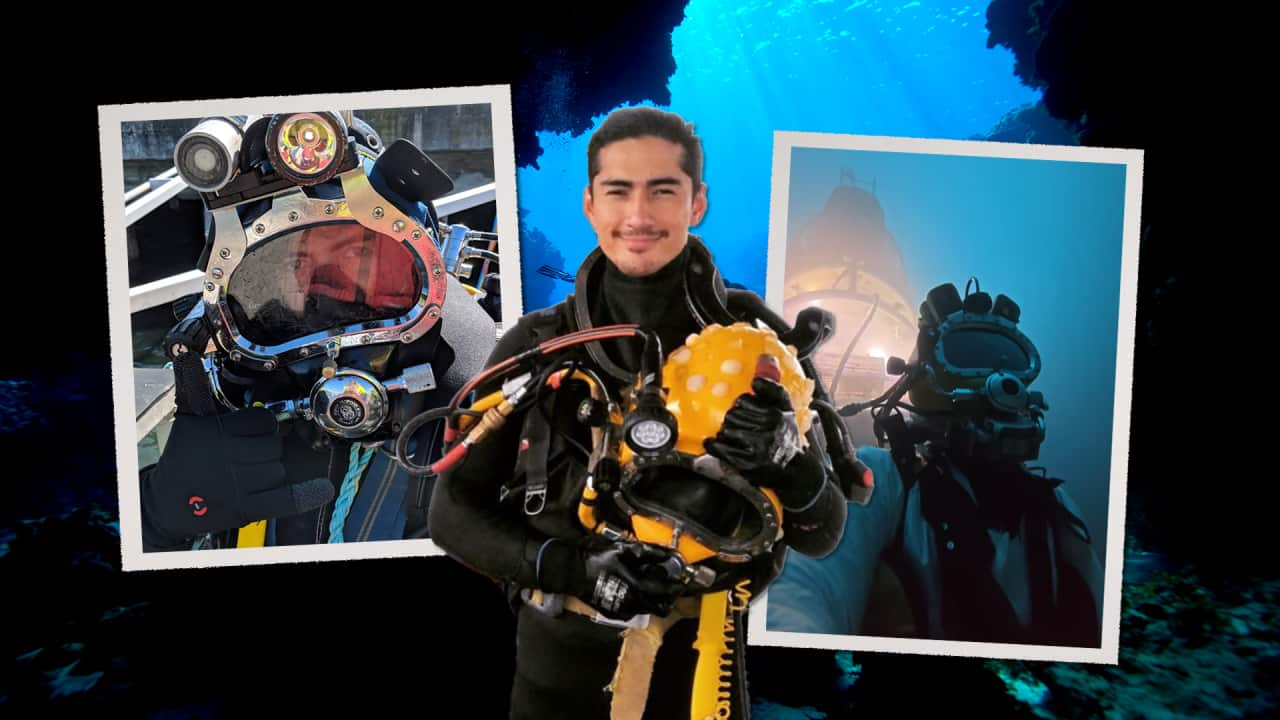
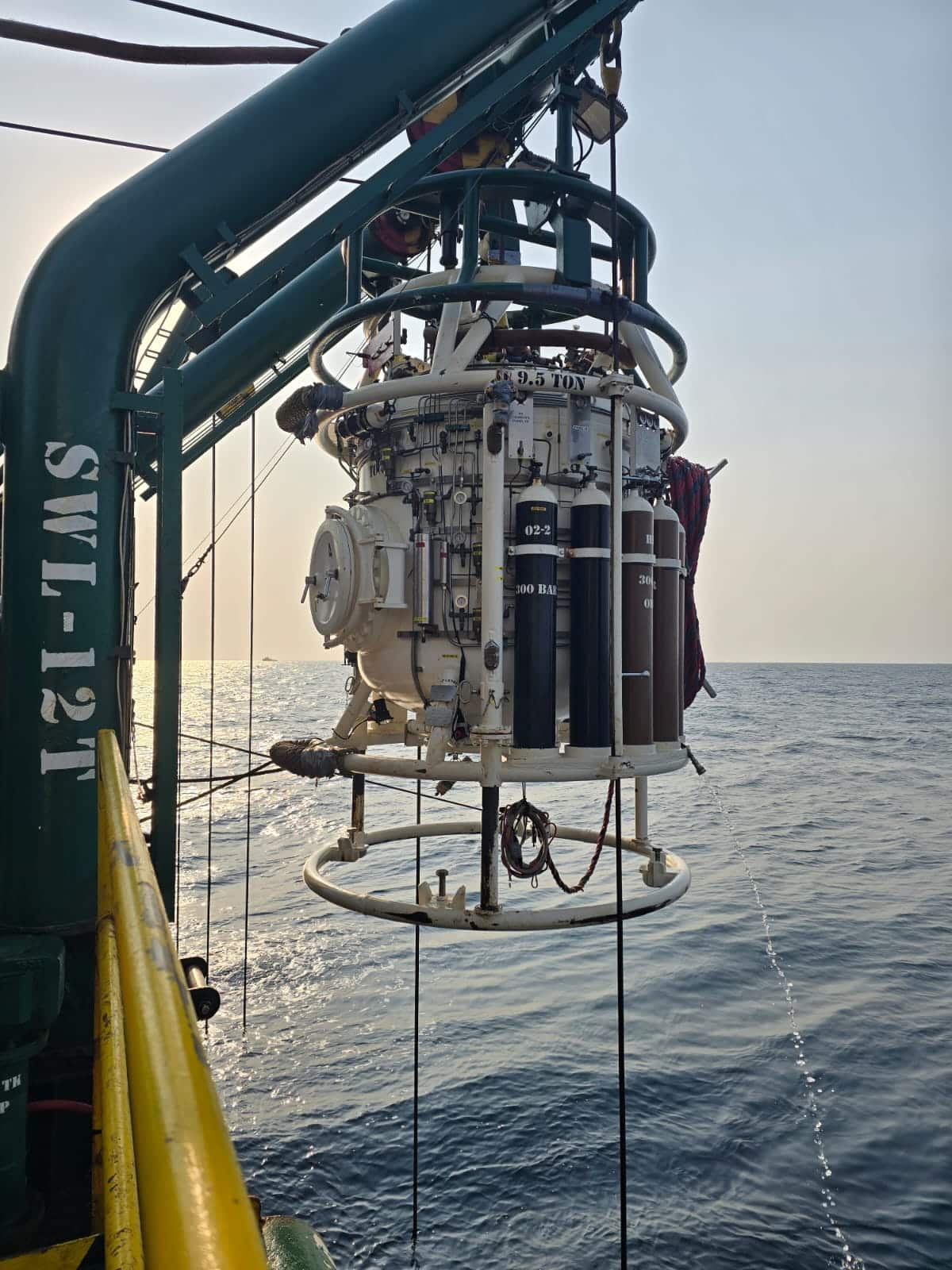
Earlier this year, Reg Hyde didn't see the sky or breathe fresh air for 28 days straight. He was shut away with a handful of men, far from his loved ones, in a small pressurised chamber bobbing in the remote ocean.
If he'd escaped outside, he would most likely have died.
"It feels like prison sometimes," the Filipino Australian told The Feed.
But Reg, 28, says he loves this life, because it takes him somewhere he believes is the world's most intriguing place: the bottom of the ocean.
Reg is a saturation diver.
News that makes sense
Your trusted source for staying up-to-date with the world around you. Get free daily news updates and analysis, straight to your inbox.
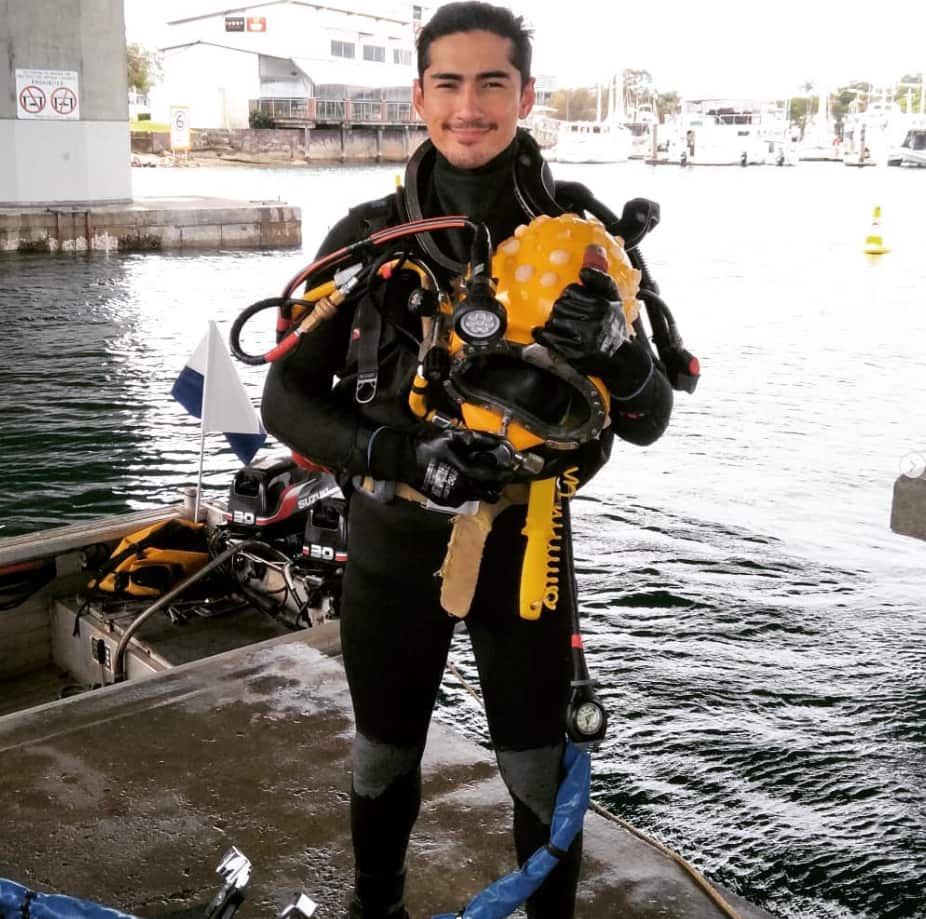
It's a profession as dangerous as it is mysterious — one that demands hardcore risk and extreme isolation in equal measure.
Saturation divers are commercial divers who live for days or weeks in chambers pressurised to mimic depths of 50m-300m. An elevator — known as a "bell" — carries them down to the sea floor for around six-hour shifts, where they perform maintenance, construction or engineering work on oil rigs, bridges, wrecks or on undersea cables and pipelines, before returning to their chamber on the support vessel.
They are called saturation divers because their bodies are 'saturated' with inert gases in the chamber that mimic the pressures they will experience deep beneath the sea. This state of saturation enables them to remain at that pressure for long periods such as a number of weeks, so long as they undergo one long decompression before surfacing, a process that can take up to five days.
To Reg, who was once a recreational diver guiding tourists around reefs, assembling new pipelines on an oil rig 188m beneath the sea off the coast of Libya feels like the best job in the world.
"If it's a new project, you're probably the first person down there … it's like going up Everest. You accomplish something. And for us … we just want to go deeper, darker … It's all adventure for us."
He's even made peace with breathing heliox for weeks at a stretch — a helium-oxygen mix used to combat oxygen toxicity and nitrogen narcosis (when divers breathe normal air at depth) — even if the side effect is sounding permanently like Donald Duck.
"The first 20 minutes are funny, then you're trying to understand each other."
Life in the dark depths
Chris Eckert, a 26-year-old from Brisbane, has spent only a few days outside the saturation chamber so far this year.
Speaking to The Feed by text from an oil field 50km off Mumbai, India — where he's working at depths of around 80m, double the recreational limit — his heliox-pitched voice was too distorted to follow over a call.
"Spending so much time away from home and stuck in a little chamber can be a bit painful, but to me it's all worth it when we lock out and drop to the bottom," wrote Chris, who started diving in 2019, lured by the freedom and opportunities.
"I personally think the bottom of the ocean is the most peaceful place on earth."
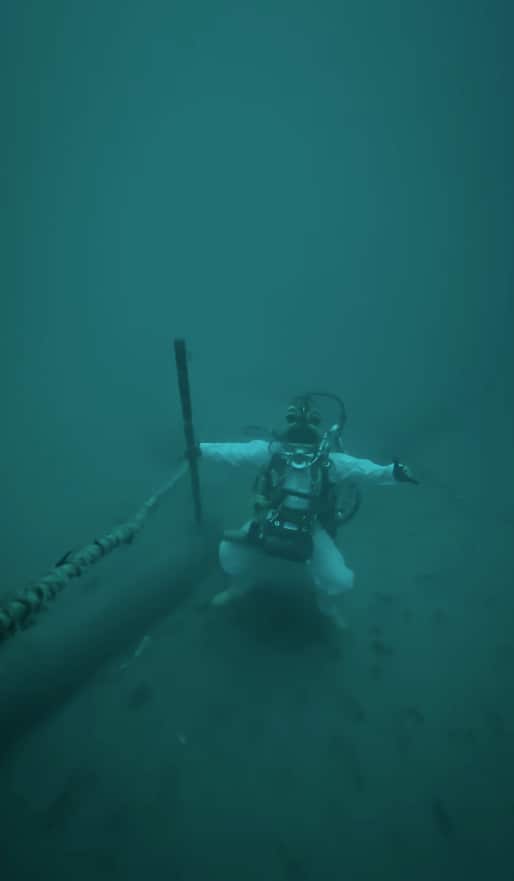
Reg agrees — and tries to remind himself to stop, breathe and take it in while he's down there.
"I just want to get out into the big open ocean and see what's out there … as long as there's light around and you can see fish, you can see these weird animals all around the place, sharks, whales even … big tunas, gropers as big as a car, sharks … It could be big stingrays and eels as big as your head … It's all just wonderful and interesting.
"If I feel like I'm in the moment, I can't believe that I'm doing this as a job."
He recalls a whale shark drifting past him off Qatar, and a murky onshore dive in the Brisbane River where the darkness suddenly lit up with bioluminescence — the emission of light by marine organisms like plankton.
"[I saw a] blue hand, blue anchor, blue chain …it was just pretty cool."
But not every dive is peaceful.
Foul weather, strong currents and zero visibility are occupational hazards — and sometimes far worse.
"[There can be] raging tides and mud up to my armpits, swell on the surface causing the heavy steel loads on the crane to be bucking like a bull, and you've got to tame and install it without getting anything or anyone damaged or hurt. It can be pretty wild," Chris said.
Then there are the sharks.
The general consensus is that saturation divers are protected from sharks by the sheer amount of equipment they carry — the hoses and cables that connect them to the bell (or surface) while they're working underwater, known as the "umbilical", communication wires, lights and cameras all emitting electrical impulses that sharks tend to avoid.
Reg tries not to worry about them.
"They're very curious … They're just having a look. Because they've never seen this weird yellow guy … [but] I think we're just too noisy and scary."
When things go wrong
The saturation industry is safety-obsessed — rigorously inspecting equipment and running constant drills for diver recovery, loss of gas, loss of comms and loss of the bell umbilical. Multiple back-up systems and support teams operate both in the bell and on the surface.
But things still go wrong.
Hard statistics are scarce, especially in Australia, but a 1998 report from the US Centers for Disease Control and Prevention estimated the occupational fatality rate for commercial divers at 40 times the national average for other professions.
If a diver loses communication, gas or their umbilical — which extends around 60m from the bell — they return to the bell immediately; it's their only route to the surface.
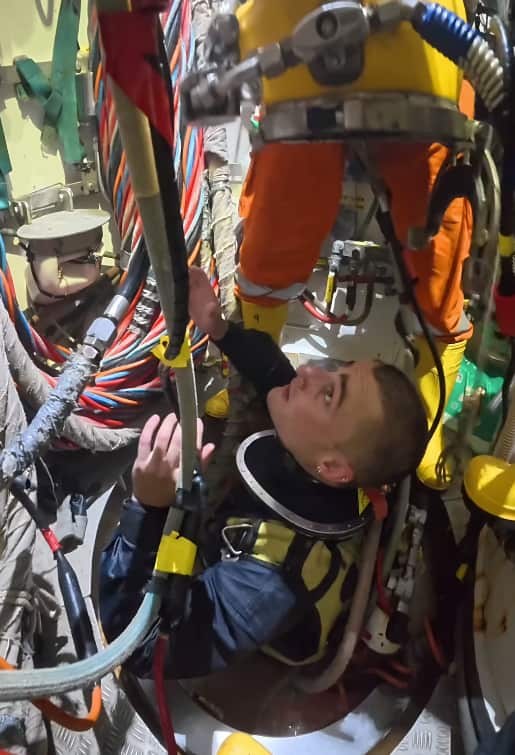
Swimming up is not an option. A rapid pressure drop causes dissolved gases like nitrogen to form bubbles in the blood and tissues, blocking vessels and triggering severe decompression sickness or "the bends" — joint pain so severe it doubles you over, and in serious cases, causes paralysis or death.
On Reg's last sat dive, the hot water pumped through his umbilical to his drysuit cut out, leaving him exposed in 2–10C water. Hypothermia at those temperatures sets in within 30–60 minutes.
"If we lose hot water, we'll just freeze to death pretty much. If you get injured down there, if something happens, it's a major. You could die," he said.
"You definitely won't live long if you're pretty stupid at what you're doing."
Luckily for him, the bell carries back-up hot water, gas and emergency supplies, with a doctor on standby aboard the dive support vessel.
But Chris says ultimately, safety comes down to the diver.
"If I am on a job and the equipment is damaged … or the procedures don't feel safe, I won't dive. At the end of the day, no one can physically force me into the water."
There are also long-term health risks.
Sat divers can develop weaker lungs from breathing high-oxygen mixes, cataracts from prolonged oxygen exposure, and skin, ear and foot infections from living in steamy chambers for weeks. Headaches, fatigue, inflammation and muscle loss from inactivity are common complaints too.
Chris is pragmatic about it.
"Keep fit, eat well and keep active … you don't deteriorate, same as anything really."
Boredom, tights spaces and lucid dreams
Four weeks living in a cramped chamber with a handful of others can bring its own challenges — boredom, zero alone time and even help going to the toilet.
Days of decompression after a deep project can be especially cumbersome.
"You're just watching movies, reading books, talking to your mates, anything to pass the time," Reg said.
The chamber itself is functional at best. Meals arrive in metal trays — blown in through a small medical airlock by the life support crew that won't upset the pressure inside the chamber — and are seldom particularly good.
Laundry, medical supplies and phone chargers come the same way.
"There's enough room to hang out, sleep, eat, shower, stretch a bit and enough blokes for some company. I think it mightn't be very well suited to someone claustrophobic, but it's fine for me," Chris said.
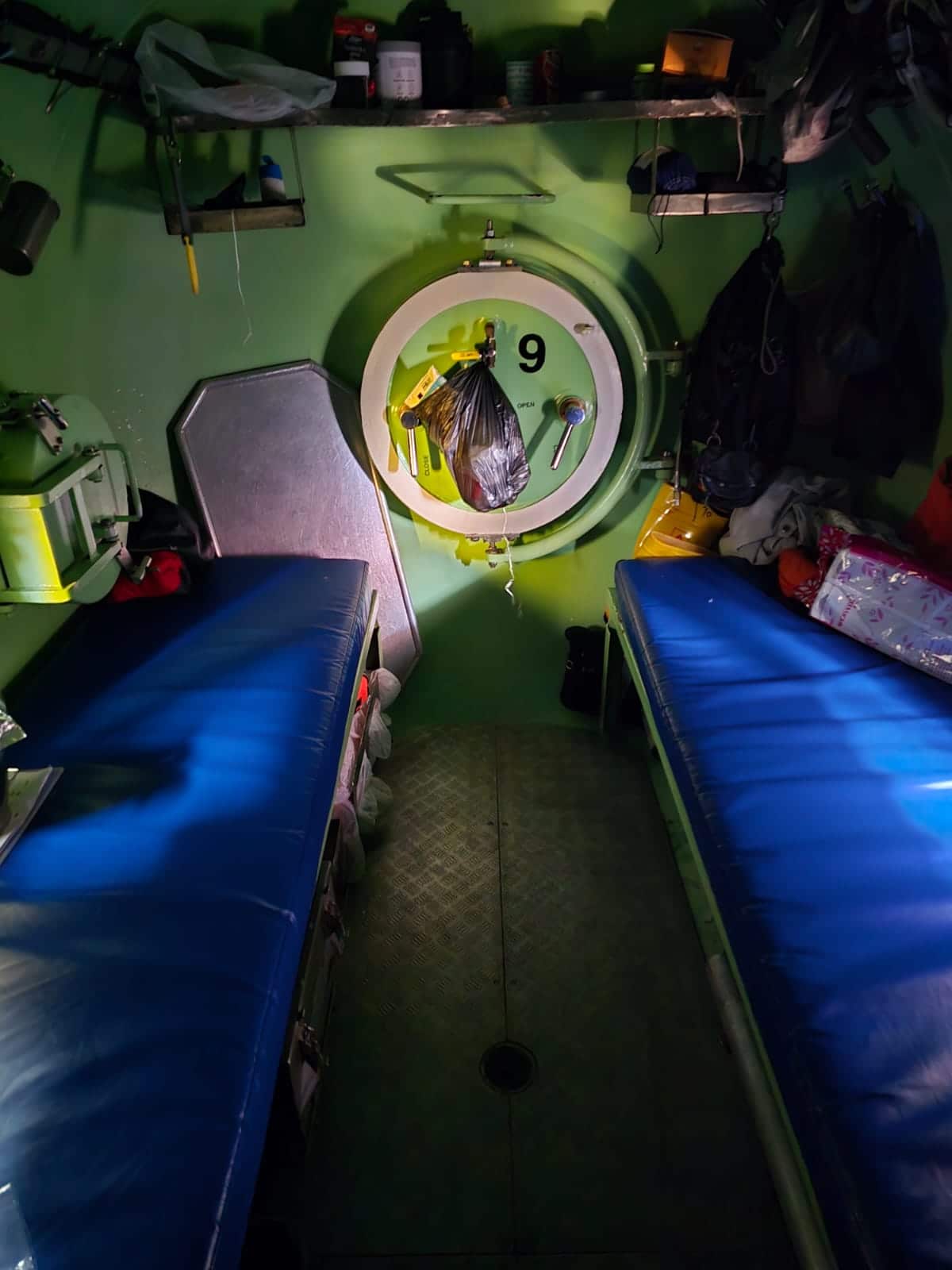
The toilet and shower are communal and tiny, which demands good hygiene and a relaxed attitude to shared spaces.
The toilet requires a specific sequence of valves — and can only be flushed from the outside, meaning divers must call the life support team every time.
"You close the door … you cover the camera … do your business. There's a procedure so that you don't flush yourself out," Reg said.
Chris says living in such close quarters for weeks on end attracts a specific kind of person.
"Almost all the divers I've met so far have a fantastic, often somewhat twisted sense of humour. I think it's very important to be able to laugh at things that may otherwise make you cry."
Reg agrees that fitting in is non-negotiable.
"You're going to be spending 28 days together … if you don't fit in, it's not going to work out."
Those who need solitude, as well as reliable wifi and regular contact with a partner or children at home, may struggle.
"It is hard for both sides of the relationship," said Reg, who is currently single and without kids.
For Chris, the time away can take a toll.
"I’ve been home only five days since the new year, so it can be very difficult maintaining a relationship, but when I am home I have no responsibilities and all the time in the world for my girlfriend and friends. I see it being the same with kids."
There are strange upsides though. The elevated oxygen pressure inside the chamber produces intensely vivid, lucid dreams — a side effect Chris has come to love.
"I think the mind stays a lot more active during sleep in here than it does normally. Some people hate it — I love it personally," he said.

Breaking into the industry isn't easy. There are only a handful of training facilities in the world — among them the very deep Lake Cethana in Tasmania, and hubs in the North Sea off Scotland and Norway. Courses can cost many thousands of dollars.
And it's harder still for women; in some parts of the world, they're barred from dives altogether.
For many sat divers, the career has a shelf life. The weeks away, the isolation, the physical toll — what feels like adventure at 26 can weigh differently when children arrive or when the body starts to age.
"When I get older, I think I’ll do one or trips a year, just to mix it up," Reg said.
For love and money
Despite the dangers and the isolation, saturation divers tend to be passionate about their work — and the pay reflects the risks.
Day rates run between $1,300 and $4,000, with a 28-day project netting around $30,000. And while you're on the job, there's nothing to spend it on.
But it's not just about the money.
"I love the work I do, it feels important. It's physical, highly specialised and universally applicable," Chris said. "I take a lot of pride in what I do. When I go into a dive knowing it's going to be a real hard slog, or there's been some problems on previous dives getting something to come together, that excites me.
"And if I come out at the other end having solved the problem and got it done, that is a bloody fantastic feeling. They say you're only as good as your last dive, so after a ripping good dive, you feel on top of the world."
Coming home is its own kind of high.
Chris revels in a day or two of movies, seeing the sun, hitting the beach, sinking a cold beer with mates, and watching the money land in the bank.
But the strangest part of returning to the surface isn't the fresh air — it's the voice.
"After weeks of breathing helium, you almost forget what your own voice sounds like. That is a bloody weird feeling."
Reg says he always longs for his life on the surface.
"I miss the fresh air, the sun and the lifestyle … For me, it's surfing, it's spear fishing, could be all of that, could be travelling."
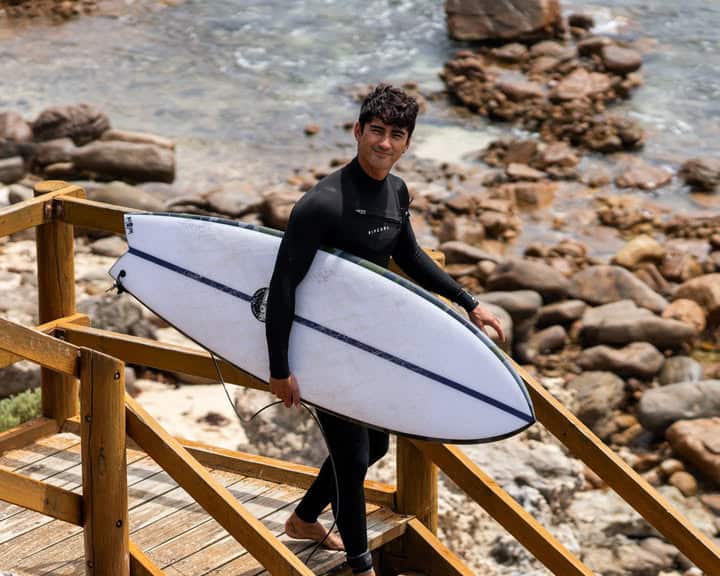
But it's never long before the pull to the deep returns.
"You want to get back and bring your camera, see what crazy creatures you're going to see down there next.
"The reason why we got into this industry is because we love diving. We love the job."

Through award winning storytelling, The Feed continues to break new ground with its compelling mix of current affairs, comedy, profiles and investigations. See Different. Know Better. Laugh Harder. Read more about The Feed

Have a story or comment? Contact Us







