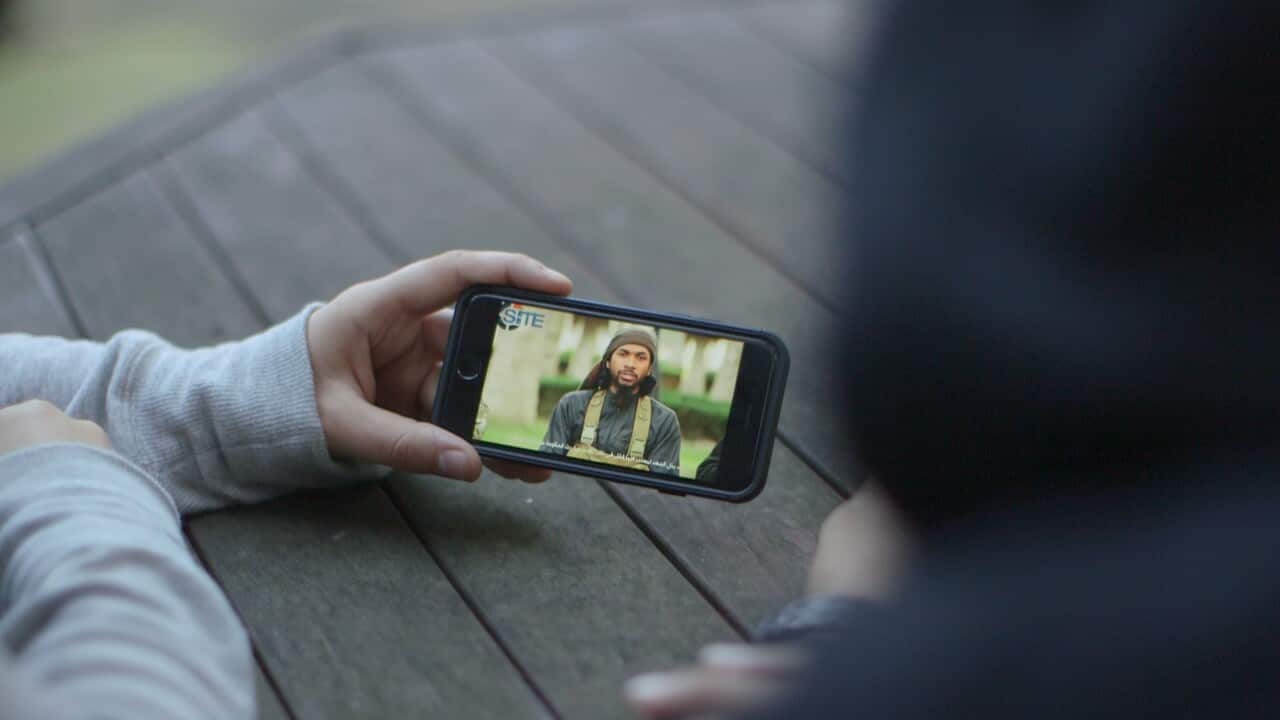
“The police approached my parents and they said that they can put me in a program to help me...get jobs and learn about Islam....they didn't call it deradicalisation.”
When I met Ali in 2014, he was a committed supporter of IS. He dreamed of going to Syria, and had contact with some who have since become notorious as fighters for the terrorist group. It hadn’t happened yet, but police would soon turn up at his door, and question him about his connections.
Fast forward to 2016, and Ali (not his real name) no longer supports IS. He calls them Daesh, considers them a “misguided” bunch of outsiders, and feels grateful that he didn’t end up arrested, or worse. He’s a participant in an intervention, what many of us would call a “deradicalisation” program. Police facilitated it, and he now meets with a religious teacher and, until recently, someone who helped him apply for jobs.
“It was completely voluntary. I didn't have to do it....they say they want to stop people going down life of crime.”
But is the program responsible for Ali’s change of heart on IS? He’s young, with a curious mind and evolving set of beliefs and values. Maybe he was always going to change. In fact, Ali tells me he was anti-IS before he entered the intervention. It happened when he began to really start studying Islam, and reading some of the scholars.
News that makes sense
Your trusted source for staying up-to-date with the world around you. Get free daily news updates and analysis, straight to your inbox.
“I thought if I learn about Islam I'll be able to defend Daesh better,” he says. Instead, the new knowledge convinced him that the group wasn’t what they claimed to be.
While Ali has denounced IS and violence, he still holds beliefs that many would consider extreme or even concerning. He loves the idea of building an Islamic State (a ‘real’ one, not the Baghdadi version), supports Sharia law and doesn’t speak kindly of Shia Muslims. But does this mean he should still be considered a risk?
The government has been funding these tailored intervention schemes since the end of 2014. But it’s fair to say that this kind of work is not easy. Already, there’s been criticism after another intervention participant was arrested and charged for allegedly planning to carry out an attack on Anzac Day.
Those charged with driving the interventions are fully aware of the enormity of the task. Dr Jenny Cartwright heads up the Diversion Team with the Australian Federal Police. She says the public has misconceptions about deradicalisation, thinking that “if someone goes on a program ...automatically within two or three months... they're no longer radicalised.” In reality, it’s a long term process. Some liken it to drug or alcohol addiction.
Behind the scenes, there’s a larger debate taking place in decision-making circles around what the end goal of this process should be, and who should be leading it.
There are essentially two schools of thought. On the one hand, there’s the idea that young would-be jihadists have been brainwashed, need to be completely “de-radicalised” and removed from any kind of extremist religious thought.
"It’s a misnomer to think that ISIS radicalises somebody."
For Haras Rafiq, a UK countering extremism expert who has advised the government there, this means encouraging people to turn away from Islamic groups that could be seen as “non-violent extremists”.
It’s “a misnomer to think that ISIS radicalises somebody,” he says. “They take people who are already radicalised and persuade them to make the next step and become jihadists. By using ‘non-violent extremists’ to try and de-radicalise violent ones, all we're doing is creating a bigger pool.”
But others say that holding radical beliefs is no big deal, it’s about getting people to give up the idea of committing violent acts.
Debra Smith, from Victoria University has sat face to face with jihadists. She says society is full of people whose views we might find offensive, but as long as the person doesn’t commit or incite violence, then isn’t that OK?
“They can maintain their quite radical political beliefs and...maintain their radical goals, political goals, they just give up the idea of using violence, and ultimately that's what we want,” she says.
Ali tells me that he doesn’t believe in violence, that he’s certainly not going to head down the road and kill someone. But he’s more devout than ever, and the religious clerics he now looks up to would still be considered controversial by many.
“What's better: your son is still a little bit extreme and then you can work on that, or your son is full blown ‘I should go and stab police officers?” he says.
Radical Rewire airs Thursday 2 June at 7.30pm on SBS 2, or streams live.

Through award winning storytelling, The Feed continues to break new ground with its compelling mix of current affairs, comedy, profiles and investigations. See Different. Know Better. Laugh Harder. Read more about The Feed

Have a story or comment? Contact Us







