Sri Lankan food isn’t just eaten, it’s learned, cracked, ground and shared. It lives in the hands as much as on the plate, passed down through muscle memory rather than measurements. Spend any time here and you realise quickly that this is a cuisine you do, not one you sit back and observe.
These are food experiences that bring Sri Lanka’s food culture to life in its messy, rhythmic, and deeply human way.
Making string hoppers the old-school way
It starts with a wooden contraption that looks like it belongs in a museum but is still very much in use, a hand-cranked press not unlike a pasta maker. Rice flour dough is fed through, emerging in delicate, tangled strands that fall into perfect circular nests on woven mats.
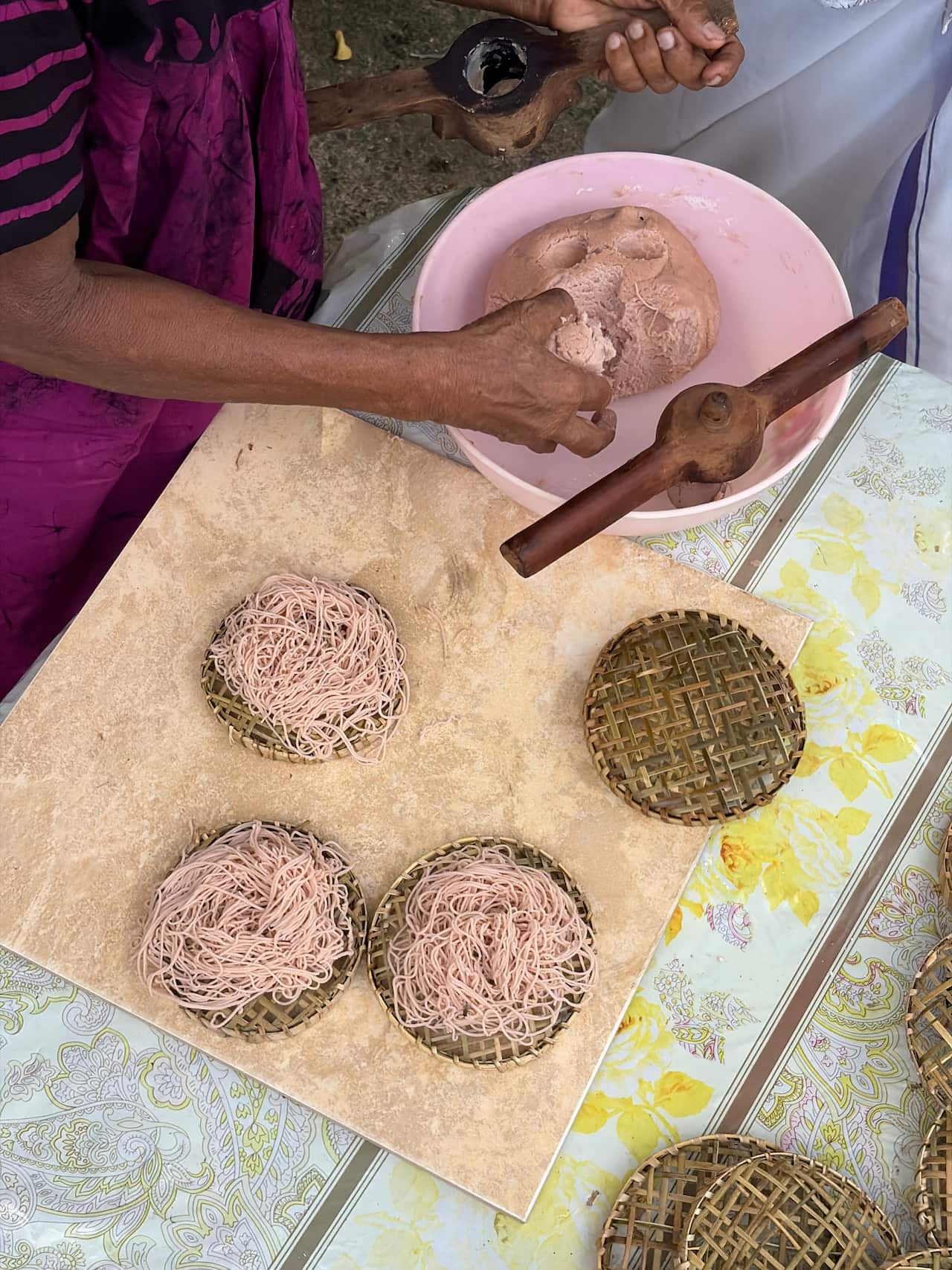
There’s something oddly hypnotic about it and if you’ve ever made pasta, it’s remarkably similar. The motion is steady, almost meditative. Press, turn, release. Press, turn, release. Once formed, the nests are stacked into a steamer, where they puff ever so slightly, holding their shape while staying impossibly soft.
Then comes the part no one really talks about, you eat a string hopper straight from the tray, still warm, before it makes it to the table. ‘When I was young, I would steal one when my mum wasn’t looking,’ shares Shanjei Permural, of Galle Fort Walks. No ceremony, no curry, just a quiet, stolen bite. It’s soft, slightly chewy, and carries the gentle sweetness of rice.
Watching kottu roti come to life
You hear it before you see it. The unmistakable clang of metal blades hitting a hot griddle in a fast, rhythmic, almost musical way - this is Kottu roti. Sri Lanka’s favourite street food that isn’t just cooked, it’s performed.
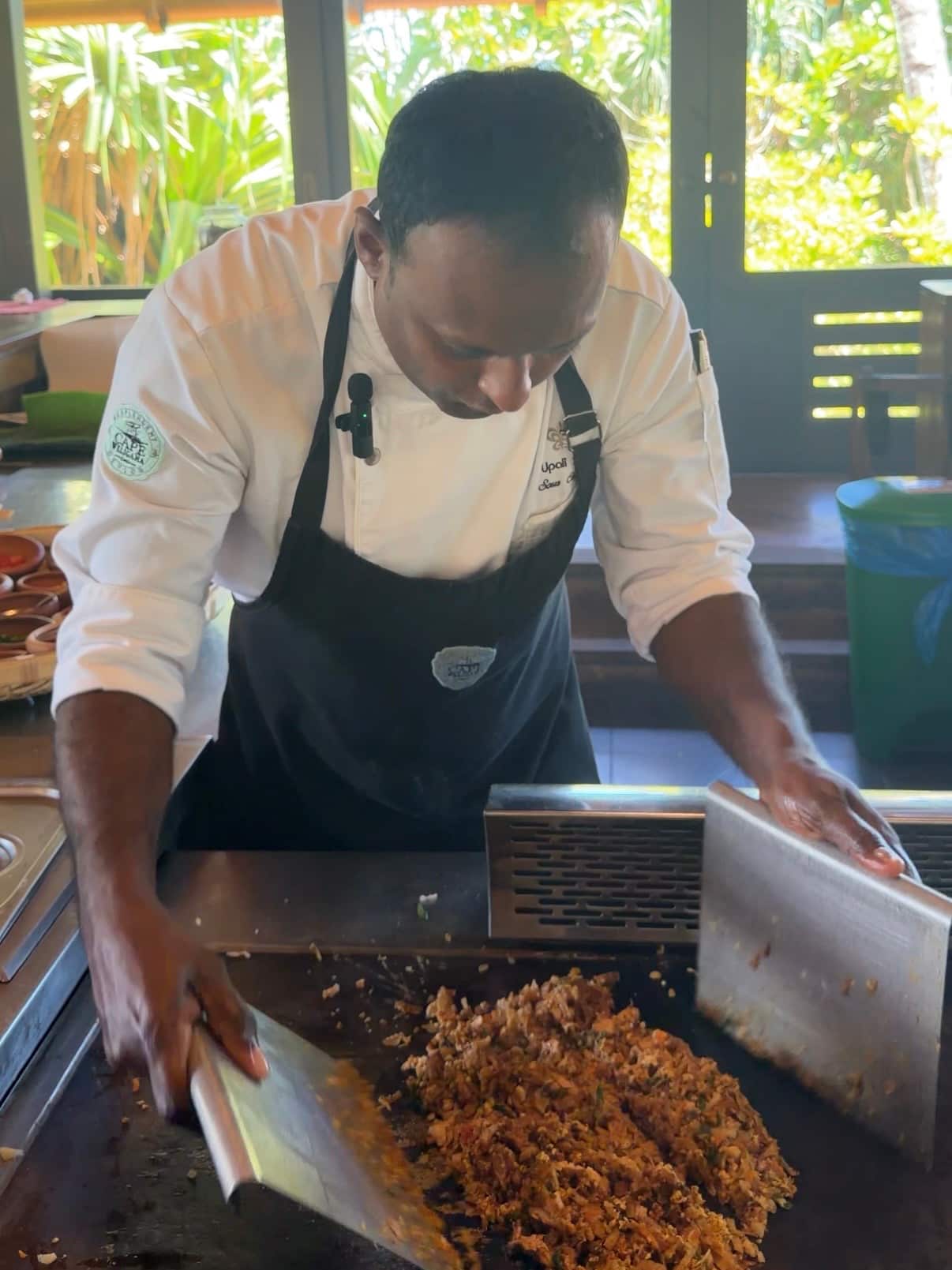
Flatbread is sizzled to life on a hot plate, rolled and sliced into thin bits, then chopped at speed, mixed with egg, vegetables, spices and whatever protein is on hand. The cook moves with precision, blades flashing, ingredients flying, heat rising. But it’s controlled chaos, and impossible to look away.
Watch it being made at a street stall, or in a Resplendent Ceylon private dining room by an award-winning chef. Wherever you are lucky enough to witness, you’re drawn into the energy of it. You may even inhale chilli infused steam into the back of your throat, but the crazed coughing is worth it because this isn’t quiet, refined cooking, far from it. It’s loud, fastand full of life. When it finally lands on your plate, still steaming, it tastes exactly as it should, bold, comforting and just a little bit unpredictable, a bit like Sri Lanka.
Mastering rice and curry by hand
At Galle Fort Bazaar, a chef gently guides you through what might be the most deceptively complex skill of all: eating rice and curry with your hands.
It’s not a free-for-all, there’s a technique that should be observed. Only the right hand is used. Rice is mixed with curry in small portions, add some pol sambol for spice, break up some pappadam for crunch, then carefully combine with the fingertips before being shaped into a neat mound. Then, in one fluid motion, it’s lifted to the mouth using the thumb as a lever.
At first, it feels clumsy. Rice falls and curry drips, but slowly, something clicks and the movements become more intuitive. And then you realise, the flavours are different this way. More integrated, more immediate.
Cook with a Sri Lankan chef
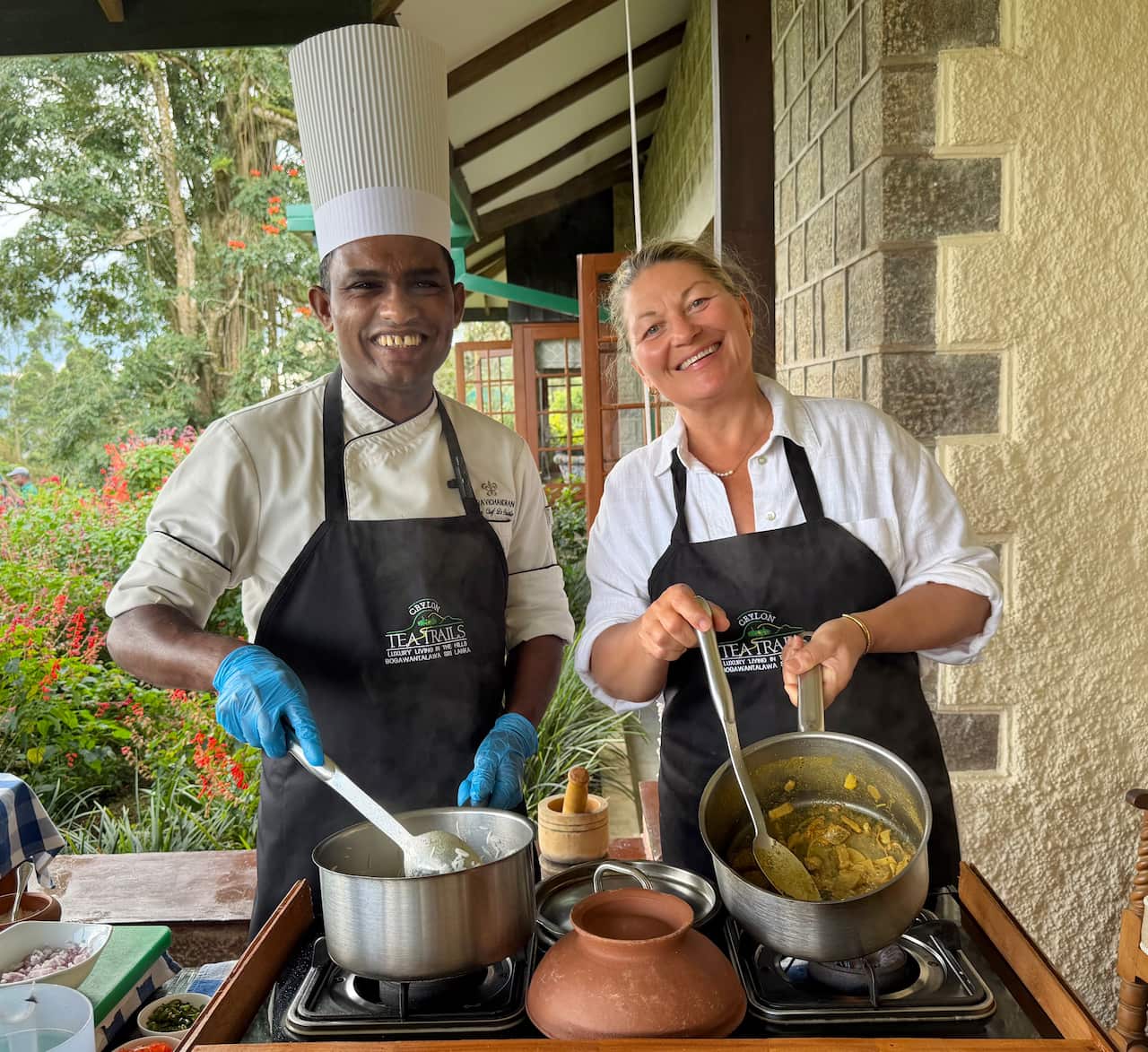
Some of Sri Lanka’s best food moments happen just beyond the restaurant, hands-on, generous and deeply personal. Think handmade breakfast hoppers by Lake Koggala at Tri Ahangama, cooking coconut pittu with a Sous Chef on a bungalow verandah at Ceylon Tea Trails, or producing a five-course Sri Lankan curry feast at Galle Fort Bazaar, from market shopping through to eating. These chefs often learned from mothers and grandmothers, passing down recipes with instinct and heart. It’s immersive and entirely unique, food you don’t just taste, but truly understand. Rare experiences like this are not to be missed.
Grinding coconut on a hiramanaya
Perched on a low wooden seat, you lean into a hiramanaya, a simple but brilliant tool with a serrated blade that transforms a hard coconut into soft, snowy shavings. It feels slightly awkward at first (there’s a technique to it), but within minutes you find a rhythm: rotate, scrape, gather, repeat. It’s tactile, physical and oddly addictive.
What makes this a must in Sri Lanka isn’t just the novelty, it’s the connection. Coconut is the backbone of the cuisine, and here you’re starting at the source, not opening a packet. The texture you create is fresher, lighter, and infinitely better than anything machine-made.
It’s also a rare moment of pause. No shortcuts, just you, the coconut and a centuries-old method that is still used in Sri Lankan homes today. By the time you turn those shavings into pol sambol, you’ll understand the food on a completely different level and that’s what makes it unforgettable.
Eating pol roti in a Sri Lankan home
Not everything here is high energy. Some of the most memorable food experiences happen in quiet kitchens, homestays, or away from the noise of the street.
Pol roti, simple flatbreads made with coconut, flour and water, are cooked on a hot pan until golden and lightly crisp. They’re served warm, often alongside dhal, sambol or a mild curry, and eaten without fuss.
It’s not just about the food, it’s about being welcomed and served by a Sri Lankan into their home, where food is a language of generosityShanjei Perumal
There’s a different kind of rhythm here, slower, more intimate. You sit at a table, or sometimes not even that, sharing food that’s been made without ceremony but with care and time.
The roti is soft, slightly chewy, with bursts of sweet coconut. You tear, dip, eat, repeat.
The takeaway
Sri Lankan cuisine isn’t defined by a single dish or flavour. It’s defined by process and the way ingredients are handled, transformed and shared.
You grind, you press, you mix, you eat with your hands. You listen to the rhythm of the kitchen, the street, the people around you. And somewhere in all of that, you stop being an observer and become part of it.

SBS Food is a 24/7 foodie channel for all Australians, with a focus on simple, authentic and everyday food inspiration from cultures everywhere. NSW stream only. Read more about SBS Food

Have a story or comment? Contact Us