
New South Wales residents will go to the polls on Saturday to decide who will lead their state for the next four years. It looks set to be a tight race; multiple polls have the Coalition and Labor deadlocked at 50-50 on a two-party preferred basis going into the election.
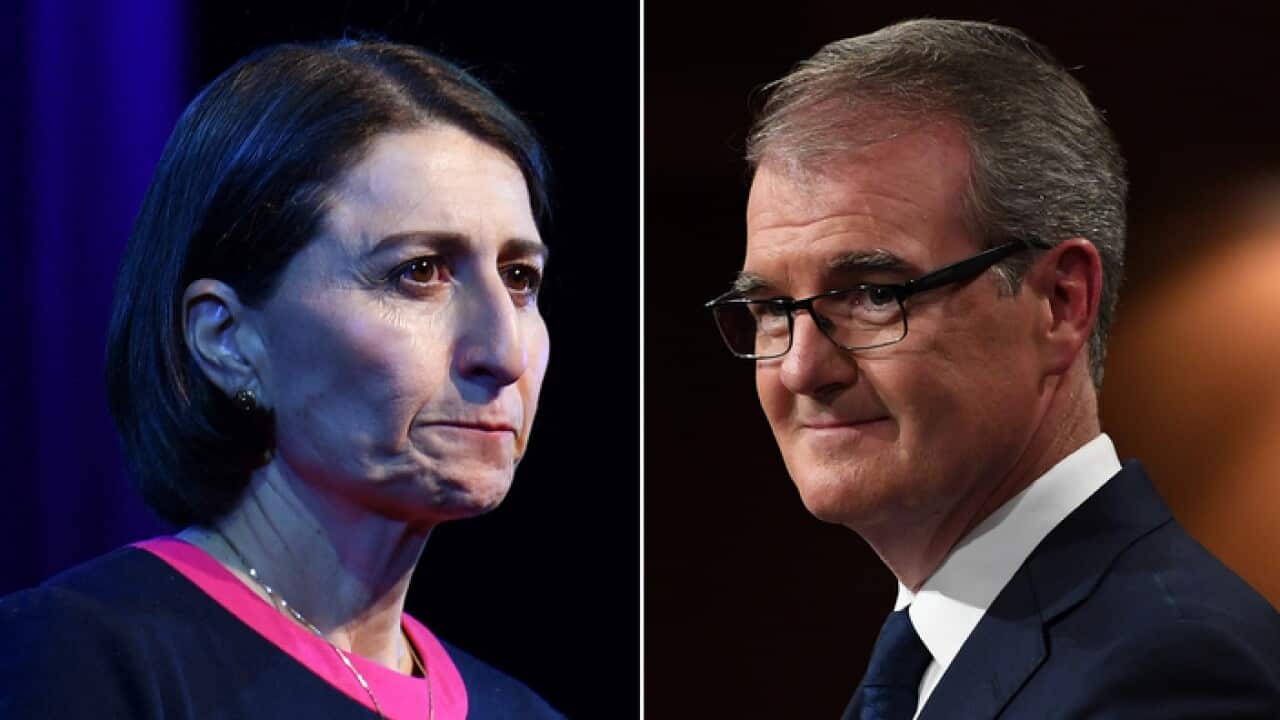
Liberal Premier Gladys Berejiklian is up against Labor leader Michael Daley in the New South Wales state election.
Mr Daley has only been in the job for a matter of months, stepping into the role after his predecessor Luke Foley resigned amid a harassment complaint in November last year.
As Election Day approaches, the two leaders are criss-crossing the state, shaking hands, taking selfies and promising to spend big.
In a uniquely Australian touch, much of the New South Wales election campaign has been centered around a football stadium.
The Coalition is in the early stages of knocking down and rebuilding Sydney Football Stadium, at a cost of $730 million.
Sensing public frustrations, Labor's Mr Daley has called for a pause to demolition work until after the election.
"If you are voting on Election Day, your vote is now worth some hundreds of millions of dollars. You have the right to determine whether this stadium stands or falls.”
State Labor is promising not to demolish the stadium, and to have all refurbishment costs covered by the Sydney Cricket Ground Trust.
Labor's going into poll using the slogan "schools and hospitals, not Sydney stadiums".
But the government remains committed to the project, and other contentious projects, with Ms Berejiklian saying "New South Wales can have it all".
"There is a clear choice on Saturday. You have a government that's proceeding to build the roads, the rails and hospitals, and all the other infrastructure we need to do about the future. And you have the leader of the Labor party who, firstly is two-faced, lacks credibility, and isn't proposing any positive plans. The only positive plans he's putting forward are axing projects."
More so than in recent years, climate change appears to be a big vote-winner in this state election.
The Liberals want New South Wales to have zero net emissions by 2050.
Labor says it will introduce a renewable energy target of 50 per cent by 2030, and 100 per cent by 2050.
Mr Daley has also vowed a Labor government would appoint a minister for climate change.
"We've given the Berejiklian government eight long years to do something about it. They're not interested in doing it. What we want to do, if we form the government, is to reset the discussion about the environment and climate change all over New South Wales."
Labor is promising to spend big on education - with plans to build new schools and upgrade others across the state, in addition to the $2.7 billion previously allocated to fully fund the Gonski agreement by 2027.
"Partnering with the next prime minister (assuming Labor wins federally) and our federal counterparts, New South Wales will become the first state to fund students to 100% of the Gonski standard."
The Coalition has said it will spend $2 billion to hire almost 5,000 new teachers and build or upgrade 170 schools.
Ms Berejiklian has also revealed plans for a new program that would give every child in the state access to before-and-after school care from 7 am to 6 pm.
"We understand that many families struggle with the competing responsibilities of work and family. And we know that long commutes, combined with the daily school drop-off and pick-up can become overwhelming. For many families, access to before- and after-school care helps to take the pressure off, but right now, before and after-school care placements are only available for one-in-five public primary school students."
Transport is proving to be another major issue.
Ms Berejiklian has promised an extra $3.4 billion to the Metro West rail project and has committed to building a rail line connecting St Mary's station to the new airport being built at Badgery's Creek in Western Sydney.
"While the Labor leader talks about all the projects he's canceling, we're building. We're building for today, and we're building for the future."
Labor is promising $5 billion towards the Metro West project.
For health services, the government is pledging to build or upgrade 29 hospitals and health facilities, including adding 5,000 more nurses and midwives.
"In the next four years alone we'll invest a record $8.4 billion to build and upgrade additional hospitals and health facilities. Hospitals like Nepean, Ryde, St George, and Sutherland."
Labor has promised to extend its policy of mandated nurse-to-patient ratios to include mental health units - part of a promised $250 million, to boost the state's mental health services.
"Only Labor will deliver an extra 4,900 health and hospital workers, including paramedics, allied health workers, security guards, cleaning and support staff to provide the best patient care. More than 5,500 nurses with mandated nurse-to-patient ratios."
While both parties have placed the emphasis on local issues, there's no escaping that federal politics could influence some voters.
Recent state and federal by-elections saw a surge in votes for independent candidates.
If that trend continues in the state election, the crossbench is likely to grow.
University of New South Wales politics expert Mark Wolfe says it makes a minority Labor or Coalition government a very real possibility.
"It will sort of be 'back to the future', back to the early 1990s when Nick Greiner was premier and had to deal, as premier of minority government, with the likes of Clover Moore and Peter McDonald. So, it's a matter of, this is nothing new in Australian political history if we get a minority government on Monday."
Mr Wolfe says a minority government wouldn't necessarily be a bad thing for New South Wales.
"What it means is that any leader, any major party leader, any premier, has got to have their wits about them. They've got to have good judgment. So it really tests the leadership of any premier in that situation."
Eligible voters have until 6pm on Saturday, March 23rd to cast their ballot.