

Kawm kom paub siv tej lus hais yooj yim uas caw koj tej phooj ywg mus ua si ntawm tej ntug hiav txwv. Ntxiv ntawd kuj txheeb txog Australia tej ntug hiav txwv uas raug kev phoj sij zeeg ib, thiab yuav ua li cas kom yus tau txais kev nyab xeeb thaum mus ua luam dej hauv hiav txwv.
Lus taw qhia: Toom sob kawm no xub raug coj los nthuav tawm lub 12 hlis ntuj xyoo 2021.
SBS Learn English yuav pab kom koj muaj peev xwm tham, nkag siab thiab sib cuag tau (sib txuas lus tau) nrog lwm tus ntawm Australia - txheeb tau txhua toom sob kawm ntawm no.
Toom sob kawm no haum rau tej neeg kawm ntawv Askiv theem nrab. Tom qab uas mloog tag lawm, sim teb tej lus nug hauv qab no ua ib co kev tshau txuj seb koj nkag siab txog toom sob kawm no npaum li cas.
Learning notes (Hom phiaj kawm)
How to invite a friend to go somewhere. (Yuav caw koj ib tug phooj ywg li cas mus rau ib qho qhov twg).
Ways to ask a friend to go to the beach (or somewhere else):
- Do you wanna hit the beach? (Koj puas xav mus ua si ntawm ntug hiav txwv?)
- Hey, how about we hit the beach? (Hey, wb mus ntawm ntug suab puam yom?)
- Let’s hit the beach. (Mus tom ntug hiav txwv os).
- Shall we head to the beach? (Peb mus tom ntug hiav txwv yom?)
- How about we spend the day at the beach? (Peb mus ua si ib hnub tom ntug hiav txwv yom?)
- Shall we hit the beach? (Peb mus ua si tom ntug hiav txwv?)
Colloquial expressions:
- Hit the ground running - starting a new activity with lots of energy and enthusiasm (Cov kev pib ua ib yam dab tsi tshiab yam muaj zog ntshis thiab kub siab lug ua).
- It’s gonna be a scorcher! – It’s going to be a really hot day (Yog ib hnub yuav sov heev).
- Sizzling – very hot (Kub kub heev).
- It is packed! – full of people (Muaj neeg coob heev).
Beach vocabulary (Tej lus siv cuam tshuam txog ntug hiav txwv):
- Esky – a box that keeps food and drink cold (Ib lub thawv tsau zaub mov thiab dej haus kom txias).
- Lifeguard – a person paid to people safe at the beach (Ib tug neeg ua hauj lwm uas nom tswv ntiav kom mus tswj kev nyab xeeb rau tej neeg ntawm ntug hiav txwv).
- Lifesaver –a volunteer (unpaid person) who helps keep people safe at the beach (Yog ib tug neeg ua hauj lwm yeem thaj (volunteer - yog tus neeg pab cawm siav uas tsis tau nyiaj hauj lwm dab tsi) uas pab kom tej neeg tau txais kev nyab xeeb ntawm ntug hiav txwv).
- Rip – an area of water that moves out to sea very quickly (Yog ib thawj chaw uas muaj tej dej hiav txwv muaj zog nqus yus rov qab mus rau tom hiav txwv sai heev).
- Patrolled –watched over (Zov/saib xyuas).
- Hazard – a danger (Ib co kev phom sij).
Cultural information: Beach safety
Australian beaches often have dangerous rips. A rip current or ‘rip’ is an area of water that moves very quickly, much more quickly than the water around it. It’s usually on a part of the beach which is deeper and where the water rushes out to sea.
If you go into one, it can take you out to sea away from the beach very quickly. On average, rips cause at least 21 deaths in Australia each year.
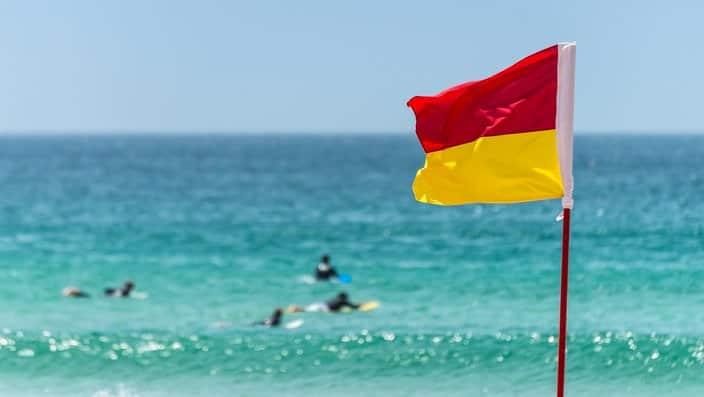
The best way to avoid rips is go to a patrolled beach and swim between the yellow and red flags.
5 beach safety tips (5 co kev taw qhia kom tau txais kev nyab xeeb ntawm ntug hiav txwv):
- Always swim between the red and yellow flags. (Nco ntsoof ua luam dej ntawm ntu nruab nrab uas muaj ob tug chij liab thiab daj txhos rau).
- Ask a lifesaver or lifeguard for advice (Nug ib tug lifesaver los yog ib tug lifeguard kom taw qhia yus).
- Read the beach safety signs at the beach entrance (Nyeem tej phiaj qhia tias yuav ua li cas thiaj tau txais kev nyab xeeb ntawm tej ntug hiav txwv ntawm qhov chaw yuav mus rau tej ntug hiav txwv).
- Always swim with a friend or adult (Nco ntsoov ua luam dej nrog ib tug phooj ywg los sis nrog ib tug laus).
- If you need help in the water, stay calm and attract attention by raising your arm (Yog tias koj xav tau kev pab cuam thaum tseem nyob hauv dej hiav txwv, ces kom tswj yus tus kheej kom tus thiab tsa yus sab caj npab thov kev pab).
Transcript (Tej lus theej los ntawm cov sob lus sib tham)
Hello, and welcome to the first episode of Learn English.
My name is Josipa, and like you, I’m still learning the English language.
It’s not an easy language to learn, is it? People seem to speak really fast, and they use all kinds of phrases that I’ve never heard before.
For us, learners, that can be so confusing. For example phrases like 'hit the ground running'. No, nobody is asking you to start hitting the ground while you run on it.
'Hit the ground running' is a phrase people use to mean ‘start something new’ with lots of energy and enthusiasm.
And that’s exactly what we are going to do. So, let’s hit the ground running.
Today, in our first episode, we will go to a place where many of us love to spend long, hot summer days. Yes – the beach! We’re going to learn how people invite each other to go to the beach, or somewhere else.
Also, we are going to hear about beach safety and the number one danger on our beaches – any idea what that is?
Yes, you got it, rips! But if you don’t know what rips are, listen on…
But first, let’s get there!
Anne:Did you see the weather forecast today? It’s gonna be a scorcher! Do you wanna hit the beach
Mark:It’ll be packed! There won’t be any room to sit down!
Anne:If we get there early, it shouldn’t be too bad. Mark:OK. Let’s hurry then.
Anne:Great. Oh, how about we ask Ben and Sonya, too. It’s a hot day. They might want to come along, too. You ask Ben, and I’ll ask Sonya.
Mark:Ok
Ben:Hello.
Mark:Hey, Ben, It’s Mark. How’s things? Look, It’s boiling hot today. How about we spend the day at the beach? Anne is coming. Ben:OK, great. See you there!
Mark:Ben can come. How about Sonya?
Sonya:Hi Anne, how you going?
Anne:Hey Sonya, it’s gonna be a scorcher today. Do you wanna check out the beach?
Sonya:That sounds lovely! I'll meet you there.
Anne:Ok. Let’s go!
I don't know about you but I need a little break from this conversation—so many expressions that are difficult to understand!
That’s because my friends, Anne and Mark, are native speakers. They love to chat, and they can speak really fast using a lot of phrases I’ve never heard before.
But when we go more slowly, we can understand and learn these expressions.
Let’s start with Anne,
It’s gonna be a scorcher! Do you wanna hit the beach?
Anne said: it’s gonna be a scorcher. To scorch something is to burn it, so Anne means is that it’s going to be a really hot day, a scorcher, a day that will really burn you if you are not careful.
There are so many other ways to describe a hot day, and Australians love talking about the weather! You may also hear people say: It's boiling hot! It's stinking hot! It's a hot one!
But enough about the weather – let’s talk about how Anne asked Mark if he wants to go to the beach with her.
Do you wanna hit the beach?
Just like 'hitting the ground running', 'hitting the beach' does not mean you actually hit the sand on the beach. ‘Hit’ is just an informal way of saying 'go', so hitting the beach means going to the beach.
And 'do you wanna hit the beach' means 'do you want to go to the beach'. People use ‘hit’ when they are talking with friends, informally, rather than with people they don’t know very well. So, don’t say it to your boss!
Instead of ‘do you wanna’ you can also say ‘how about’, so you can ask them to go to the beach by saying ‘Hey, how about we hit the beach?’ You can also say ‘Let’s hit the beach’. You can also use these expressions to invite people to go with you to other places.
Friends also invite each other to do things using other informal phrases like: ‘Shall we head to the beach?’ ‘Do you wanna check out the beach?’ ‘How about we spend the day at the beach?’
Listen to the different ways Anne and Mark invite Sonya and Ben to go with them to the beach.
Anne: Hey Sonya, it’s gonna be a scorcher today. Do you wanna check out the beach?
Mark: Hey, Ben, It’s Mark. Look, it’s boiling hot today. How about we spend the day at the beach?
Do you remember how Mark answers Anne when she asks him to the beach? Let’s hear him again.
Mark:It’ll be packed! There won’t be any room to sit down!
It will be packed.
Mark thinks that there will be so many people that they will have to sit very close to each other, that is, that the beach will be very full or ‘packed’. And he is probably right that the beaches near the city will be packed, full of children building sandcastles and running around playing with a ball; a lot of families sitting in deckchairs eating and drinking the food and drinks they have brought in their eskies.
Esky, that’s an Australian word you should know about. An ‘esky’ is a cool box that keeps our food and drinks cold even on a scorcher!
Mark said,
There won’t be any room to sit down!
He means that the beach will be so packed that there will not be enough space to sit down. ‘Room’ here doesn’t mean a room in a house, but it means ‘space’, so that it will be difficult for them to find enough space to put their things down.
By the way, did you know that we have over 10,000 beaches in Australia? That means that if we decided to visit a different beach every day, it would still take us…
Oh, it would take us about 30 years to visit them all. That’s a lot!
Ok, so now we are all on the beach.
Lifeguard:Attention please! Attention please! You need to swim between the flags!
In summer, when there are a lot of people on the beach, there are lifeguards to watch people very carefully to keep them safe in the water.
They put red and yellow flags on the beach to show people where it is safe to swim. Then they watch the area very carefully so that they can help anyone who has difficulty in the water. This is called a patrolled beach.
If you don’t see flags on the beach, it means there are no lifeguards watching the sea, and swimming is not recommended.
That’s because our beaches can be very dangerous places, and people who were not born here, like me, don’t always understand the hazards like dangerous rips.
By the way, 'hazard' is just another word for danger, and the biggest hazard on Australian beaches is a rip current or a rip. R-I-P.
Australian beaches often have dangerous rips. A rip current or ‘rip’ is an area of water that moves very quickly, much more quickly than the water around it and it can take you out to sea away from the beach very quickly. On average, rips cause at least 21 deaths in Australia each year.
The best way to avoid rips is go to a patrolled beach and swim between the yellow and red flags.
But even the strongest swimmers can sometimes get caught in the rip current.
So, we asked surf scientist and surf lifesaver Rob Brander from the University of New South Wales to tell us what to do if we are caught in a rip.
Rob:The main thing is not to panic. Don’t panic because the rip will not pull you under the water. All the rip will do, it will take you further out to sea, and it’ll sometimes also bring you back. Remember that you've got air in your lungs, you float, you are very buoyant. So, don’t panic.
"The second thing to do if you are not a particularly good swimmer, put your hand up, straight up like that, it signals for the lifeguards and lifesavers to come and get you."
"What you could also do is, if you are a good swimmer, you could look around. And if you could see the size of the rip, which is usually the shallower water where the waves are breaking, lot of white water, swim towards that area. White water is good because it means that is shallow. You can maybe stand up, and also white water brings you back to the beach."
"What you should never do is swim against the rip. These things move pretty fast and you’ll just find yourself going backwards, swimming faster, getting tired and then you'll start to get scared. So just go with the flow, signal for the lifeguard, and let the rip take you around and get out of it yourself."
Thanks Rob.
So, did you catch the main points?
The main thing is not to panic because you will float as you have got air in you. The second thing is to signal for help to a lifeguard by raising your arm, and thirdly, remember, don’t try to swim against the current.
To stay safe on the beach, I always follow these five easy tips from the kids at Surf Life Saving NSW (Kuv yeej ib txwm ua raws li 5 cov kev taw qhia yooj yooj yim ntawm tej neeg ua hauj lwm ntawm lub koom haum Surf Life Saving NSW no kom tau txais kev nyab xeeb ntawm ntug hiav txwv).
- Look for the yellow and red flags, and always, always, always swim between them (Nco ntsoov nrhiav thaj chaw ntug hiav txwv nruab nrab uas muaj ob tug chij daj thiab liab txho rau ua luam dej).
- Ask a lifesaver or lifeguard for advice (Nug ib tug lifesaver los sis ib tug lifeguard seb ho taw qhia li cas rau yus).
- Read the safety signs (Nyeem tej phiaj qhia tias yuav ua li cas thiaj tau txais kev nyab xeeb).
- Always swim with a friend or adult (Nco ntsoov ua luam dej nrog ib tug phooj ywg los yog nrog ib tug laus).
- If you need help, stay calm and attract attention by raising your arm. If no one can see you, no one can save you (Yog yus xav tau kev pab thaum tseem nyob hauv dej hiav txwv, ces tswj yus tus kheej kom tus thiab tsab yus sab caj npab thov kev pab).
Thanks to our educational consultant Professor Lynda Yates, surf scientist and surf lifesaver Rob Brander from the University of New South Wales and kids at Surf Life Saving NSW.
For more beach safety tips, or to find out which beach is patrolled by lifeguards and lifesavers in your state or territory, visit beachsafe.org.au or download the Beachsafe app.
Mloog tau ntawm SBS Hmong, SBS Adio app, Facebook thiab YouTube.