

La NASA ritiene ora di essere un passo più vicina a rispondere a una delle domande più urgenti dell’umanità grazie al lancio di un nuovo telescopio che, secondo l’agenzia, potrebbe svelare alcuni dei più grandi misteri dell’universo.
SCARICA la trascrizione col testo a fronte in inglese.
Italiano
"Three, two, one, ignition and liftoff! Go Falcon Heavy and go Roman Space Telescope."
Una missione senza precedenti alla ricerca di vita oltre la Terra.
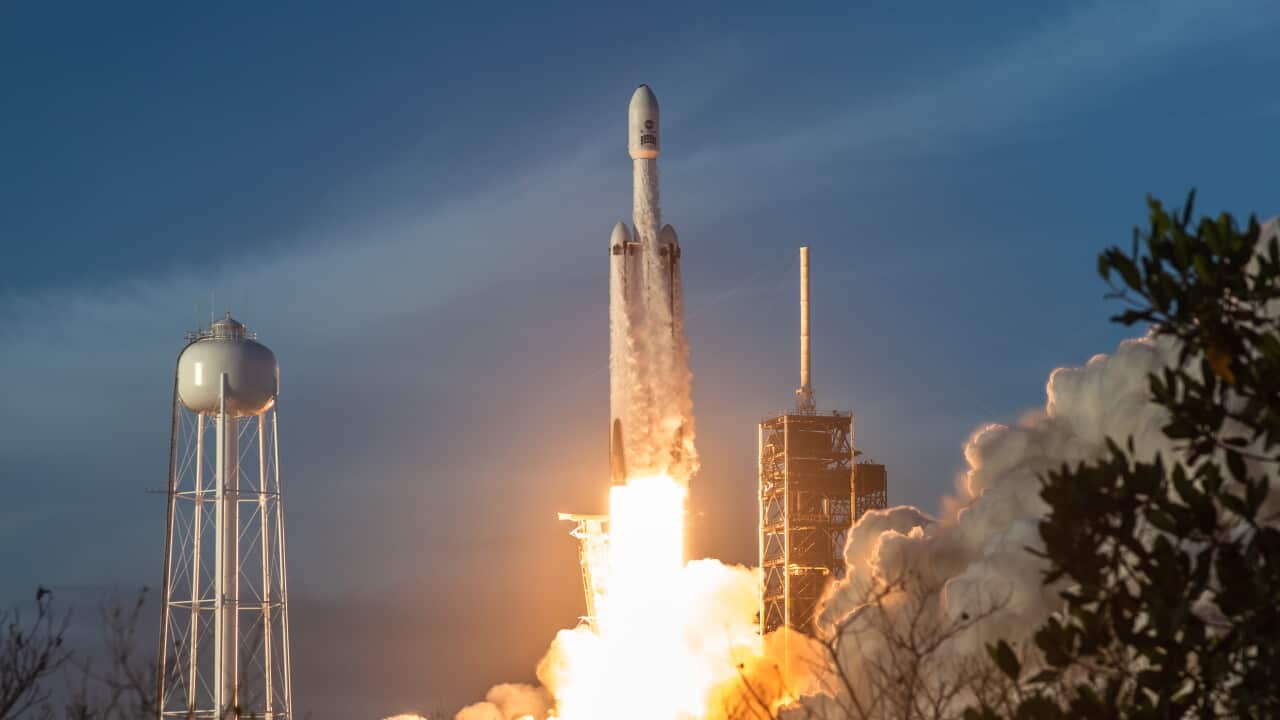
Al Kennedy Space Center in Florida, il razzo Falcon Heavy di SpaceX è decollato.
"Falcon heavy has cleared the tower and is on its way to space."
Trasporta il telescopio spaziale Nancy Grace Roman della NASA.
Chiamato semplicemente "Roman", prende il nome dalla prima astronoma capo e dirigente donna dell’agenzia.
La NASA fa sapere che il telescopio ha un campo visivo almeno 100 volte più ampio del famoso telescopio spaziale Hubble e catturerà vaste vedute panoramiche dello spazio.
"One of our main goals at NASA is answering the question, 'Are we alone in the universe?'. Whether you like space, whether you like technology, whatever it is, people look up at the sky, and they think - 'Am I alone, are we alone, is there another Earth 2.0 looking back at me?'."
Sono le parole di Nicky Fox, della Direzione delle Missioni Scientifiche della NASA.
Fox ha detto che il telescopio, la cui realizzazione ha richiesto più di un decennio, sarà utilizzato per far luce su due dei più grandi misteri della fisica: la materia oscura e l’energia oscura.
"And, with Roman we are going to make this giant leap forward with the coronagraph technology that is going to allow us to look at these distant, distant worlds ... just one mission, doing all of that. Billions of galaxies will be found, tens of billions of new stars, tens of thousands of new planets, and thousands of supernovae, all wrapped up in one beautiful telescope."
Nei prossimi 100 giorni, il telescopio Roman si allontanerà dalla Terra di oltre un milione e mezzo di chilometri.
Per almeno i prossimi cinque anni, invierà poi dati e immagini che, secondo gli scienziati, potrebbero rivoluzionare la nostra comprensione fondamentale dell’universo.
Julie McEnery guiderà la missione Roman in qualità di responsabile scientifico senior del progetto.
Un’impresa che lei stessa ha descritto come l’apice della sua carriera.
"It feels like I'm on the edge of a precipice and we're just about to set a foot off into the unknown that is going to be pointed out by what Roman is going do. We're going to open Roman's eyes, we're going see the sky in a new way with Roman for the first time."
Il telescopio è dotato di uno strumento specializzato noto come coronografo, che blocca il bagliore delle stelle, rendendo più facile fotografare i pianeti che le orbitano con estrema nitidezza.
Roman è inoltre dotato di uno strumento a campo largo, in grado di catturare ampie porzioni del cosmo.
Lavorerà in tandem con il telescopio James Webb, che viene paragonato a un obiettivo zoom, mentre Roman è un obiettivo grandangolare.
L’amministratore della NASA Jared Isaacman ha dichiarato che la straordinaria potenza del nuovo telescopio aprirà un nuovo mondo di conoscenze agli scienziati.
"Now, Roman has a field of view at least 100 times that of Hubble and over 1,000 times the scan rate. So, the telescope will provide a vast new atlas of the universe, potentially revealing more than 100,000 new exoplanets through its various surveys."
Durante l’evento Isaacman è stato interrotto da una telefonata del presidente degli Stati Uniti Donald Trump.
Isaacman: "The president of the United States of America would like to address and congratulate everyone on this mission. You're live, Mr President.
Trump: "I just want to thank everybody and congratulate you. Boy, it looked beautiful on television. I just called Jared to find out, is there anything negative that I should know about? Like, it will never be able to return? The little things like that. He said no, it's looking great."
I media statunitensi riferiscono che lo sviluppo, il lancio e il funzionamento del telescopio Roman costeranno sei miliardi di dollari.
Le lodi di Trump arrivano nonostante i suoi tentativi di tagliare i fondi al progetto, una mossa che alla fine è stata respinta dal Congresso degli Stati Uniti.
"You are doing a fantastic job and I am supplying you all that money."
Il telescopio rende omaggio a Nancy Grace Roman, una delle artefici del programma scientifico moderno della NASA.
Viene spesso descritta come la madre del telescopio spaziale Hubble e, secondo la NASA, il suo lavoro ha gettato le basi per generazioni di telescopi spaziali.
Oggi, sia gli scienziati che il grande pubblico avranno accesso a tutti i dati raccolti dal Roman.
La NASA afferma che l’enorme volume di informazioni sarà impressionante, ma che le opportunità di scoperta sono praticamente illimitate.
Inglese
"Three, two, one, ignition and liftoff! Go Falcon Heavy and go Roman Space Telescope."
A first-of-its-kind mission to search for life beyond Earth.
At the Kennedy Space Centre in Florida, the SpaceX Falcon Heavy rocket made liftoff.
"Falcon heavy has cleared the tower and is on its way to space."
It carries NASA's Nancy Grace Roman Space Telescope.
It's called Roman for short and is named after the agency's first chief astronomer and female executive.
NASA says the telescope has a field of view at least 100 times larger than the infamous Hubble Space Telescope and will capture vast, panoramic views of space.
"One of our main goals at NASA is answering the question, 'Are we alone in the universe?'. Whether you like space, whether you like technology, whatever it is, people look up at the sky, and they think - 'Am I alone, are we alone, is there another Earth 2.0 looking back at me?'."
That's Nicky Fox, the Science Mission Directorate at NASA.
She says the telescope, which has been more than a decade in the making, will be used to shed light on two of the biggest mysteries in physics: dark matter and dark energy.
"And, with Roman we are going to make this giant leap forward with the coronagraph technology that is going to allow us to look at these distant, distant worlds ... just one mission, doing all of that. Billions of galaxies will be found, tens of billions of new stars, tens of thousands of new planets, and thousands of supernovae, all wrapped up in one beautiful telescope."
Over the next 100 days, the Roman telescope will travel more than 1.5 million kilometres from Earth.
For at least the next five years, it will then send back data and images that scientists say could change our fundamental understanding of the universe.
Julie McEnery will lead the Roman mission as senior project scientist.
A venture she's described as the pinnacle of her career.
"It feels like I'm on the edge of a precipice and we're just about to set a foot off into the unknown that is going to be pointed out by what Roman is going do. We're going to open Roman's eyes, we're going see the sky in a new way with Roman for the first time."
The telescope features a specialised instrument known as a coronagraph cor-own-oh-graph which blocks glare from stars, making it easier to photograph planets around them in sharp detail.
Roman is also equipped with a Wide Field Instrument, capable of capturing large swathes of the cosmos.
It will work in tandem with the James Webb telescope, which is likened to a zoom lens - while Roman is a wide-angle lens.
NASA administrator Jared Isaacman says the remarkable power of the new telescope will open up a new trove of knowledge to scientists.
"Now, Roman has a field of view at least 100 times that of Hubble and over 1,000 times the scan rate. So, the telescope will provide a vast new atlas of the universe, potentially revealing more than 100,000 new exoplanets through its various surveys."
He was interrupted during the event, by a phone call from US President Donald Trump.
Isaacman: "The president of the United States of America would like to address and congratulate everyone on this mission. You're live, Mr President.
Trump: "I just want to thank everybody and congratulate you. Boy, it looked beautiful on television. I just called Jared to find out, is there anything negative that I should know about? Like, it will never be able to return? The little things like that. He said no, it's looking great."
US media reporting that the development, launch and operation of the Roman telescope will cost six billion dollars.
Mr Trump's praise comes despite his attempts to axe the project, a move that was eventually rejected by US Congress.
"You are doing a fantastic job and I am supplying you all that money."
The telescope pays homage to Nancy Grace Roman, one of the architects of NASA's modern science program.
She's often described as the mother of the Hubble Space Telescope, with NASA saying her work laid the foundation for generations of space telescopes.
Today, both scientists and the general public will have access to all of Roman's data.
NASA saying the sheer volume of information will be daunting, but that opportunities for discovery are practically limitless.
Report by SBS News
Ascolta SBS Italian tutti i giorni, dalle 8am alle 10am.
Seguici su Facebook e Instagram o abbonati ai nostri podcast cliccando qui.