
The federal government has met with state and territory treasurers to try to help solve the problem of managing Australia's burgeoning population. It's an important issue, but it's one that still seems to have as many questions as it does answers.
Everyone agrees Australia's population is growing rapidly. The permanent migration number is currently capped at around 190 thousand people per year. It has only reached around 160 thousand people per year in recent years. But, even with that, Australia has the fifth-fastest rate of population growth amongst countries that are members of the Organisation for Economic Co-operation and Development (OECD).
It hit the population landmark of 25 million people twenty years earlier than had been previously expected. But it's the question of what do about that population growth that brought officials from two different levels of government to Canberra for a meeting. Federal Treasurer Josh Frydenberg has been quick to declare the day's meeting a success.
"Out of today's very constructive discussion, we agreed to set up two working groups, to begin work immediately. Those working groups will look at data sharing, as well as regional aspects of the population debate. When it comes to data sharing, it's about infrastructure, it's about skills, it's about population trends, and getting greater co-operation and co-ordination between state and federal governments. When we're talking about regional analysis, we need to know where are the jobs that are open and where are workers needed."
Much of the problem surrounding Australia's population growth is that it appears that too many new arrivals are headed to too few destinations- putting pressure on those places. Those places, are, naturally, Australia's biggest states and cities. Two-thirds of new immigrants are going to capital cities - in particular, areas like Sydney, Melbourne, and south-east Queensland.
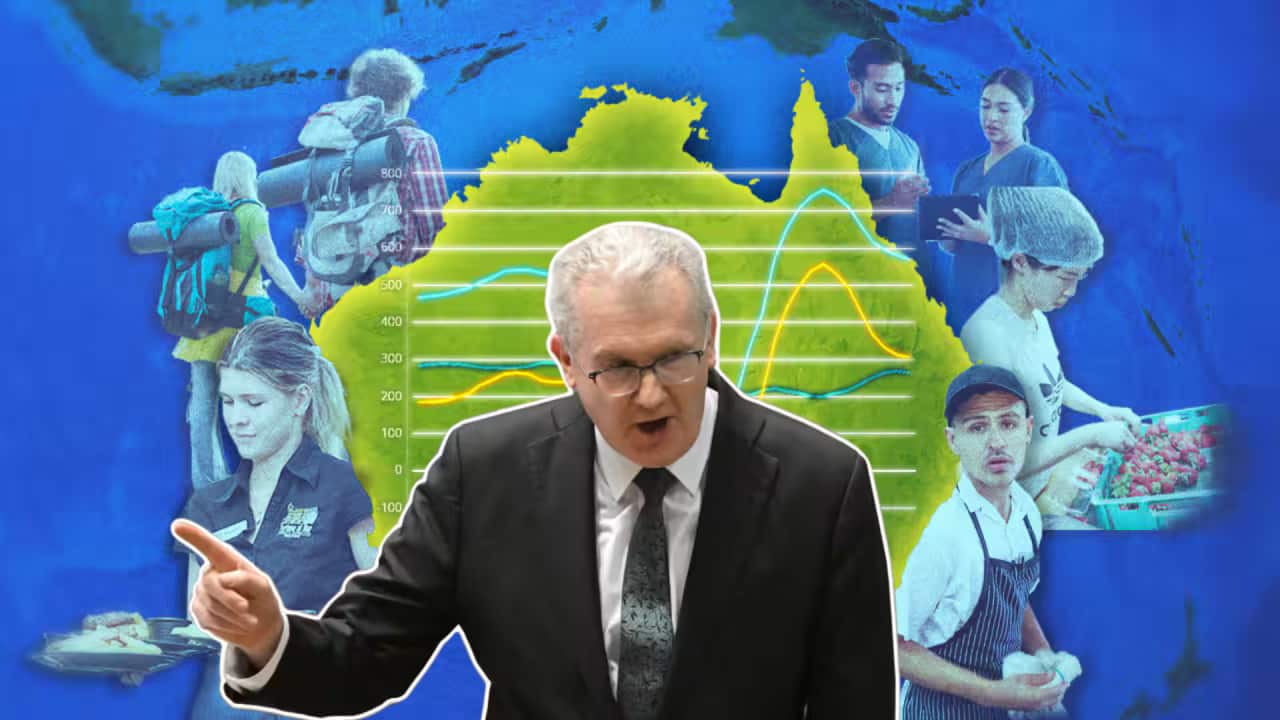
It's creating a tension between the federal government, who decides whether to let people into Australia or not, and the state and territory governments, who have to cater for them once they arrive. It's a tension acknowledged by federal Infrastructure Minister, Alan Tudge.
"One of the key problems with our federation that we control the primary population growth lever, being the migration settings, whilst the states and territories are largely responsible for the infrastructure and the service delivery. And what today's about, and what a new framework is about, is trying to marry those two things more closely together."
Infrastructure is the issue everyone is talking about in this regard. And that's an issue that has become as much political as it is practical. Federal opposition leader Bill Shorten says his federal government, should he be elected later this year, would be much better than the present one in helping provide the necessary infrastructure for a growing population.
"There's no point in bringing people into crowded cities if our infrastructure's not keeping up. So, a big part about dealing with immigration is making sure that we've got the proper infrastructure to deal with it. It's only Labor who's got a proper plan for public transport in our national cities. It's only Labor who's got a proper plan to make sure our schools and our roads are properly funded. In terms of moving new Australians to the regions, we are up for that discussion, because we think there are some regional communities who are keen to get more people. But it's just common sense, and we've got make sure, though, that our infrastructure is coping with the people we bring in."
Immigration minister David Coleman has unveiled a 19.4 million dollar plan designed to help those regional areas who are, as Mr Shorten says, keen to get more people. The plan would see skilled migrants have their Australian visa applications dealt with faster if they move to regional areas.
Amongst areas being targeted at the moment in this general regard are the Northern Territory, central and north-western New South Wales, Cairns in northern Queensland, and Warrnambool in Victoria. But, according to the state and territory treasurers present at the meeting in Canberra, it all comes back to that key area: infrastructure.
The Queensland government has not been afraid to attack the federal government in this area recently, claiming the federal government is not sufficiently supporting the new cross-river rail infrastructure project in south-eastern Queensland. Queensland treasurer Jackie Trad says the federal government, at the moment, is mainly just posturing.
"This is just a non-conversation unless the Commonwealth wants to get serious about funding infrastructure. And, quite frankly, from Queensland's experience, we know that they're not interested in funding and financing infrastructure projects. So, until they get serious on that front, I'm afraid that this is just a lot more words, and not a lot of action."
The New South Wales government, unlike the Queensland Labor party government, is on the same side of politics as the current federal government. But, it too, has its gripes with Mr Frydenberg, Mr Tudge, and their colleagues. New South Wales treasurer Dominic Perrottet (pair-oh-tet)) says his state, too, doesn't get enough infrastructure money from the federal government. And, not only that, he thinks they're giving too much money to states that don't deserve it- like his neighbours to the north.
"It's the federal government that gets the benefit of immigration, but it's the states like New South Wales that pay the bills. So what we would say, on a per capita basis, is that New South Wales should get a fairer share when it comes to infrastructure investment. We're already seeing the taxpayers of New South Wales continue to support states, like Queensland, who don't recycle their assets, who don't have a reform agenda. And we think, when it comes to the GST, when it comes to infrastructure investment, states that reform should benefit. And states should be incentivised to embark on reform."
With even the federal government only having limited funds, and with both immigration and the demands of states and territories set to continue, it's an argument that's bound to go on for some time to come.
Listen to SBS Punjabi Monday to Friday at 9 pm. Follow us on Facebook and Twitter.