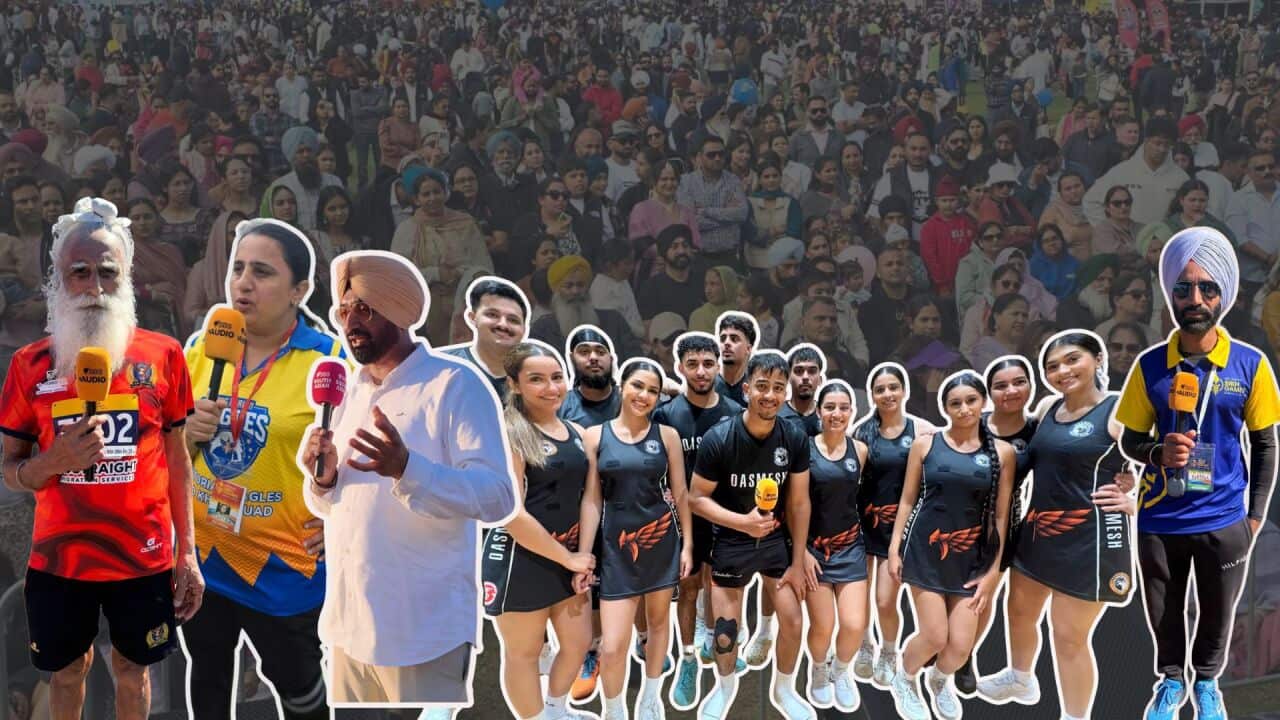

The 38th Australian Sikh Games in Melbourne have wrapped up with record participation, bringing together more than 9,000 athletes across over 550 teams in what organisers described as one of the largest editions.
The Australian Sikh Games are the premier sporting and cultural event for the Australian Sikh community.
They are held every year in capital cities and major regional areas around Australia.
Held over three days from 3–5 April across Parkville, State Sports Centres, and surrounding venues, the Games featured around 18 sports, including kabaddi, athletics, basketball, cricket, hockey, netball, soccer, volleyball, alongside bhangra, giddha, art exhibitions, Sikh Forum, women engagement initiatives, gatka competition and stage performances.
Vice President Kulwant Singh said the event’s growing scale meant more planning, funding, and volunteers were needed each year.
"The initial budget was around $1.2 million, but final costs could reach approximately $1.7 million, with support including state backing and a $450,000 federal election commitment," Mr Singh said.
"The games remained free and volunteer-run, with the Bedi family, volunteers, and multiple gurdwaras helping provide langar and food services over the three days."
"New additions such as All Ability Sports, Kho-Kho, the Women Engagement Forum through Kaur Rising, and increased youth participation through the Sikh Forum helped expand inclusion and engagement across the community," he said.
Participation in athletics crossed 1,200 competitors, while the Sikh Forum also drew more than 1,200 participants, with soccer recording the highest registrations. A notable point was that all kabaddi players were Australian-based, with no overseas participation.
The games also partnered with the Royal Children’s Hospital Foundation through the “Sponsor a Bed” campaign, continuing the Sikh principles of Seva and Sarbat da Bhala.

While many attendees described the Games as a vibrant celebration of sport, culture, and community, many also raised concerns about logistical challenges, including venue layout, langar management, game scheduling, coordination, and limited food and water access for players at some grounds.
One attendee from Sydney, Harkirat Singh Sandhar, said, with games, langar, and fields spread far apart, it was challenging for families—especially those participating in different events—to manage and attend everything smoothly.
The games are beautiful, but this year there were many logistical challenges around venue and a lack of clarity.Harkirat Sandhar
"Many families left without food, which could be better managed with improved planning for volume and distribution. Toilets were also not enough to accommodate the people," he added.
Some attendees also reported long langar queues, limited food availability at certain sporting grounds, and concerns about water access, toilets, signage, delayed games, and occasional referee shortages.
Sports coordinator Kuldeep Singh Aulakh also pointed out that lack of food at the athletic ground at Melbourne University was impacting children and their parents.
"But the spirit was exemplary, and athletics saw record participation this year," said Mr Aulakh.
Kids and veteran athletes faced food and water shortages at the grounds. Spectators were limited mostly to parents, as the venue was far from the main area.Kuldeep Aulakh, Athletics coordinator
Parking also emerged as another major issue over the weekend. The City of Melbourne confirmed that more than 500 parking infringements were issued during the three-day event.
In a statement to SBS Punjabi, "The council said fines were issued for offences including parking on nature strips, footpaths, reserves, and in permit zones, involving both attendees and non-participants."
"Council understood the impact increased parking demand had on nearby residents and visitors during the Games and that parking officers and Park Rangers monitored compliance and safety throughout the event."
The Games concluded with the ceremonial handover of the flag to Perth, which will host the next Australian Sikh Games, with Melbourne expected to host again in six years.
As the Games continue to grow in size and popularity, both organisers and attendees said future planning around transport, venue access, and player facilities will be key to maintaining the event’s strong community reputation.
Interviews with Kulwant Singh, Vice President of the Australian Sikh Games, athletics coordinator Kuldeep Singh Aulakh, and several attendees have been included in the podcast.
More detailed interviews and extended coverage will be shared in the coming days. A lot of coverage has been shared on SBS Punjabi's Facebook and Instagram page.
To hear the interviews featured in this report, listen to the podcast.
The podcast includes some of the following key details:
- Over 9,000 athletes and 550+ teams across 18 sports participated.
- The Games were hosted at State Sports Centres, Parkville, and surrounding venues.
- Final figures, including langar distribution, are expected to be released soon by the committee.
- Estimated cost of the Games was up to $1.7 million, including a $450,000 federal election commitment and some state support.
- 500+ parking infringements were issued by the City of Melbourne.
- New additions included All Ability Sports, Kho-Kho, a two-day Women Engagement Forum through the Kaur Rising initiative, and increased youth participation through the Sikh Forum.
- Athletics and Sikh Forum each drew more than 1,200 participants, while soccer recorded the highest registrations.
- No overseas players participated in kabaddi, keeping it Australian-based.
- Cultural stage performances and art exhibitions added to community engagement.
- Key issues raised included venue distance, food and water access, toilets, signage, game scheduling, and coordination.
🔊 Find all our podcasts and stories that matter here at SBS Punjabi Podcast Collection.
💻 For news, information and interviews in Punjabi from across Australia and the homeland, you can tune in to SBS Punjabi live from Monday to Friday at 4pm on SBS South Asian on digital radio, on channel 305 on your television, via the SBS Audio app or stream from our website.
📲 Also, follow us on Facebook and Instagram.