
In brief
- Yemen's Houthi rebels have vowed to impose a maritime blockade on long-time foe Saudi Arabia.
- The latest flaring of that longstanding conflict could have severe consequences for global energy supplies.
There are concerns global energy supplies could be crippled and oil prices spike even further after Yemen's Houthi rebels opened up a new front in the US-Israeli war on Iran by vowing to impose a maritime blockade on Saudi Arabia.
And it could put added pressure on the Albanese government to extend the fuel excise discount — which is due to end on 2 August.
Energy supplies have already been stifled by volatility in the Strait of Hormuz — now at the centre of a continuing war that was originally intended by the US and Israel in February to target any Iranian nuclear weapon capability.
Though it's not clear how the Houthis would carry out their campaign against Saudi Arabia, it threatens to disrupt shipping in the Red Sea, through which the Saudis have been exporting millions of barrels of oil.
Lurion de Mello, a senior lecturer in applied finance at Macquarie University, said oil prices, especially diesel, could take a hit.
News that makes sense
Your trusted source for staying up-to-date with the world around you. Get free daily news updates and analysis, straight to your inbox.
"Saudi Arabia has been pumping quite a fair bit of oil, and exporting it through its ports in the Red Sea, and this oil has been making its way all the way to China and also into refineries into Asia," he told SBS News.
"So this threat, I think it's really going to hurt the supply coming out of Saudi Arabia, and I think definitely will have an uptick on the oil price."
Why are the Houthis blockading the Red Sea?
The Yemeni militant group has been fighting guerrilla wars against the Saudi-backed Yemeni government for years. It is aligned with Iran, which considers the Houthis as part of its regional "Axis of Resistance", though the Houthis deny being an Iranian proxy and say they develop their own weapons.
It is not clear how far the group's new blockade campaign stems from its own strategic priorities or is being made on Iran's behalf.
A long-running conflict between the Houthis and the Saudis flared up again last week, when Yemen's internationally recognised government said it had struck Sanaa airport to stop an Iranian plane landing.
The Houthis said Saudi Arabia was responsible and in response fired missiles at Abha airport in the kingdom's mountainous southwest.
Why is this Red Sea route important?
Yemen sits on the Bab al-Mandab Strait — the southern gateway to the Red Sea — and closing that would open up a new front in the energy crisis and Iran's overarching conflict with the US.
The strait has emerged as a much-needed alternative to the Strait of Hormuz for global oil flows, with more than seven million barrels per day transiting the strait in June, up from roughly four million barrels before the Iran war.
Following Iran's partial blockade of the Strait of Hormuz, Saudi Arabia responded by diverting more than 70 per cent of its normal daily crude exports to the Red Sea port of Yanbu. Ships from Yanbu bound for Europe go north through the Suez Canal. Those heading to Asia go south through Bab al-Mandab.
Around seven per cent of the world's oil output now transits through Bab al-Mandab — a lifeline for the energy market that's credited with keeping down global oil prices.
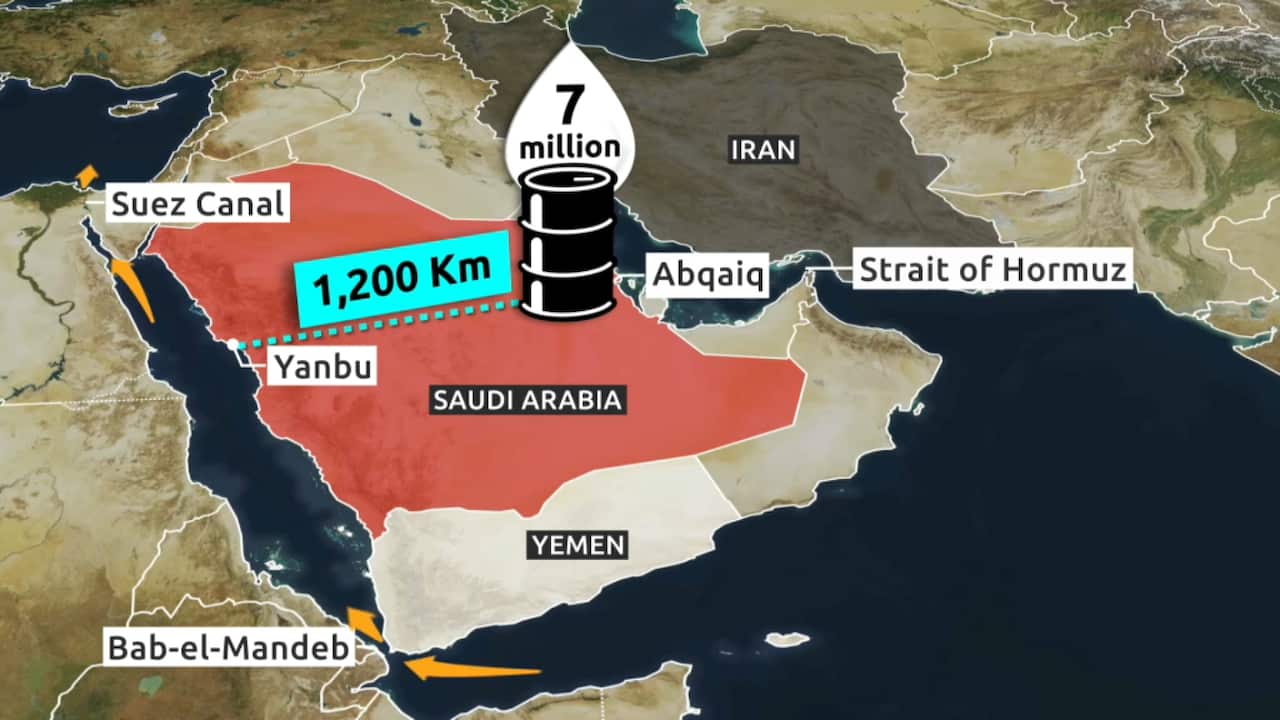
A serious disruption would mean both of the Middle East's major oil export routes are shut simultaneously.
"These are two of the world's most important energy and trade corridors," Ben Fahimnia, a professor in supply chain management at the University of Sydney, told SBS News.
"If the conflict extends beyond a short-lived event and both choke points experience sustained disruption, triple-digit oil prices become highly likely.
"In a severe, but quite plausible, scenario of prolonged military escalation, prices well above US$120–150 per barrel become highly likely."
De Mello says it remains to be seen whether the Houthis follow through and start attacking ships on the waterway.
"I don't think it's as catastrophic as what we first experienced when the Strait of Hormuz was closed. But we have to see," he said.
"If they literally go in and start striking some of the Saudi ships or the oil tankers, I think that definitely will send jitters around the world."
The impact could be felt in Australia — though to a lesser extent.
"Australia purchases fuel in a global market, and global shortages ultimately affect everyone regardless of where individual cargoes originate," Fahimnia said.
Luke Hartigan, a senior lecturer in econometrics at Sydney University, says Australia could be affected, but not as much as Asian neighbours.
"I think will be as as well likely be as bad as what happened in February. So it could be bad, but I think depending on how things play out," he said, adding that the US mid-term elections could spur the Trump administration to seek a resolution.
He said it could put pressure on the federal government to extend the fuel excise discount, which has been extended through a partial cut of 16 cents until 2 August.
The government is still considering whether to extend the fuel excise cut for a second time beyond its latest end date of 2 August.
"if there was to be some material movement in price and looked like it was going to be sustained, and then that would feed through to other prices via second round effects.
"But again, it would depend on what's what's happening in the in oil prices. It's still below 100 US dollars a barrel, so that's encouraging. But if it was to shoot up quite maturely above that, then we could see the government trying to or plan for talk about extending that."
— With additional reporting by Reuters.
For the latest from SBS News, download our app and subscribe to our newsletter.







