
In brief
- Solar flare activity means aurora australis could be seen in parts of the country tonight.
- The lights are more likely to be seen in southern regions.
Australians could soon witness brilliant green and red lights gleaming in the sky, after the Bureau of Meteorology's Space Weather Forecasting Centre issued an alert.
The centre said that a "coronal mass ejection" was expected to impact the Earth, possibly resulting in geomagnetic activity and what's known as aurora australis in some parts of the country during night hours.
The aurora could be seen before dawn on Friday in some parts, experts say, with the weather bureau to issue more alerts if geomagnetic activity occurs.
The 'big burp': What is an aurora?
Auroras are the result of a complex sequence, all beginning with solar activity.
News that makes sense
Your trusted source for staying up-to-date with the world around you. Get free daily news updates and analysis, straight to your inbox.
Jonti Horner, astrophysics professor at the University of Southern Queensland, said that like Earth, there is wind blowing out from the sun all the time, gently carrying material and charged particles into space.
That solar wind can push towards Earth, where magnetic fields send it towards the north and south magnetic poles.
"But occasionally the sun is more active than normal. It has these things called coronal mass ejections and solar flares, and they're like the sun having a big burp into space. It throws out more material … and the more materials coming in, the more our magnetic field can be overloaded," Horner says.
The more it's overloaded, the further auroras are likely to be visible away from the poles.
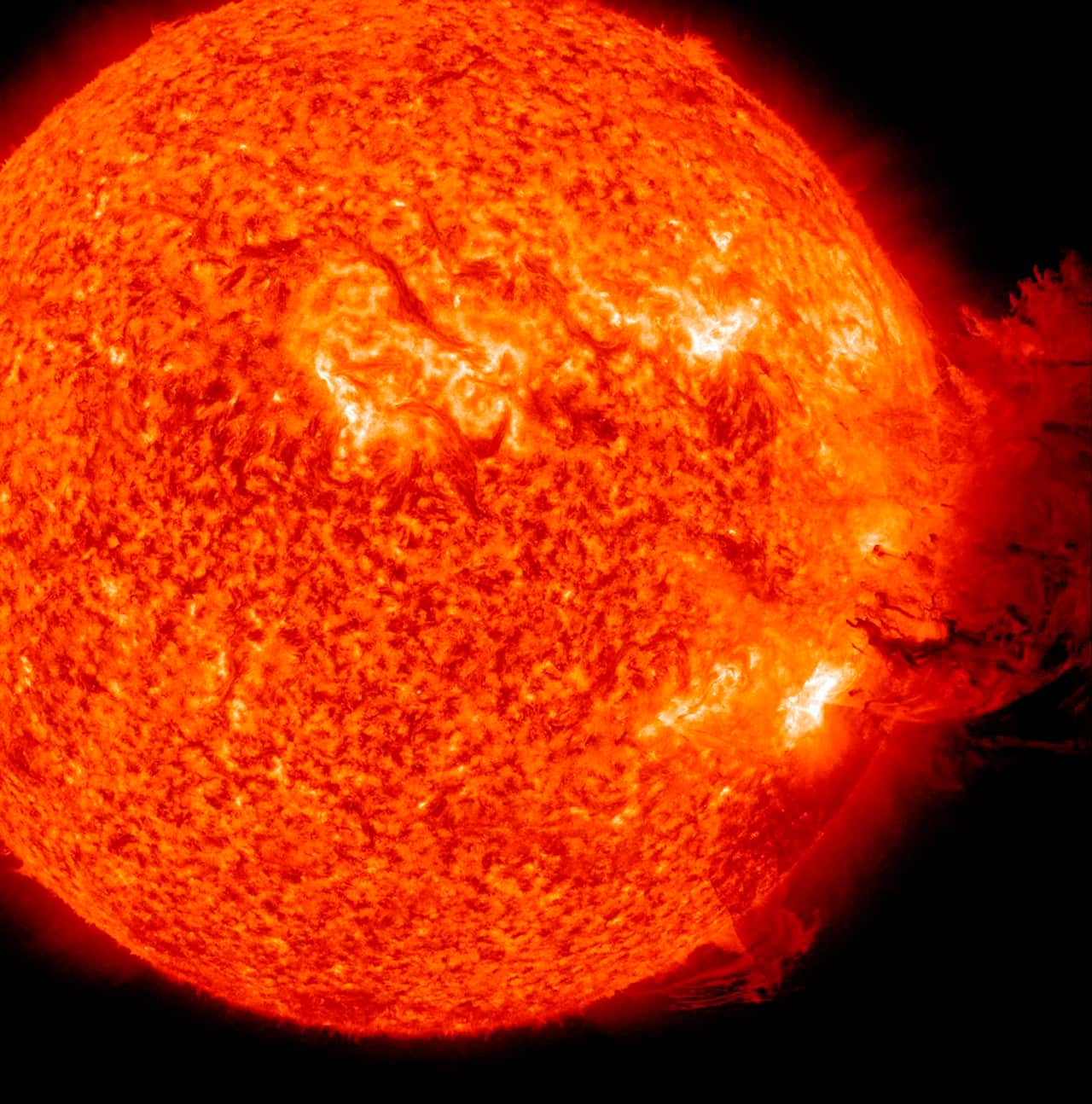
"That's why in the last couple years, we've had three massive solar storms where the auroras were even visible as far as north Queensland," he said.
Predicting a smaller solar flare this time, Horner says it's generally more common for those in Australia to see red and green lights than other colours.
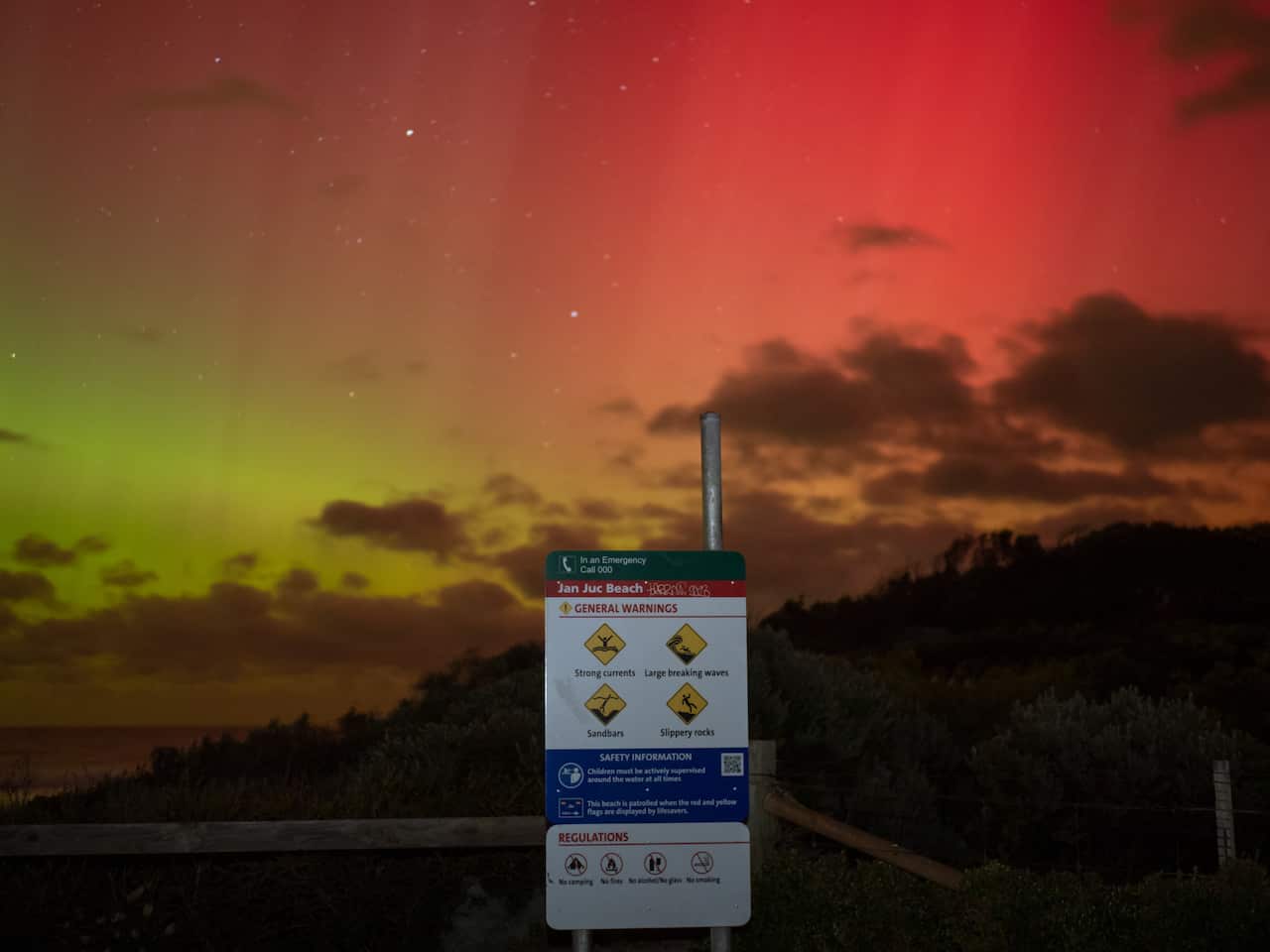
According to the National Aeronautics and Space Administration in the United States, the location and type of gas released determine what colours appear:
Green: Comes from charged oxygen at an altitude of 100 to 200km
Red: Comes from charged oxygen above an altitude of 200km
Pink: Comes from charged nitrogen below an altitude of 100km
Blue: Comes from charged nitrogen at an altitude of 100 to 200km
Where in Australia will you be able to see the aurora?
With the right weather conditions, the Bureau of Meteorology says aurora sightings are more likely in southern parts of Australia, including Tasmania and southern Victoria.
Before dawn on 20 March, stargazers will have their first chance at seeing the colourful displays. They'll have another opportunity at night on 21 March.
Unfortunately for viewers in northern NSW and Queensland, Horner says it is "very unlikely" for the phenomenon to be seen, but says it's not out of the question.
"There is one thing acting a little bit in our favour, which is that if you have the same auroral storm happen twice and one of them happened at midwinter or midsummer, and the other happened at the equinox, the one at the equinox would make a little bit of a bigger aurora further from the poles."
How to get the best view of the aurora?
Auroras are strongest at Earth's north and south magnetic poles, so looking towards the southern horizon will increase your chances of seeing a glow.
Moving away from areas with light pollution can increase chances of a dark sky, and finding an unobstructed view away from trees and buildings can assist with a clearer southern view.
However, Horner says it is the uncertainty that makes this event interesting.
"It's just a reminder that we need to be continually monitoring this and seeing what’s happening essentially, because it's always got the potential to, I guess, surprise us and do something a little bit unexpected."
He says the best recommendation before heading out is to check social media groups, particularly in Tasmania and the southern parts of Australia, where people often post sightings.
For the latest from SBS News, download our app and subscribe to our newsletter.







