
Days after the federal budget was handed down on 12 May, Holly Nebauer and her partner placed an offer on a family home.
It was something the 31-year-old had been working towards since she was 22 years old, when she began educating herself about money and investing the spare change from everyday purchases using the round-ups feature on an online investment platform.
"I'd grown up in a community and a family where money was taboo, it wasn't really spoken about [and] we didn't really have that much financial literacy taught in schools," Nebauer tells SBS News.
She says the low-risk nature of those initial investments helped her to learn how investing works and ignited her passion for understanding finance.
When Nebauer found out about the changes to capital gains tax (CGT) in the budget, she was initially disappointed they would apply to shares as well as property.
News that makes sense
Your trusted source for staying up-to-date with the world around you. Get free daily news updates and analysis, straight to your inbox.
"But at the end of the day, something had to give, we knew we were on a pretty good wicket in terms of things like that, and we can't as a society continue to have our cake and eat it too."
Nebauer, like many other Australians, is moving forward with plans to sell her current apartment and upgrade to a house, despite tax changes that could reshape investment decisions across housing, shares and businesses.

The reforms already appear to have rattled the real estate market, with data from Cotality showing dwelling values fell by 0.9 per cent in Sydney and 0.8 per cent in Melbourne during May. Auction clearance rates have also slipped below the 60 per cent benchmark in recent weeks, with conditions increasingly appearing to favour buyers.
Financial planner Amie Baker, founder of wealth advisory firm Rekab Advice, says the changes have created uncertainty among her clients, with many now considering whether to offload assets before the proposed CGT changes are due to take effect on 1 July 2027.
"I have had a number of clients ask whether they should sell assets, obtain valuations, or review existing investment strategies," Baker tells SBS News.
"We are definitely seeing clients seek advice as they try to understand what the proposals may mean for them."
What decisions need to be made and when?
On budget night last month, the Albanese government unveiled the "most significant transformation of Australia's tax system in more than a quarter of a century".
While several measures still require legislation to pass parliament, some changes are designed to take effect immediately.
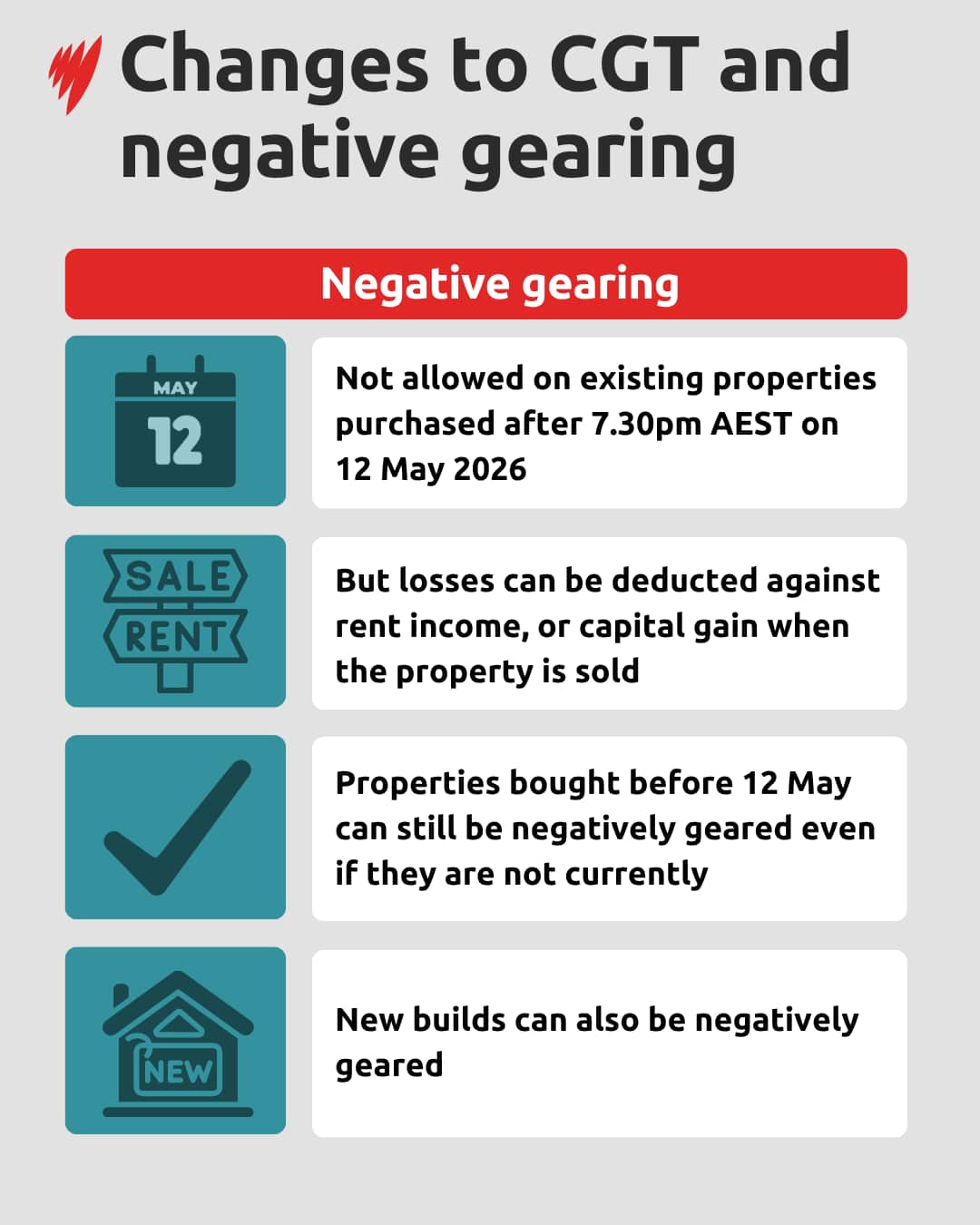
Anyone who bought an existing residential property after 7.30pm AEST on 12 May, will no longer have access to negative gearing, which allows investors to offset property losses — such as interest costs — against taxable income from unrelated sources such as wages and salaries.
But newly built homes will still be able to be negatively geared, and existing rules will be grandfathered for those who owned property before budget night, allowing them to negatively gear these properties.
From 1 July next year, CGT measures will also be changed.
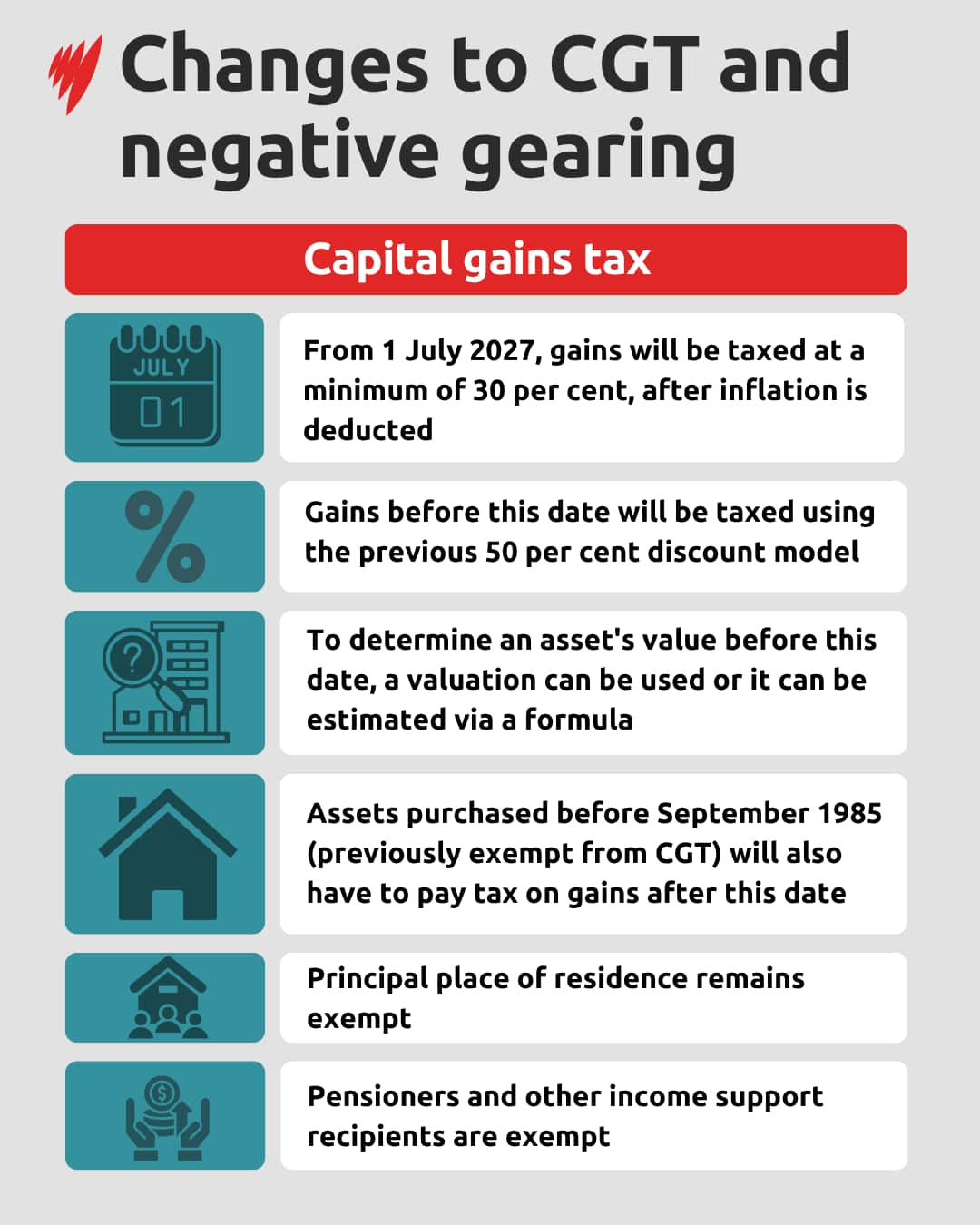
The current rules provide people with a 50 per cent discount on the tax they pay when they sell an asset held for more than 12 months — such as property, shares and businesses — for profit.
But the budget papers argue the discount provides an incentive for people to hold on to their assets and sell in years when their other income is lower, such as during retirement.
Profit will instead be taxed at a minimum of 30 per cent, after an amount for inflation is subtracted. This new formula only applies to capital gains earned after 1 July 2027. Income earned before this date will be taxed under the existing rules.
Like negative gearing, there will be an exemption for newly built residential dwellings.
The changes would also impact those who bought their property before September 1985, and previously did not have to pay CGT. They will now have to pay tax on any gains after 1 July next year.
Impact can vary depending on personal circumstances
Baker says the proposed CGT changes provide a reason for investors to review their strategies, but do not automatically mean that selling an asset is the right decision.
She points to the example of a retired couple who own an investment property bought before September 1985.
"At first glance, some people might assume that selling before the proposed commencement date is the obvious answer," Baker says.
"However, when we look at the couple's circumstances more closely, the answer becomes far less straightforward."
One member of the couple is over 80 years old and both are retired. They are using rental income from the investment property to help support their lifestyle.
Baker says if they were to sell the property they would need to consider what happens to the money — whether it is possible to make further superannuation contributions, whether alternative investments could generate comparable income, and whether selling the property would actually improve their overall retirement position.
The impact may look very different for a young family who bought several investment properties in recent years as a way to build wealth and climb the property ladder.
Such investors may not have much equity in their properties yet and would also lose access to negative gearing under the proposed changes.
"It really comes down to how much equity will be in that asset before we decide when it's right to sell," Baker says.
Baker says the answer is rarely as simple as "sell before 2027" or "hold forever".
The first question I ask is why the asset was purchased in the first place. Before looking at tax outcomes, we need to understand whether the asset is still serving the purpose it was originally intended to serve.
Nathan Coad, director of finance brokerage NMC Finance, points out homeowners are also unlikely to be significantly impacted by the CGT changes in the near future because recent weaknesses in the property market could limit future capital growth.
"The reality is ... the growth is not going to be there from that period onwards [unless another factor starts to drive property prices high again]," he tells SBS News.
Selling stocks and businesses
There are also CGT exemptions for certain assets. Some small businesses owned for longer than 15 years, and worth less than $6 million, may not be liable for CGT if the owner is aged 55 or over and retiring, provided certain conditions are met.
"There's many layers to talking about the business situation because it's not just one-size-fits-all with business structures," Baker says.
Questions remain about how the changes will affect start-ups and business investment, with industry groups raising concerns about their potential impact on entrepreneurship and access to capital.
Prime Minister Anthony Albanese has flagged further consultation about the implementation of the new measures.
"Treasury are going about consulting not just in tech, but consulting COSBOA [Council of Small Business Associations of Australia], for example, ACCI [Australian Chamber of Commerce and Industry], [and] the Tech Council," he told a press conference on 25 May.
A second lot of legislation will be introduced to deal with implementation of the changes. This week the first bill was passed by the House of Representatives and will now be considered by the Senate.
Undoubtedly, some clients will pay more tax, Baker says, noting that one client who is a retiree now faces paying the new 30 per cent CGT when she sells a parcel of shares.
Under the previous system she may have been able to avoid paying tax if the gain was under the effective tax-free threshold of $22,575. The client can't put her assets into superannuation (which is exempt from CGT in the pension phase) because she is already retired and over the age limit for making contributions.
But Baker says market volatility must also be taken into account when selling shares.
Sometimes it's best to hold onto an asset [and] not crystallise a loss if it's a downturn period.
Despite the changes, Craig Keary, the CEO of micro-investing service Raiz Invest, believes Australians will continue investing and saving to build wealth.
He says investing in equities, for example, still delivers reasonably good long-term returns even if the CGT discount is changed.
"That's still attractive and if people are using it to buy and hold for the long term, that strategy is still very much a valid strategy."
Moving ahead despite the uncertainty
Given the recent decline in the market, Nebauer is not expecting to make much on the sale of her apartment, which is expected to go to auction this month. But she says that's not why they are selling.
"We're selling for the sole purpose of future-proofing our family," she says, adding that she now has an active three-year-old daughter.
The family recently exchanged contracts to buy a "forever home" in Bungendore in NSW, just outside of Canberra. They have also seen decent buyer interest in their apartment as it is still in the first home buyer price range.
Nebauer considers herself lucky as she was able to buy her first property in Canberra for $442,000 under the then Morrison government's 5 per cent deposit scheme just as the COVID-19 pandemic was kicking off in 2020. She and her partner were able to sell for a $200,000 profit and buy their current apartment for $725,000.
"I don't know [what] our situation would look like if we didn't buy that initial property — I've got friends who are like us, [who] are in houses, but then I also have people our age and younger [who say] 'I'm never going to be able to afford a house'."
Nebauer says she is not bothered by the budget changes even though she will lose the chance to negatively gear her current property once it is sold.
"It doesn't really impact us because ... I can't ever really imagine having and owning more than one property.
"I don't think morally I could ever be that person that has investment properties and rents them out."
Correction: An earlier version of this article included incorrect modelling provided by an expert, illustrating a scenario where property owners were not worse off if they did not sell before 1 July 2027. This has been removed.
This article is general information. Please see a professional if you need financial advice.
For the latest from SBS News, download our app and subscribe to our newsletter.







