
IN BRIEF
- Experts say buyers are increasingly experiencing the "fear of overpayment" more than the fear of missing out.
- As homes take longer to sell, some vendors have taken to offering luxury cars or designer bags to lure buyers.
After selling her apartment in Sydney's inner-west suburb of Marrickville, Stephanie (last name withheld) thought the hard part was over.
Instead, she says she has found herself trapped in a strange middle ground in Australia's cooling property market, as she starts the search for her new home.
While buyers in Australia are reportedly experiencing a gradual increase in negotiating power, actually securing a home still feels brutally difficult.
At inspections, crowds are thinner. Auction clearance rates are falling. Sellers are increasingly nervous.
Another problem persists: agents told SBS News there simply aren’t many quality homes hitting the market.
News that makes sense
Your trusted source for staying up-to-date with the world around you. Get free daily news updates and analysis, straight to your inbox.
"It feels like everyone says buyers have the upper hand now, and it certainly felt that way when I was selling in April," Stephanie told SBS News.
"But when a good property does come up, there's still huge competition because it seems like there's not much stock around."
That contradiction is becoming a common feature of Australia's housing market in 2026.
Experts say the market is shifting away from the frenzy of the pandemic-era boom and towards conditions that favour buyers, at least on paper.
But for many Australians trying to buy a home, it may not actually feel that way just yet.
Even in a time of year that's typically slower, the housing market is doing weird things and a correction appears underway.
The market is fast cooling
Australia's housing market has been losing momentum for months, with higher interest rates reducing borrowing power and shaking buyer confidence.
Now, fresh uncertainty following federal budget changes to negative gearing and capital gains tax has added another layer of hesitation across the market.
The clearest sign of the shift has been a decline in auction clearance rates.
Data from Cotality indicates that, across the capital cities, preliminary auction clearance rates recently slipped below the key 60 per cent benchmark that analysts often associate with a balanced market.
In Sydney, clearance rates have hovered in the mid-50 per cent range in recent weeks.
Brisbane recently recorded one of its weakest preliminary auction results since 2023.
And according to experts, buyers are becoming far more cautious about how much they're willing to spend.
That caution could be shifting the psychology of the market.
Where sellers once dictated terms, buyers are now more willing to negotiate, walk away, or wait for prices to soften further.
RMIT University behavioural economist Meg Elkins described the current state of the economy as "a bit crazy", saying buyers are navigating a market unlike anything seen in a very long time.
"Even when data tells us it is a buyer's market, the asking price of properties is still doing the work on the behaviour of buyers … So regardless of what the bigger market is doing, if sellers haven't adjusted their prices down, buyers will remain anchored toward inflated expectations," Elkins told SBS News.
A shifting power dynamic
Experts told SBS News that this shift is a textbook transition into a buyer's market.
In practical terms, that means homes taking longer to sell, fewer bidders at auctions, more pass-ins and vendors increasingly having to compromise on price expectations.
Where a newly renovated kitchen or ducted air conditioning was once enough to entice buyers, these may no longer cut through in a slower market, with agents saying some sellers are even turning to increasingly creative tactics to attract attention.
In western Sydney, one vendor recently offered buyers a free Alfa Romeo 4C sports car as part of a multi-million-dollar property sale.
Ray White Parramatta agent Alexander Sallit, who was responsible for the car incentive, said the offer reflects a broader shift underway, with sellers working harder, while buyers are gaining leverage.
"We're now offering additional showings of properties on Sundays. We are also shifting campaigns and changing how we advertise properties," he told SBS News.
"I have one property coming up where the sellers are offering a complimentary Chanel bag with the purchase ... With the car, the owners of the property wanted buyers to see it as a cherry on top, kind of like a buy two and get one free," he said.
But experts say there's still a disconnect between what buyers are willing to pay and what sellers think their homes are worth, with this tension contributing to a growing number of auctions passing in without a sale.
"On both ends of the spectrum, as a seller and now a buyer, it's been extremely exhausting to try and read a market which seems confused in and of itself," Stephanie said.
"It’s this weird mix where, as a seller, I felt nervous, and now, as a buyer, I feel nervous too, and nobody really knows what a fair price is anymore."
A burden not yet eased for buyers
Despite the shift in negotiating power, many aspiring buyers say the market still feels intensely competitive.
Property market strategist Cameron Kusher told SBS News that part of the reason is supply, with some homeowners holding off listing altogether — partly because they fear they've missed the market's peak.
He said others may be reluctant to lower price expectations after years of rapid growth.
The result is fewer quality homes available, particularly in already tightly-held suburbs.
"Generally speaking, we are seeing very low supply levels … And there are a number of different reasons why we are not seeing much supply in certain markets, from low rental vacancy, to the time of the year when activity slows quite a bit," Kusher said.
So while demand has weakened overall, buyers are often still competing fiercely for the small number of desirable properties that do come on the market.
Adding to the complexity, banks are cutting the size of loans.
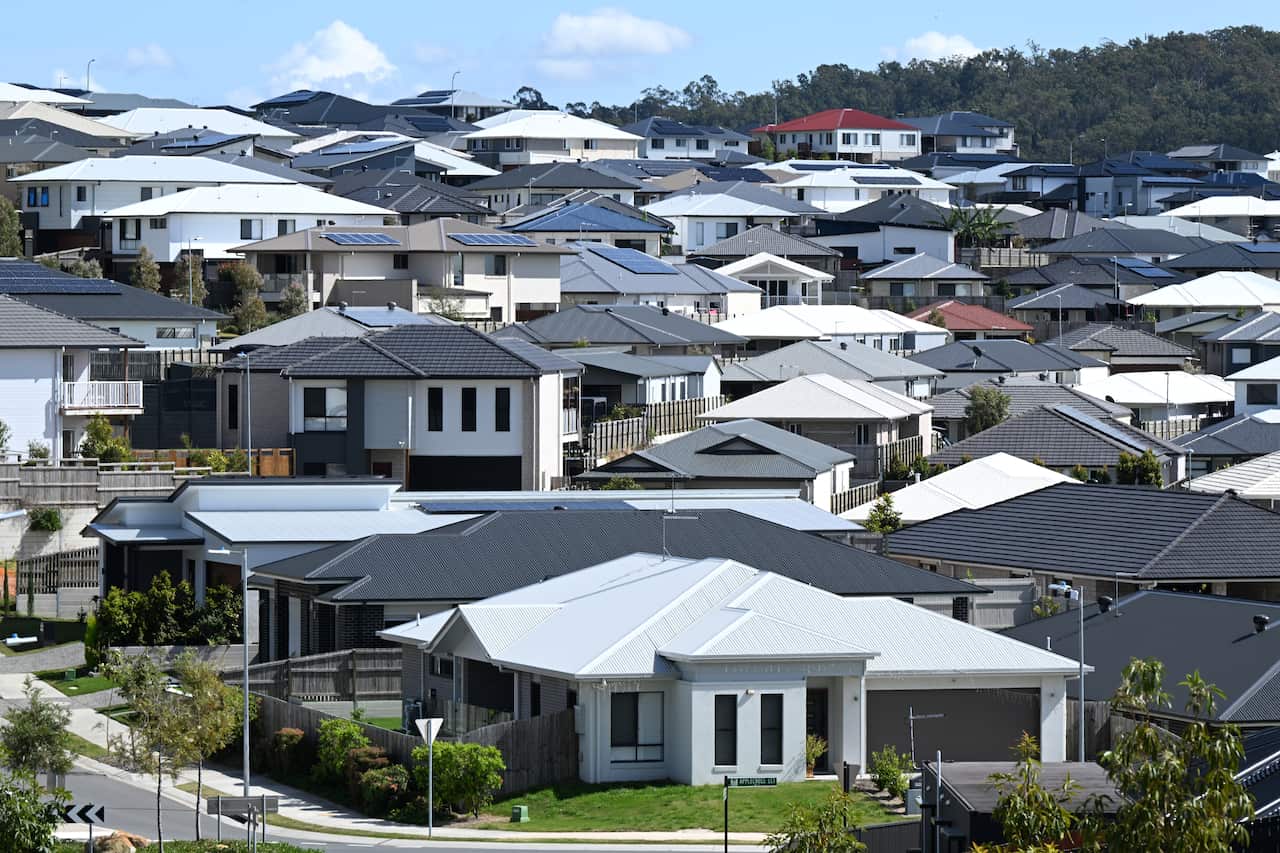
After multiple interest rate rises, many borrowers have lost tens of thousands of dollars in borrowing capacity, shrinking what they can realistically afford.
For first-home buyers especially, that means even modest price drops may not fully offset the impact of higher repayments.
"Losses loom much larger than gains, so buyers often need to adjust their expectations," Elkins said.
"The feeling of paying more than expected, or holding out too long, tends to linger psychologically, especially when so much money is tied up in these decisions," Elkins said.
For many buyers, falling prices have done little to ease affordability pressures as higher interest rates continue to limit borrowing capacity.
"The hardest part is that even if prices are softening a little, my borrowing power has shrunk and it almost cancels that win out," Stephanie said.
"Twelve months ago, I think I could have borrowed a fair bit more, so it doesn't necessarily feel like homes are suddenly affordable."
Is there a perfect time to buy?
Buyer's agent Michelle May urged first-time buyers to tune out the noise and focus on preparation.
"You're still seeing buyers queue up for new properties coming onto the market, and they’re often competing against people in very similar situations, other first-home buyers, many with help from Mum and Dad," she said.
She said government incentives, including low-deposit schemes and shared equity programs, were still fuelling strong demand among entry-level buyers, particularly in major cities.
"There's definitely a knowledge gap for a lot of first-home buyers," May said.
May said the uncertainty surrounding interest rates, the cost of living and the broader economy had shifted buyer psychology, with many now more fearful of overpaying than missing out altogether.
"The fear of overpaying becomes a huge issue … And it's not entirely unfounded, especially for buyers entering the market with very small deposits."
But despite the uncertainty, she said waiting on the sidelines in the hope prices would fall further was unlikely to help most buyers, particularly given borrowing power had already been significantly reduced by higher interest rates.
She suggested buyers could study recently sold listings rather than advertised prices to better understand value in their chosen suburbs.
What the cooling means for sellers
For sellers, the days of easy bidding wars appear to be fading.
Sallit told SBS News that realistic pricing is becoming critical in a softer market environment.
He said homes priced too aggressively risk sitting stale on the market, while buyers increasingly expect flexibility around conditions, repairs, or settlement terms, with some vendors still anchored to the prices neighbours achieved during the peak of the boom.
But economists say the market has changed significantly since then, with the balance of power no longer entirely one-sided.
"A few years ago, we were observing buyers with the fear of missing out; now we are seeing the fear of overpayment, the fear that there are other options because of what is going on in the market," Sallit said.
A correction or a crash?
Kusher told SBS News that economists are not forecasting a housing crash.
Instead, many expect a correction or prolonged slowdown, particularly in Sydney and Melbourne.
"In Sydney and Melbourne there are actually quite a high volume of properties available for sale which have sat on the market for some time. People aren't willing to adjust their price expectations to meet the market," he said.
Kusher said housing shortages, strong population growth, and constrained supply are still expected to support prices over the long term.
But for now, the market mood has clearly changed.
The panic buying is being replaced by caution, negotiation, and uncertainty.
"That doesn’t mean the housing prices will just continue to consistently rise. There is going to be fluctuations in our interest rates, there is also some big tax changes coming that is going to impact sentiment and how people invest in the housing market, which may lead to a period of weaker price growth in some markets," Kusher said.
And for buyers like Stephanie, that means navigating a market where they technically have more power, even if it doesn't quite feel like it yet.
For the latest from SBS News, download our app and subscribe to our newsletter.







