
That's a wrap for today
We're ending our live coverage of the Reserve Bank's rates announcement.
- The Reserve Bank of Australia has increased the official cash rate from 4.10 per cent to 4.35 per cent, a 0.25 percentage point increase.
- It's the Reserve Bank's third consecutive hike this year, bringing the cash rate back to 2024 levels.
- The decision comes after inflation rose to 4.6 per cent in March, driven largely by surging fuel prices tied to the ongoing conflict in the Middle East.
- The RBA has left the door open for further rate rises as it works to keep inflation under control.
- Treasurer Jim Chalmers said the Australian economy was "hostage" to the US-Iran conflict.
- Opposition treasury spokesperson Tim Wilson said government spending — not the conflict in the Middle East — was to blame for inflation.
- Here's more about what an interest rate rise means for your hip pocket.
— Samantha Jonscher
Australians 'staring down the barrel', says Bullock
RBA governor Michele Bullock has acknowledged the pain of rising interest rates but argued that leaving inflation unchecked would hurt Australians even more — particularly those on the lowest incomes.
"It's hard — those households with mortgages and debt. This is hurting them immensely," she said. "They've got a double whammy."
"The thing is, though, and I've said this before, inflation is actually hurting everyone. But the people who are most impacted by inflation are the most vulnerable, the people on the lowest incomes. They're the ones who don't have savings."
Bullock painted a stark picture of the global moment.
"We're staring down the barrel, not only here — many other countries are staring down a similar barrel. It's a very, very tough time."
— Alexandra Koster
Government relief makes it 'harder to dampen demand', says Bullock
Asked about how government relief and stimulus measures are impacting inflation, RBA governor Michele Bullock said both the government and private sectors need to contribute to slowing demand in the economy to curb inflation.
"To the extent that the government is demanding goods and services of the economy ... that adds to demand," she said.
"The extent to which the government make up the shortfalls for households by giving them more money, it makes it harder to dampen demand."
But Bullock was also blunt about the broader reality facing Australians.
"This is a real income shock for Australia and the world. Australians are poorer because of this shock to oil prices and energy prices," she said.
"So we are poorer, and there is no way out of that."
— Alexandra Koster
RBA governor warns inflation could 'get away from us' without action
RBA governor Michele Bullock has acknowledged the pain of today's rate rise but said the bank had no choice but to act.
"I understand this is a really difficult time for households who are already facing higher fuel prices and other cost-of-living pressures, but we must get on top of inflation now so that it doesn't get away from us," she said.
Bullock warned that if cost pressures were left unchecked, they would become "embedded" in the economy.
"Higher costs get embedded into price and wage-setting decisions. These second-round effects could lead to even higher and persistent inflation, and if so, would require even more tightening and monetary policy to get inflation under control," she said.
"It doesn't take much additional spending to make the job of returning inflation to target more challenging.
"This means spending will need to grow more slowly for a time to help restore the balance between demand and supply."
— Alexandra Koster
Macquarie Bank has passed on the rate increase
Macquarie Bank has already passed on the RBA's rate increase.
"Following the RBA’s decision on 5 May 2026, we’re increasing our variable home loan reference rates and variable everyday bank account interest rates by 0.25 per cent p.a., effective 22 May 2026," it wrote on its website.
— Alexandra Koster
Government should 'stop pouring petrol on the inflation fire', says Opposition
Opposition treasury spokesperson Tim Wilson has also just spoken about the Reserve Bank's rate increase, placing blame on the government.
"We need the government to stop the spending binge, stop borrowing debt, stop pouring petrol on the inflation fire," Wilson said.
Asked by SBS' Rayane Tamer about how much blame he placed on United States President Donald Trump for the war in Iran and subsequent economic turmoil, Wilson said the "root cause" of the problem was in Canberra.
"There's no doubt that there's an influence from the Iranian conflict, but ... the persistent inflation problem is off the back of public spending," he said.
"The Iran conflict is compounding it, but the root cause of it starts in Canberra, because they are the ones who are driving it."
— Alexandra Koster
Treasurer: Australia 'hostage' to US-Iran conflict
Treasurer Jim Chalmers has pointed the finger at the war in the Middle East for driving up inflation at home.
"The inflation that we saw in the month of March was a story about higher petrol prices. Higher petrol prices are all about the war in the Middle East," he said.
"I think any objective observer would conclude that now when it comes to decisions taken in Washington DC, or indeed in Tehran, Australians are hostage to those decisions taken about the conduct of this war and the end of this war.
"I'm not going to get into, you know, a kind of a rolling critique of the conduct of the war, but my job is to manage the Australian economy, and the Australian economy is getting absolutely pummelled by this war in the Middle East."
— Samantha Jonscher
Australians paying a 'hefty price' for war in the Middle East, says treasurer
Treasurer Jim Chalmers is speaking at a press conference, addressing the RBA's rate hike decision.
He has blamed the war in the Middle East for worsening Australia's inflation challenge, saying Australians are already feeling the consequences at the bowser.
"We have an inflation challenge in our economy, which is made worse by the war in the Middle East," Chalmers said, noting that petrol was the "primary driver of that higher inflation figure that we saw in March".
The treasurer said the government's decision to halve the fuel excise was a direct response to those pressures.
"Our petrol tax cut is all about recognising the substantial pressures that motorists are under because of this war in the Middle East," he said.
He also acknowledged the pressure that today's RBA decision will bring upon families, promising relief in the upcoming federal budget.
"We know that Australians are paying a hefty price for this war in the Middle East. We know that this inflation is a substantial challenge, and we will help to address it in the budget.
"We know that today's decision makes things more difficult for a lot of people."
— Alexandra Koster
Further rate rises may still be on the table, says RBA
The Reserve Bank of Australia has left the door open to further interest rate rises, saying it will "do what it considers necessary" to bring inflation under control.
Today's increase — the third consecutive hike this year — brings the cash rate to 4.35 per cent, but the RBA offered little comfort to borrowers hoping the tightening cycle is near its end, warning there may be "second-round effects" on the economy.
"Higher fuel prices are adding to inflation and there are indications that this is likely to have second-round effects on prices for goods and services more broadly," the board said.
"This inflation impulse is in addition to the high inflation recorded around the start of 2026, reflecting capacity pressures in the economy."
Capacity pressure refers to a situation in which an economy is unable to produce goods and services without generating significant inflation.
The RBA noted that inflation "is likely to remain above target for some time", which may see more rate rises on the horizon.
"Having raised the cash rate three times, monetary policy is well placed to respond to developments and the Board is focused on its mandate to deliver price stability and full employment," it said.
Not everyone is convinced the rises will stop here.
Westpac was the only major bank to predict further rate rises in 2026, forecasting two more 0.25 percentage points hikes in June and August that would bring the rate to 4.85 per cent.
That view is shared by the CAMA RBA Shadow Board, which this week put a 70 per cent probability on rates needing to go higher over the next six months.
— Alexandra Koster
RBA forecasts inflation likely to get worse
The Reserve Bank of Australia has flagged that things may continue to get worse in the future, warning that underlying inflation will peak higher than it anticipated in February.
"The Board assessed that inflation is likely to remain above target for some time and that the risks remain tilted to the upside, including to inflation expectations," it wrote.
"It was therefore judged appropriate to increase the cash rate target."
The RBA's baseline forecast assumes the Middle East conflict will be resolved soon and fuel prices will decline — but even under that optimistic scenario, the bank says inflation will only decline as "demand growth slows and capacity pressures ease in response to higher interest rates".
But it also flagged a more grim scenario, warning that a longer or more severe conflict could see inflation higher and activity lower than the current baseline forecast.
"A longer or more severe conflict could put further upward pressure on global energy prices; this would push up near-term inflation and could also increase inflation further out as these costs are passed through and if price rises get built into longer-term inflation expectations," the bank said.
"But higher prices and prolonged uncertainty may cause growth to be lower in Australia’s major trading partners and also in Australia."
— Alexandra Koster
One RBA board member voted against today's rate rise
Today's decision to raise the cash rate was not unanimous, with one member of the Reserve Bank board voting to hold the cash rate at 4.10 per cent.
Eight members voted in favour of the 0.25 percentage point increase to 4.35 per cent.
The RBA does not identify individual board members in its statements, so it is unclear who cast the dissenting vote.
— Alexandra Koster
RBA points to inflation and Middle East conflict in rate rise decision
The Reserve Bank of Australia has cited inflation and the war in the Middle East as key reasons for lifting the cash rate.
"Inflation picked up materially in the second half of 2025, and information since the beginning of this year confirms that some of this increase reflected greater capacity pressures," a statement by the RBA read.
The bank also pointed to the Middle East conflict driving up fuel and commodity prices, with early signs that firms are passing those cost pressures on to consumers.
"Short-term measures of inflation expectations have also risen," the board said.
— Alexandra Koster
Interest rates set to rise after RBA lifts cash rate to 4.35 per cent
The Reserve Bank of Australia (RBA) has increased the official cash rate from 4.10 per cent to 4.35 per cent, an increase of 0.25 percentage points.
It is the Reserve Bank's third consecutive hike this year, bringing the cash rate back to 2024 levels and effectively undoing the savings from the last three cash rate cuts.
The decision comes after inflation rose to 4.6 per cnet in March — its highest level since 2023 — driven largely by surging fuel prices tied to the ongoing conflict in the Middle East.
— Alexandra Koster
Seventy per cent chance rates need to rise further, shadow board warns
The CAMA RBA Shadow Board — a group of Australian economists with no affiliation to the Reserve Bank of Australia — also recommended the cash rate be raised this week, citing a "71 per cent probability that raising the rate above 4.10 per cent is warranted".
The board offers its own policy recommendations a day before the official RBA decision, rather than predicting RBA board behaviour.
It says the main driver is inflation, which is up to 4.6 per cent in March compared to 3.7 per cent in February.
"Housing and transport were the main contributors, with automotive fuel prices surging in March as the Iran war and the disruption around the Middle East pushed oil prices sharply higher, noting that the March reading preceded the 1 April halving of the fuel excise," the Shadow Board wrote.
"At the same time, the unemployment rate has risen only gradually, to 4.3 per cent," they wrote, adding that it leaves the policy mix in an "awkward position" ahead of the federal budget, set to be handed down on 12 May.
There's also trouble in the business sector, the board says.
"The business-sector data describe an economy hit by a stagflationary shock: weaker confidence and slower momentum, but also higher costs and more difficult inflation dynamics."
It also predicts more rate rises ahead, with the board putting a 70 per cent probability on rates needing to go higher over the next six months.
— Alexandra Koster
What does inflation have to do with interest rates?
Good question.
Whenever we talk about interest rates — and the potential of a rate rise — we're often talking about inflation alongside it, as it acts as a big determining factor for the RBA's decisions.
Earlier this month, Australian Bureau of Statistics figures showed inflation rose to its highest level since 2023 in March, as the war in the Middle East continues to add widespread price pressures.
Canstar's Sally Tindall says a rate rise would be looking to curb rising inflation to below 3 per cent.
Think about inflation as the cost of a carton of eggs. When inflation goes up, so too does the price you'll pay for that carton.
Central banks raise interest rates to cool down consumer spending. A rate rise means it costs more to borrow, repayments are higher, and there's more incentive to save — so people spend less.
In turn, the price of goods is moderated because fewer people can afford that expensive carton of eggs.
Banks pass on the cash rate rise to borrowers, meaning mortgage repayments increase. That all adds up to less money floating around the economy that would otherwise push prices up.
— Alexandra Koster, Cameron Carr
What are the banks predicting?
All four banks are predicting a rate rise today.
ANZ, CBA and NAB all currently predict a rise of 0.25 per cent in May, bringing the cash rate to 4.35 per cent.
But Westpac expects the cash rate hikes to continue, forecasting two further 0.25 percentage hikes in June and August, which would bring the rate to 4.85 per cent.
SBS News reporter Cameron Carr wrote all about this yesterday — give it a read below.
— Alexandra Koster
What would an interest rate rise mean for your hip pocket?
That depends if you’re a homeowner or not — and how recently you bought.
Finder analysis predicted that Aussies with an average home loan of $736,259 would fork out an extra $2,657 a year on their mortgage if the cash rate rises by 25 basis points today.
That's compared to what they were paying before the RBA started hiking the cash rate this year.
Cash rate is the interest rate that banks pay other banks and lenders, and it influences all other interest rates.
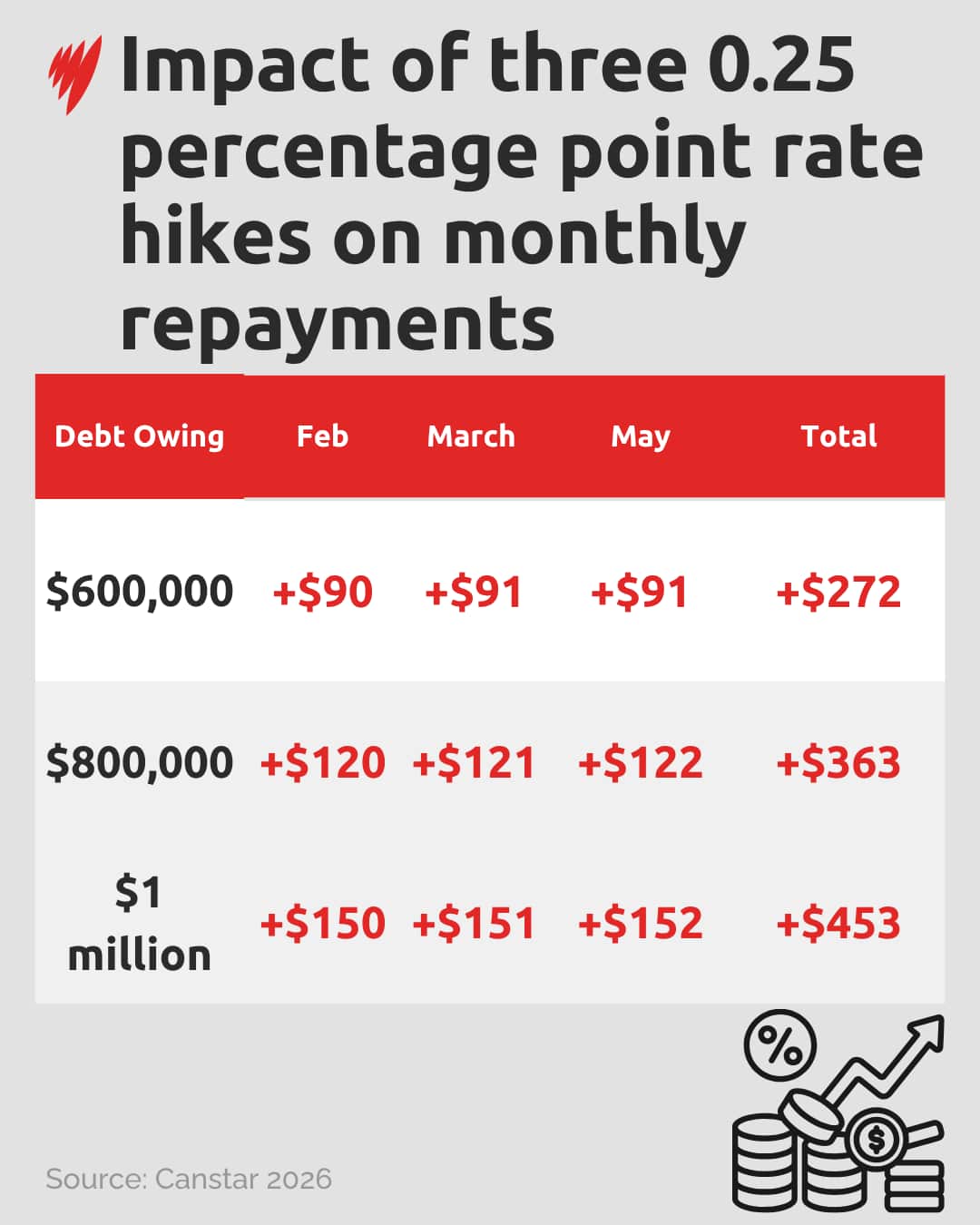
Canstar analysis estimated that a 0.25 percentage point hike today would mean borrowers could pay an extra $91 a month on a $600,000 mortgage.
If the RBA decides to increase the cash rate, it will be the third hike this year, totalling a $272 rise in monthly repayments on a $600,000 mortgage compared to 2025.
Current homeowners would be the most impacted in the short term by an anticipated hike, Canstar’s Sally Tindall says.
Tindall said another hike could be "the straw that breaks the camel’s back" for everyday Aussies.
"For new borrowers, who potentially might not have even been expecting any cash rate rises after last year's drops, they could have a wake-up call," she said.
Australians with a larger mortgage debt will pay more over the lifetime of their mortgage.
A homeowner with $800,000 in debt would pay an additional $363 each month, and those with $1 million in debt would owe $453 more in monthly repayments.
— Cameron Carr, Alexandra Koster
When is the Reserve Bank’s decision?
That will come today at 2.30pm AEST.
It’s expected the Reserve Bank will hand down its third rate rise this year after data from the ABS last week showed inflation had surged to an annual rate of 4.6 per cent in March, up from 3.7 per cent in February.
At 3.30pm, RBA governor Michele Bullock will speak a bit more about the decision. We'll bring that in when it's up.
— Alexandra Koster
Is the cash rate expected to rise today?
Let's put it this way: it would be surprising if the RBA didn't raise the cash rate today.
Three quarters of panelists (75 per cent, or 27/36) from Finder's RBA cash rate survey expect rates to increase today to 4.35 per cent.
Sally Tindall from financial comparison site Canstar said today’s rate hike could be another "split decision".
"The last (RBA) board decision was split five to four. If one person around that board table last time around had a different view, we might've ended up with potentially a hold rather than a hike," Tindall said.
"I can only imagine it'll be yet another split decision that comes down to the wire because of these competing factors."
— Alexandra Koster, Cameron Carr
It's rates day (again)
Good morning and welcome to the SBS News live blog for today's Reserve Bank rates announcement.
A quick recap of what we expect to see today:
- The Reserve Bank of Australia will release its Monetary Policy Decision Statement at 2.30pm AEST.
- The Monetary Policy Board met yesterday to discuss a potential rate increase. That meeting will continue this morning.
- All four big banks expect the RBA to hike rates later today.
- A 0.25 percentage point hike in May would result in higher monthly repayments of $91 on a $600,000 mortgage.
My colleague Cameron Carr wrote a useful explainer on what Australians can expect from today's announcement. You can read that here:
Stay with us throughout the day. This blog will be updated as news comes to hand.
— David Smith







