

In brief
- Heatwave deaths could exceed 1,500 a year by 2100 under current trends, with hotter regions hardest hit.
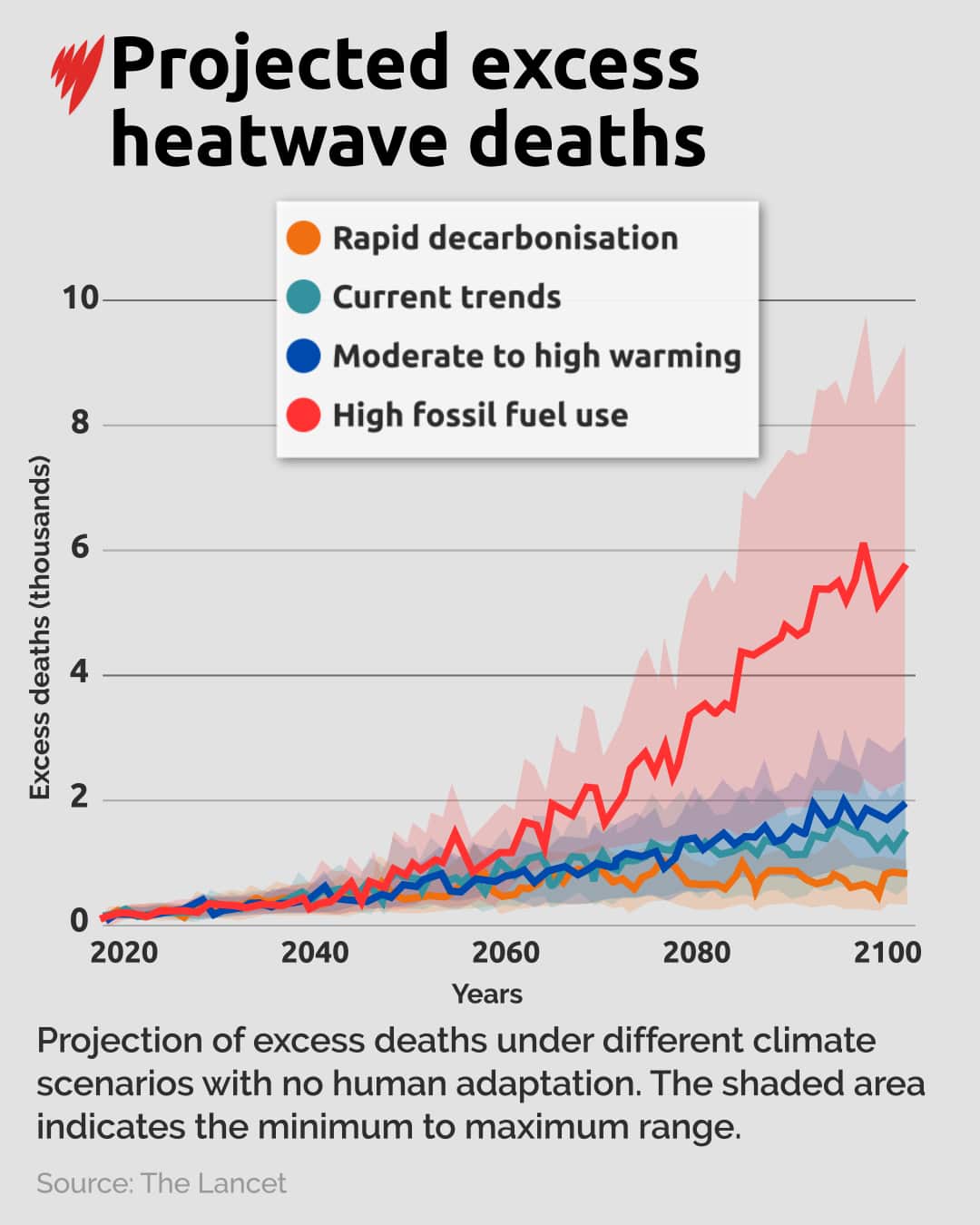
- In a worst-case scenario there could be nearly 6,000 deaths a year.
More than 1,500 people a year could die from heatwaves in Australia by the end of the century under current climate trends, with the hottest parts of the country hardest hit, new research shows.
The study, led by Monash University researchers and published in The Lancet Planetary Health, is the first nationwide community-level projection of heatwave-related excess deaths.
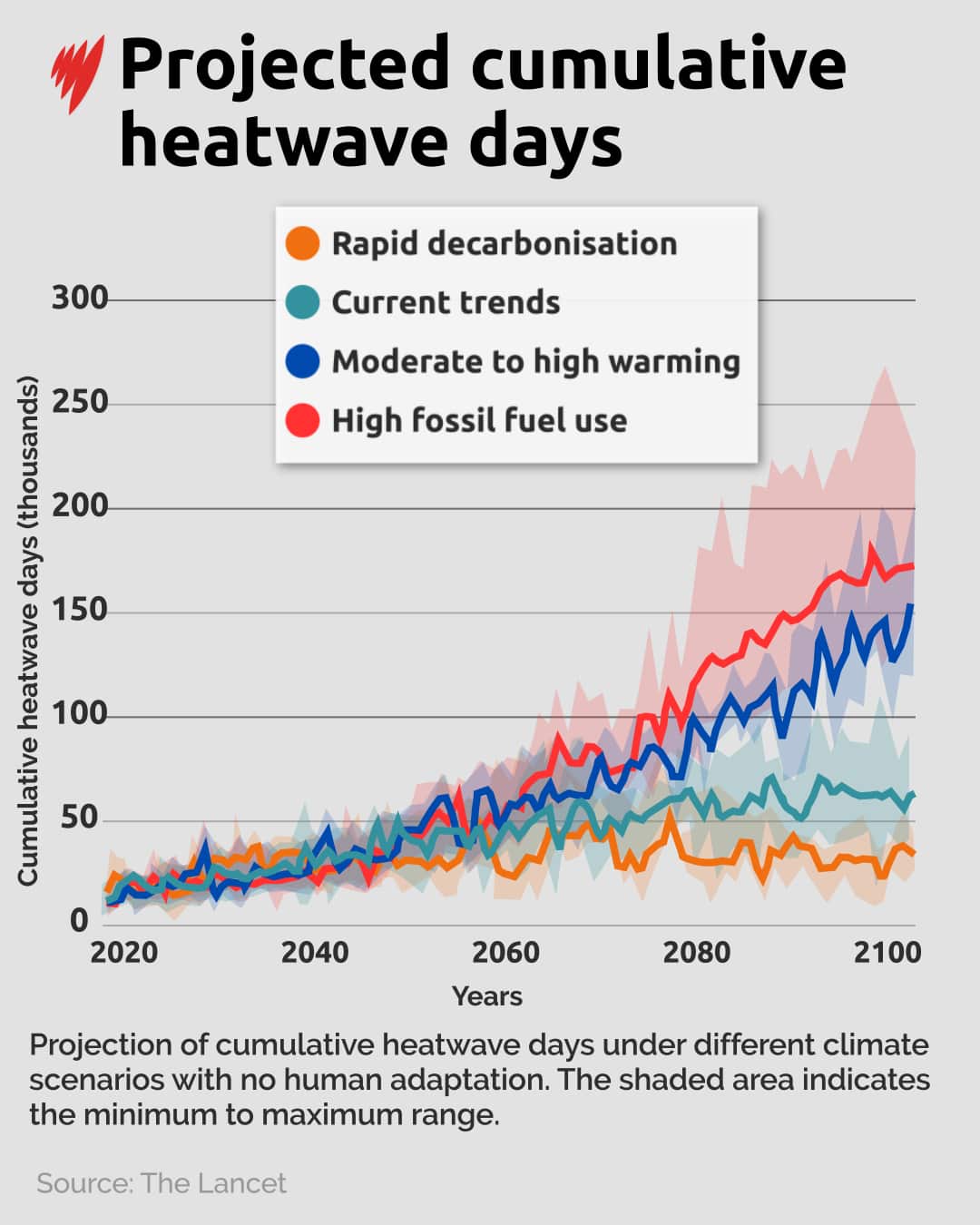
Researchers used a two-stage model across four scenarios — rapid de-carbonisation, current trends, mid-to-high warming and high fossil fuel use — to estimate heatwave mortality rates by 2100.
They also compared outcomes with and without adaptation to rising temperatures, analysing 2,288 communities across Australia.
Without adaptation, annual deaths by 2100 were projected to reach 842 under rapid de-carbonisation, 1,558 under current trends, 1,956 under mid-to-high warming, and 5,820 under a high fossil fuel scenario.
By comparison, Australia recorded about 250 heatwave-related deaths per year between 2016 and 2019.
Under current trends, without adaptation, mortality rates were projected to rise sharply by 2100.
Deaths would increase by 1,071 per cent in the Northern Territory, 686 per cent in Queensland, 444 per cent in NSW, 412 per cent in Tasmania, 337 per cent in Western Australia, 296 per cent in Victoria, 281 per cent in the ACT and 199 per cent in South Australia.
Urban areas (398 per cent) were projected to see a slightly higher increase in mortality rates compared to rural areas (326 per cent).
The study, which accounted for population growth, found adaptation — such as improved infrastructure and acclimatisation — would significantly reduce deaths. For example, NT mortality rates could fall from 10.5 to 1.5 deaths per 100,000 people.
However, researchers warned that "considerable residual risks" would remain, with deaths rising under all scenarios.
In a worst-case scenario without adaptation, nearly 6,000 people a year could die by 2100, with mortality rates increasing more than 42-fold in the NT, the worst-hit region.
The hardest-hit community was projected to be Thamarrurr, south-west of Darwin, with a mortality rate projected to increase by 4,412 per cent.
The study highlighted geographic and social inequalities, with the highest death rates in northern and inland regions where baseline temperatures are already high.
"In these areas, which are also home to high proportions of Indigenous and remote communities, residents' vulnerability to extreme heat is amplified by inadequate health-care infrastructure," the study said.
Slightly higher mortality rates were also projected in socioeconomically disadvantaged.
Lead researcher Shandy Li said the findings highlighted the need for targeted action.
"These projections underscore the urgent need for integrated mitigation and locally tailored adaptation strategies to address climate-related health inequities," she said.
Researcher Yuming Guo said rural and socioeconomically disadvantaged areas had higher exposure to heatwaves, and generally insufficient adaptive capacity, while metropolitan centres faced intensifying urban heat-island effects.
"Without coordinated action, climate change will substantially exacerbate the health impacts of extreme heat and strain public health resilience across Australia," Guo said.
The modelling drew on death and weather data from 2009 to 2019 to estimate how heat affects mortality risk, before applying climate projections and population forecasts to calculate future deaths.
The study noted limitations, including possible overestimation of adaptation benefits, not factoring in Australia's ageing population and reliance on historical data that may not capture future healthcare or social changes.
'Silent killers'
Dr Tom Mortlock, head of climate analytics for Asia Pacific at insurance company Aon and adjunct fellow at the UNSW climate change research centre, said the findings carried weight.
"We know that Australia's already warmed by about 1.5C since 1910 and while this may sound like a small amount we get … extreme heat weather days or heat wave events," he said.
Emeritus professor Mark Howden from the Australian National University said heatwaves are often called "silent killers" because deaths are difficult to directly attribute to extreme heat events.
"That's why you have to do a statistical approach to it, comparing actual death rates against background death rates for that time of year in that place," he told SBS News.
"The other one is that impacts from heat are often expressed as things like heart attacks … and so it's disguised."
He said the combined effects of high temperatures and humidity also contributed to heat-related illness.
A spokesperson for the Australian Centre for Disease Control said the findings were broadly consistent with Australia’s first National Climate Risk Assessment published last year.
"Under Australia's first National Health and Climate Strategy, we’re working to build a climate-resilient health system and reduce the greenhouse gas emissions from the health system," they said.
For the latest from SBS News, download our app and subscribe to our newsletter.





