
in brief
- Australia faces a choice between higher immigration or having more babies to fix an ageing workforce and shrinking tax base.
- Experts say migration is the most effective strategy to staff essential sectors like aged care long term.
Australia will need to boost its population to support the elderly and the economy in the long term, experts warn, after the government's latest Intergenerational Report (IGR) found that people are expected to live longer and have fewer children.
The report landed as politicians float the idea of bringing back the Howard-era baby bonus and argue over the need to reduce migration.
Independent MP Bob Katter has recently suggested an up-front cash payment of $75,000 per child would reverse the declining birth rate, which is now expected to fall to just 1.34 children per woman by 2065.
The argument was dismissed by Treasurer Jim Chalmers and Nationals leader Matt Canavan, who said on Monday that family support policy should be more than just "here's some cash".
However, Australia does face challenging demographic questions, with experts saying the choice will come down to more migrants or more babies.
News that makes sense
Your trusted source for staying up-to-date with the world around you. Get free daily news updates and analysis, straight to your inbox.
"We will have a large pool of elderly people that we have to support," Dr Pelin Akyol, research manager at the economic think tank The e61 Institute, told SBS News.
"If we have a smaller pool of people working, then it will be a big fiscal problem in this country — and in every country."
Global and domestic surveys show that most people want to have more children than they end up having, owing to cultural, social, and economic constraints which are difficult to address.
"With AI and everything else going on right now, it is hard to know what will happen," Akyol said. "But what we know at this point is that it's going to affect the economy in a bad way".
The fertility illusion
While the IGR highlights a collapsing birth rate, demographers caution that official metrics paint a distorted picture of Australian family choices.
Peter McDonald, emeritus professor of demography at the Australian National University, told SBS News that the country's reliance on international students and temporary visa holders skewed the headline Total Fertility Rate (TFR).
Temporary migrants are often young adults aged 20 to 35 who are in higher education or the early stages of their career. While they are counted as potential mothers, they "hardly have any births," McDonald said, which drives the TFR down.
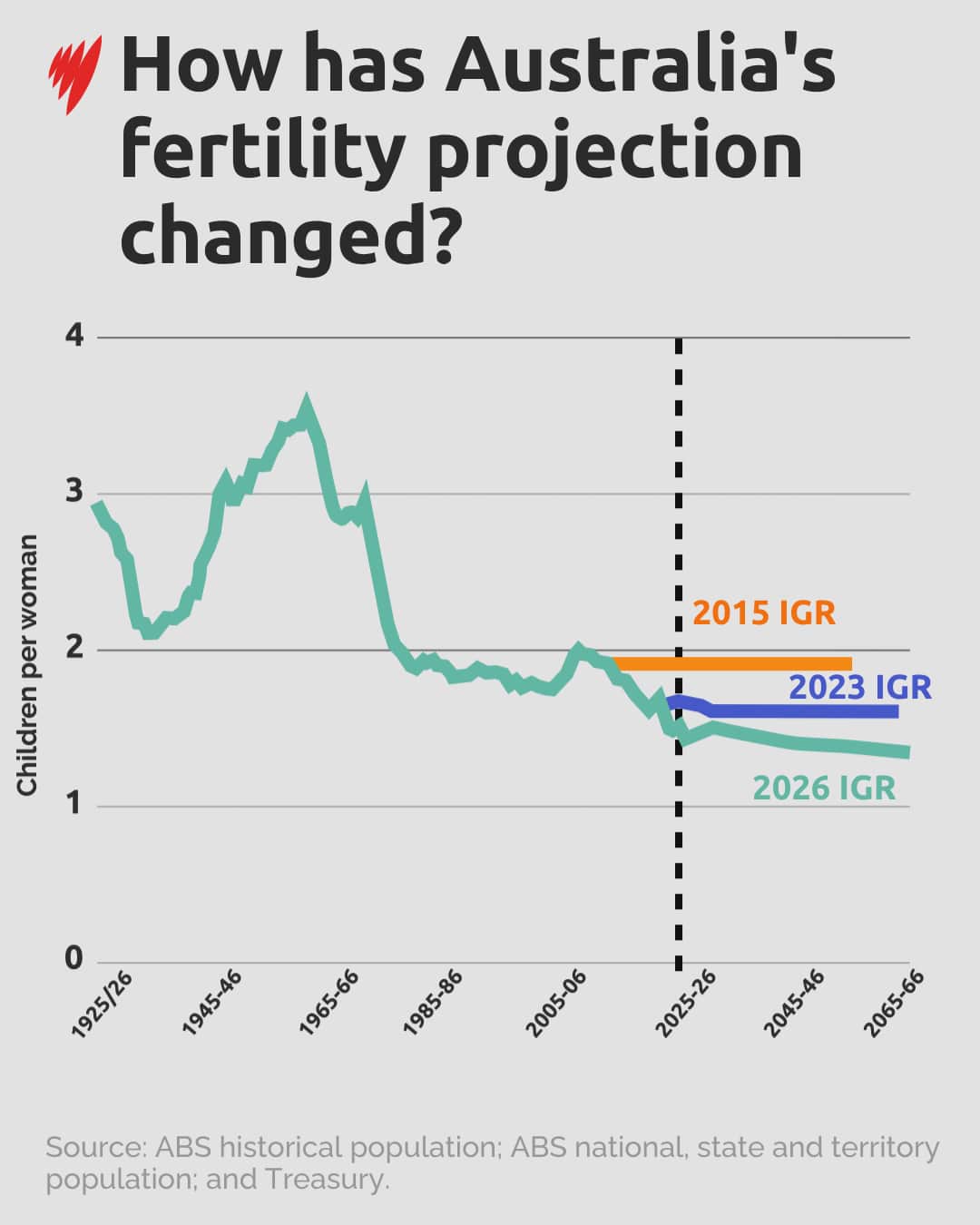
"That's one of the central reasons why Australia's fertility rate has been falling because the temporary population's been rising," he said.
The birth rate for women born in Australia is around 1.64, higher than the Australian Bureau of Statistics headline fertility rate of 1.48. While this is still below the replacement rate of 2.1, Akyol said the immigration influence on TFR is different in Australia than in other comparable nations.
"In Germany, migrants have higher fertility rate than natives," she said. "But in Australia, it is the opposite".
McDonald also warns against placing too much faith in the long-term projections of the IGR — which assumes net overseas migration will remain flat at 235,000 annually for the next four decades — and that immigration and total births can't be viewed separately as they are "not independent of each other".
"If you can tell me what the birth rate is going to be in 10 years, you're a better man than me," he said. "But if you can tell me what it is in 40 years, then you're a miracle worker."
Is a baby bonus the answer?
Katter's proposed return to former treasurer Peter Costello's cash payment for each newborn child would cost upwards of an estimated $22.5 billion a year for the present 300,000 babies born each year in Australia.
Akyol's research into the 2004 policy indicates that cash incentives do increase the fertility rate, but the effect is "not huge" and, given how different the world is today, "it is not guaranteed we will see a similar effect".
While a $75,000 payment is "huge" compared to the $3,000 of the original policy and "might have an effect", Akyol doubted this was the best use of money when other factors like support benefits also play a key role in family decisions.

McDonald said Australia's tax system has become too narrowly focused on early childcare, making raising older children harder for working families.
"Today, about 58 per cent of families get no family allowance for their children," he said. "It's not just about very young children... supporting families with children is also about supporting older children, and we've gone a long, long way away from doing that."
A median worker claiming both employer and state parental leave would already receive around $48,700 before tax, something McDonald said disadvantages those without full-time employment. Instead of re-introducing lump-sum payments, he calls for a broader review of child equity.
"I think there's a need for an inquiry into the system of child support payments, to deal with two issues: one is the inequity of the system for very young children, and two, the lack of support for older children," he said.
"Children are a social good.... so I think there is justification for supporting families with children; it's called horizontal equity."
"Horizontal equity used to be quite a big thing back in the 1980s ... I think it needs to be revisited."
A national trade-off
To offset a declining taxpayer base, the IGR highlights increasing older workforce participation and leveraging artificial intelligence to automate labour gaps.
However, McDonald questioned the feasibility of expecting Australians to work deeper into their 60s and 70s.
"A lot of people, particularly those who work in physically demanding jobs, do not want to work beyond pension age. They've had enough," he said.
"AI is going to make a big difference to future labour force needs, but AI is not going to wipe the bottoms of people in aged care."
Akyol said current debates around migration could soon flip as birth rates drop across the globe, including in key migrant origin countries such as China and India. With a shrinking global talent pool, nations could shift from seeking to restrict migration to actively competing for skilled workers.
"In the long run, there might really be a competition for getting the best migrants," Akyol said. "Because in all developed countries, fertility rate has been decreasing... and it seems like there is no hope that it will just turn back and increase again."
"There is no easy solution here. There is a trade-off with every kind of policy."
Relying on immigration is the most direct mechanism to address workforce shortages in sectors like aged care, which are already under strain, McDonald said — something he said the government has failed to communicate in its messaging.
"The IGR shows the advantage of a higher level of migration for the federal government's bottom line," McDonald said. "Migrants make our prospects of dealing with a future aged population much better."
For the latest from SBS News, download our app and subscribe to our newsletter.







