
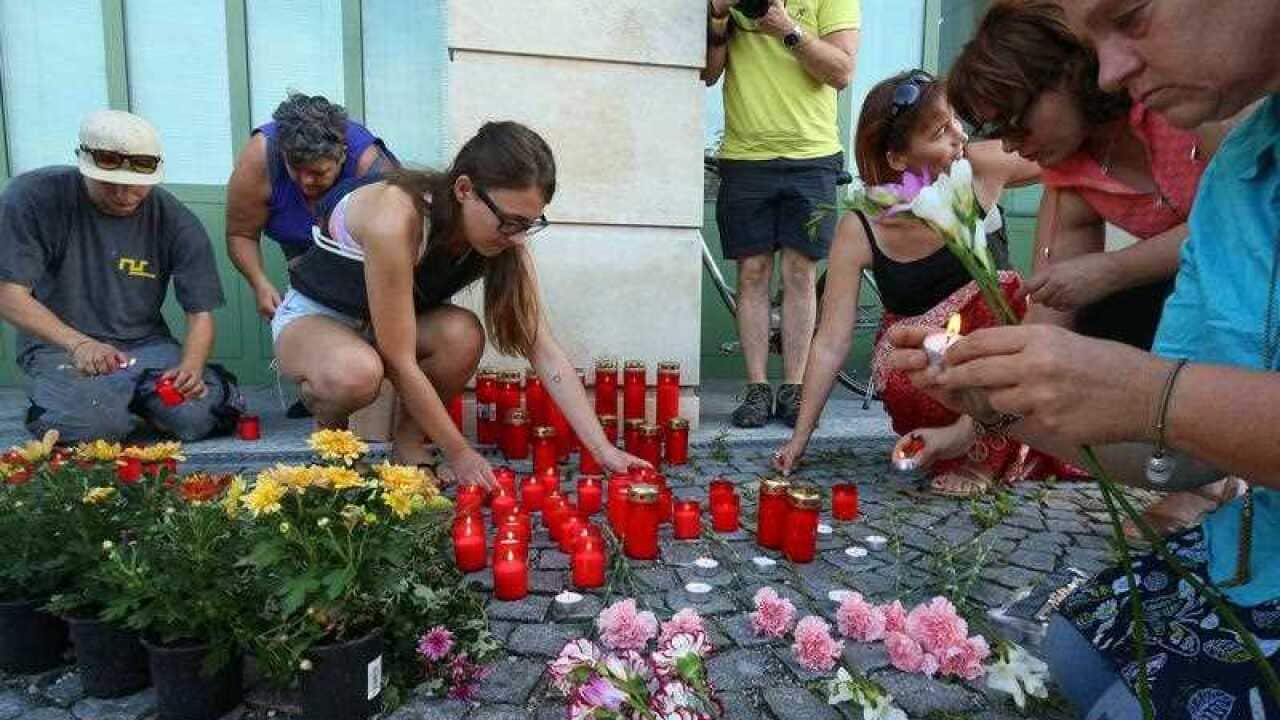
- Austrian police put death toll at 71, including 4 children
- Three suspects arrested in Hungary
- Police believe Bulgarian-Hungarian ring behind crime
Four children, including a baby girl, were among 71 migrants found dead in a truck on an Austrian highway and three people have been arrested in Hungary in connection with the tragedy, Austrian police said on Friday.
At a news conference in the town of Eisenstadt, Hans Peter Doskozil, police chief for the province of Burgenland, said one Syrian travel document had been found among the victims but that it was too early to say from which countries the entire group had come.
Of the 71 dead, 59 were men, 8 were women, and four were children, including a girl estimated at 1-2 years old and three boys of roughly 8-10 years.
"We currently have four people under arrest in Hungary... and expect that that this is the trace that will lead us to the perpetrators," Doskozil told reporters, making clear that the people being held were not ring leaders.
The refrigerated truck was found by an Austrian motorway patrol near the Hungarian border just before lunchtime on Thursday, with fluids from the decomposing bodies seeping from its back door.
The vehicle had come to Austria from Hungary and is believed to have been parked on the highway for at least 24 hours before it was discovered.
Doskozil said there were "signs" that a Bulgarian-Hungarian trafficker ring was behind the deaths. Of the three people arrested in Hungary, one was Bulgarian-Lebanese, another Bulgarian and the third of Hungarian nationality.
Thousands of people from countries like Afghanistan or Syria have fled through the Balkans to Austria, pushing the number of asylum requests to 28,300 in the first six months of this year - more than the total for all of 2014.
Austria's Interior Minister Johanna Mikl-Leitner said the best way to handle the refugee crisis was to create legal pathways into Europe, rather than stricter border controls.
The 28 member states of the European Union have not yet agreed on introducing binding quotas for the distribution of refugees. Leaders of the EU declared this week that it has "failed" in the face of human agony on its frontiers.
Meanwhile, the U.N. refugee agency UNHCR said on Friday the number of refugees and migrants crossing the Mediterranean to reach Europe has passed 300,000 this year, up from 219,000 in the whole of 2014.
German Chancellor Angela Merkel said at a summit on the West Balkans in Vienna: "We are of course all shaken by the appalling news. This reminds us that we must tackle quickly the issue of immigration and in a European spirit - that means in a spirit of solidarity - and find solutions."
A security official in the Libyan city of Zuwara said several hundred people had been on board a boat that sank off the coast on Thursday. Some appeared to have been trapped in the hold when it capsized.
"Some 100 illegal migrants have survived," the official said, adding that rescue operations were continuing. Those on board had been from sub-Saharan Africa, Pakistan, Syria, Morocco and Bangladesh, he added.
Another local official and a journalist based in Zuwara confirmed the sinking but had no information on casualties.
Even before the latest incidents, the International Organization for Migration estimated 2,373 people had died so far this year while trying to reach Europe by sea, and 3,573 in the past 12 months.
On Thursday the Swedish coastguard ship Poseidon arrived in Sicily with 52 corpses it found on a boat off the coast of Libya on Wednesday. Most of the victims had been trapped in the hold and died of asphyxiation, according to survivors.
Poseidon, which arrived in the port of Palermo, also began disembarking 471 migrants who were among the more than 3,000 rescued by several ships on Wednesday.
"There are thousands and thousands of dead lying in the Mediterranean whose bodies will never be found, and no one is paying attention," said Palermo's Mayor Leoluca Orlando.
Hundreds of thousands, many fleeing war in countries such as Syria and Libya, have made it into the European Union. Germany alone expects 800,000 asylum-seekers this year; Hungary is building a barbed wire fence along its border with Serbia.
Smell of death
Investigations were launched in Austria and Hungary after the bodies in the lorry were discovered. The truck had Hungarian number plates, a Hungarian official said.
Helmut Marban, press officer for Burgenland police, said a highway patrol had spotted the lorry and at first thought it was damaged or had been in an accident.
"When they checked they found it had no driver and blood was dripping out of the vehicle and there was a smell of dead bodies," he said.
Janos Lazar, Prime Minister Viktor Orban's chief of staff, said a Romanian citizen had registered the number plate in the eastern Hungarian town of Kecskemet.
Police limited motorway traffic to one lane while forensic experts checked over the lorry parked on the hard shoulder.
Austrian Chancellor Werner Faymann told the summit in Vienna: "The refugees who died today wanted to save their own lives by fleeing, but instead lost their lives at the hands of traffickers."
EU foreign policy chief Federica Mogherini said she hoped the tragedy would push member states to "take decisions and responsibility". European Commissioner Johannes Hahn reiterated that Brussels would propose within weeks a fresh look at the situation, with a view to sharing responsibility between countries.
"We will have another go at quotas. I hope that in the light of the most recent developments now there is a readiness among all the 28 (member states) to agree on this," he said.
Serbian Foreign Minister Ivica Dacic put the onus on EU countries to find a better way to handle the influx of refugees.
"So you have a problem but you are asking us, Serbia, to come up with the action plan for migrants. You should come up with an action plan first."





